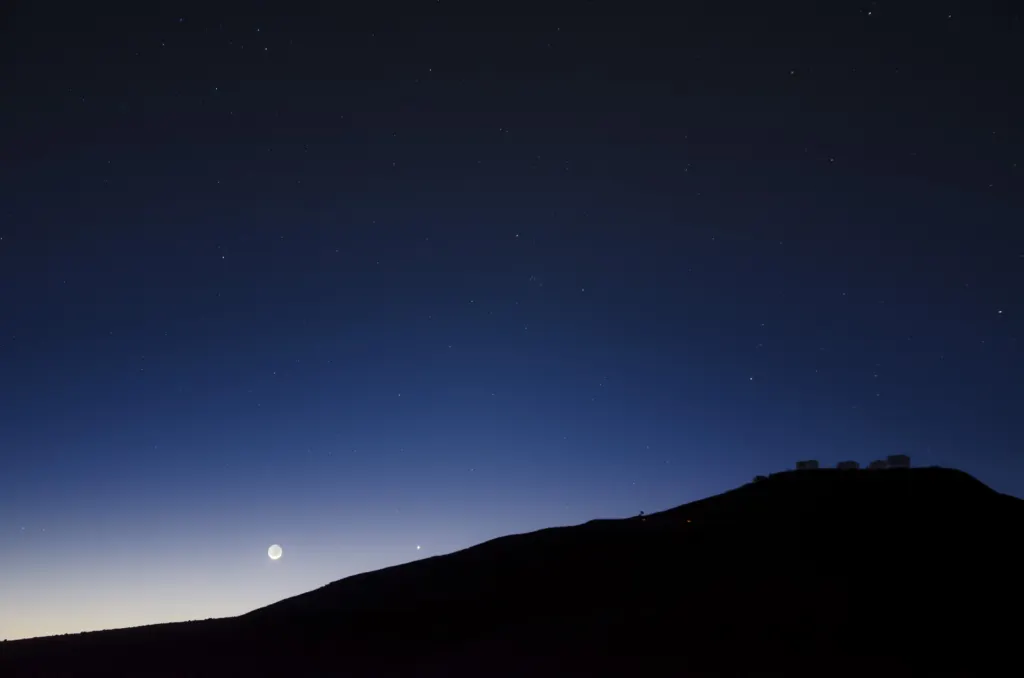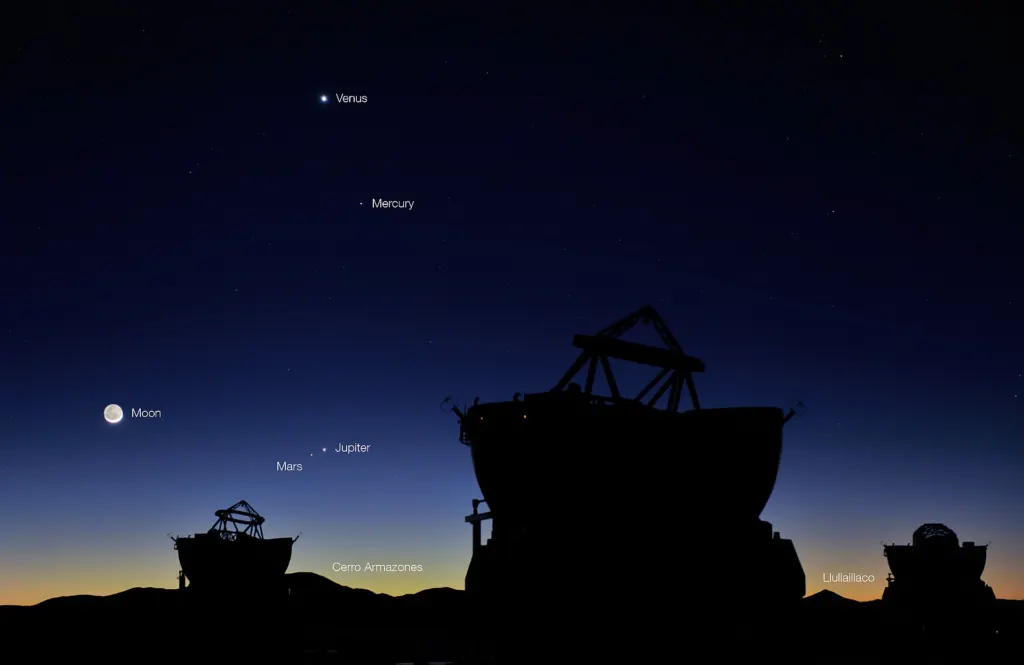
Three bright planets are sharing the pre-dawn sky over the US, UK and Canada this month: Jupiter and reddish Mars high in the southeast, with Venus hugging the horizon below them. NASA’s skywatching team had Mars and Jupiter just 1.2 degrees apart on the mornings of November 15 and 16, a gap a little wider than two full Moons placed side by side, and the pair drifts apart in the days that follow.
Lineups like this get called a planetary parade. The label sounds grand, but the planetary parade entry is blunt: it is an apparent alignment, not a real one in space. The planets only look strung out along an arc because of where they sit in their orbits relative to us on Earth.
What to look for and when
According to NASA’s What’s Up guide for November 2026, presented by Raquel Villanueva of the Jet Propulsion Laboratory, the best view comes before sunrise looking southeast. NASA’s chart for 5 a.m. on November 15 shows Mars and Jupiter paired high in the sky and bright Venus sitting low between east and southeast, with the stars Arcturus, Procyon and Sirius nearby.
- Jupiter: the brightest point of light in the pair.
- Mars: fainter and reddish, just beside Jupiter in mid-November.
- Venus: brilliant but low, so you need a clear eastern horizon.
All three are easy to see without binoculars. NASA notes that Mars and Jupiter are still far apart in space even when they appear almost side by side, and suggests watching over several mornings to see them close in and then go their separate ways. Our earlier preview of the Mars and Jupiter pairing before dawn on November 15 and 16 has the details of the closest approach.
Why a parade is not an alignment
Every planet orbits our Sun in roughly the same flat plane. From Earth, that plane shows up as a single line across the sky, the ecliptic, so any planets above the horizon at the same time will always fall along a curve. They can be hundreds of millions of kilometers apart and still look like beads on a string.
That is why small parades are routine. Groupings of three, four or five planets are commonplace, according to the planetary parade entry; bigger ones take longer to come around. Two large ones happened in 2025: a six-planet lineup from January 21 to February 21, followed by seven planets around February 28 when Mercury joined in. The next seven-planet parade is not due until 2040, when the five naked-eye planets will bunch within 7 degrees of one another on September 12.
Limits and what to expect
Do not expect the planets to look like a neat row. Venus is low, so trees, hills or city glow can hide it, and the gap between Mars and Jupiter grows each morning after mid-month. A planet parade is also not the same as a syzygy, a true straight-line arrangement of bodies in space.
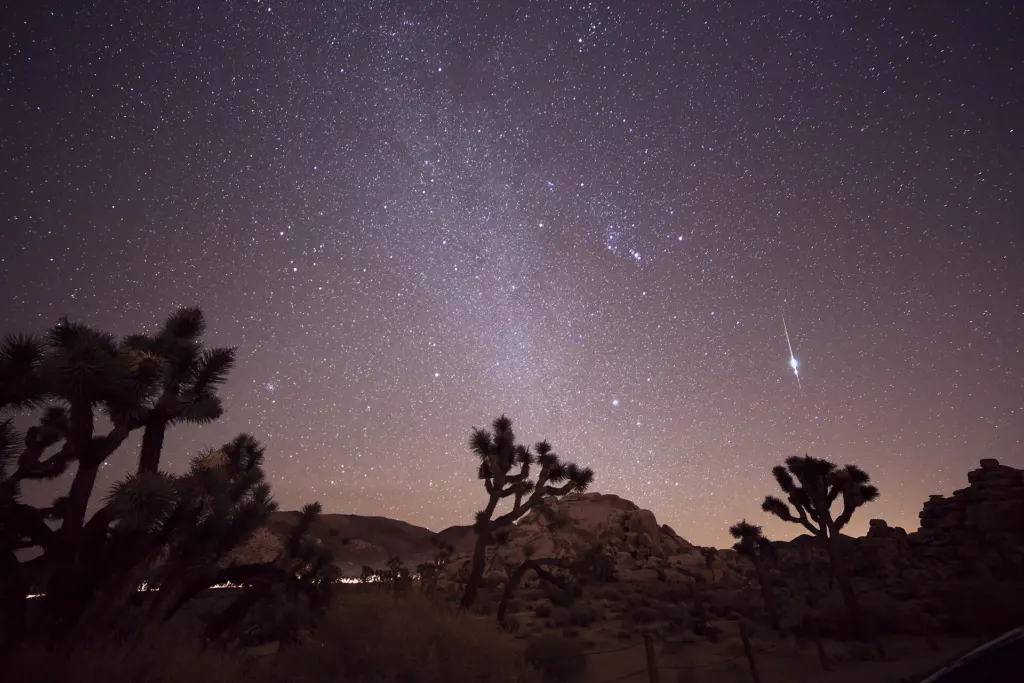
Early risers have a bonus. NASA’s Leonid chart for the morning of November 18 puts the meteor shower’s radiant high in the east near Jupiter and Mars, with up to around 15 meteors an hour under ideal skies; see our Leonid meteor shower guide. The next big date on NASA’s list is the November 24 full supermoon, which rises in the east around sunset.
Further reading
Image: G.Hüdepohl (atacamaphoto.com)/ESO, CC BY 4.0 via Wikimedia Commons
This article was produced with AI assistance and reviewed by our Editorial Desk. How we work.