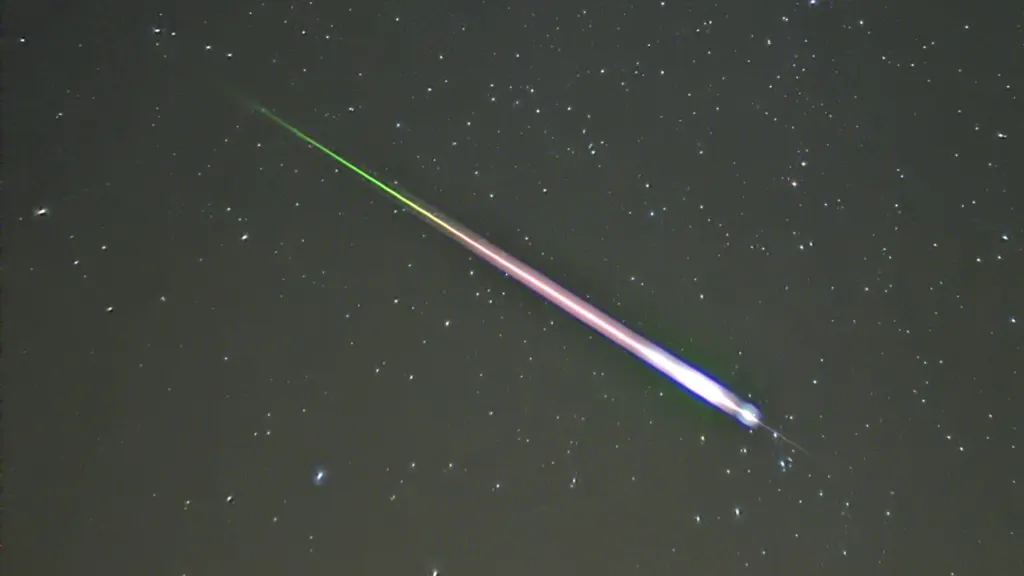
The Leonid meteor shower reaches its peak next week, and the Moon is stepping out of the way. NASA lists the night of November 16 to 17 as the peak, while astronomers at the Royal Observatory in Greenwich, London, put the maximum on the evening of November 17 into the early hours of November 18, adding that the Moon sets just before midnight that night in the UK. Watching on both nights covers either forecast.
Set expectations honestly. In an ordinary year the Leonids are modest: NASA says rates are often as low as about three meteors per hour under dark skies, and Greenwich gives a peak rate of 10 to 15 an hour. What they lack in number they make up in speed and shine. According to NASA’s Leonids page, these meteors hit the atmosphere at about 44 miles (71 kilometers) per second, among the fastest of any shower, and they are known for bright fireballs and colorful trails.
Where the streaks come from
Every Leonid is a speck of dust shed by comet 55P/Tempel-Tuttle, a small comet whose nucleus is only about 2.24 miles (3.6 kilometers) wide. Ernst Tempel found it in 1865 and Horace Tuttle independently in 1866. Each November, Earth plows through the trail of grit the comet has left along its orbit, and the particles burn up high overhead. Greenwich notes that some of the streaks come from grains no bigger than a grain of sand.
The shower is named for its radiant, the spot in the constellation Leo the Lion where the meteors appear to start. You do not need to stare at Leo, though. NASA advises looking away from the radiant, because meteors seen there look short; farther away they draw longer, more dramatic lines.
The 33-year storm cycle
The comet takes 33 years to loop around our star, and that rhythm is what makes the Leonids famous. Roughly once a cycle, Earth crosses a dense clump of fresh debris and the shower becomes a storm, defined as at least 1,000 meteors per hour. Greenwich lists storms in 1799, 1833, 1866, 1966 and 1999 to 2001, with the 1833 display reaching an estimated 100,000 meteors an hour. In 1966, NASA says, thousands of meteors per minute fell during a 15-minute window. The last Leonid storm was in 2002.
Do the arithmetic on that 33-year spacing and the next window lands somewhere in the early 2030s: 1966 plus 33 is 1999, and 1999 plus 33 is 2032. That is a pattern, not a forecast, and the expected 1899 and 1933 storms were letdowns, so nothing is guaranteed.
How to watch this year
- When: after about midnight local time, when NASA says the Leonids are best, and on until dawn. The shower runs from November 6 to 30, so the nights either side of the peak still produce some meteors.
- Where: somewhere well away from streetlights, with as much open sky as possible.
- How: no telescope or binoculars needed. Lie back with your feet toward the east and give your eyes about 30 minutes to adjust to the dark.
- Dress: it is mid-November, so blankets, a sleeping bag or a reclining chair help.
The Leonids close out a busy autumn for skywatchers. Badiyaa covered the Northern Taurid fireball peak earlier this week and the Orionid meteors from Halley’s Comet in October.
The next major shower after the Leonids is the Geminids in mid-December. For the Leonids, the date to circle is November 17.
Further reading
Image: Navicore, CC BY 3.0 via Wikimedia Commons
This article was produced with AI assistance and reviewed by our Editorial Desk. How we work.