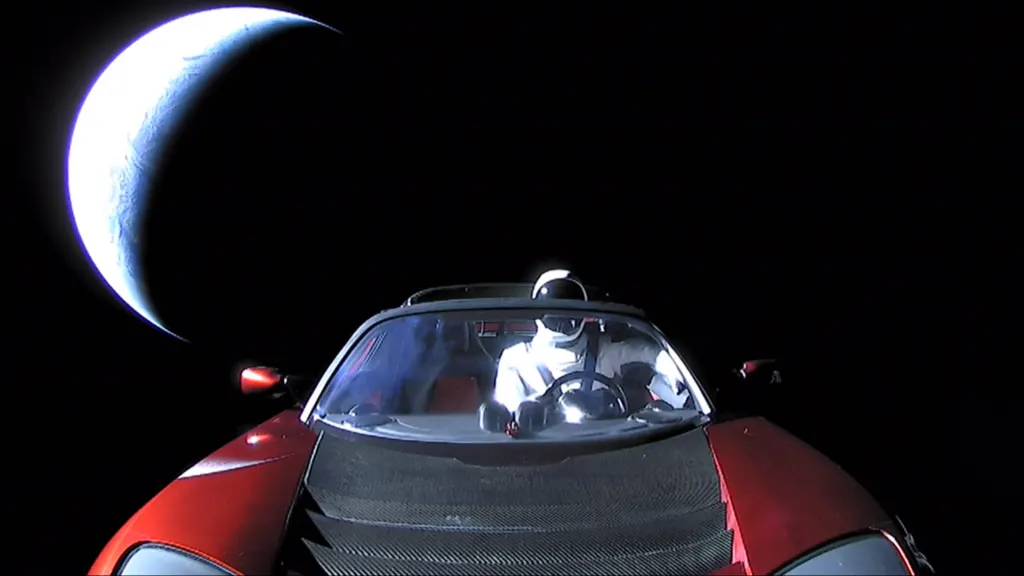
Elon Musk’s cherry-red Tesla Roadster, the dummy payload from the first Falcon Heavy launch, was about 68.2 million miles (109.8 million km) from Earth at the start of Halloween, and it is pulling farther away at almost 9 km per second. Those figures come straight from NASA’s JPL Horizons ephemeris for the car, which tracks it as target -143205.
That is a long way from the Florida launch pad. The car left Kennedy Space Center’s Launch Complex 39A on February 6, 2018, with a spacesuited mannequin called Starman strapped into the driver’s seat and David Bowie’s “Space Oddity” set to loop on the stereo.
Where the Roadster is on Halloween
JPL’s numbers for 00:00 UT on Saturday, October 31, 2026, put the car 0.7342 au from Earth and 1.4519 au from our star. At 149,597,870.7 km per astronomical unit, that works out to 109.8 million km (68.2 million miles) from Earth and 217.2 million km (135.0 million miles) from the center of the solar system.
Horizons gives the car’s speed away from Earth as 8.98 km per second. Over one hour that adds roughly 32,300 km to the gap, and over a full day about 776,000 km, or twice the distance to the Moon. A hobbyist tracker that also draws on JPL data showed the same picture on Halloween, with the car about 0.737 au out and still receding.
Counting the laps, with the working
Here is the Badiyaa calculation. From launch on February 6, 2018, to October 31, 2026, is 3,189 days, or 8.73 years. The car’s orbit takes about 1.525 years to complete, so 8.73 divided by 1.525 gives 5.72 trips around the solar system’s center so far. The hobbyist tracker’s running tally, 5.7246 orbits, agrees to two decimal places.
Light makes the trip from the car to Earth in about 6.1 minutes at the current distance: 109.8 million km divided by 299,792 km per second is 366 seconds. Any radio signal would take that long, though the car fell silent long ago. Its upper stage was deliberately drained of leftover energy after launch and stopped sending telemetry.
Why it is still worth watching
The Roadster’s path stretches from just inside Earth’s orbit, at 0.986 au, out to 1.664 au, beyond the orbit of Mars. It reached that far point for the first time on November 9, 2018. Its tilt of about 1 degree means it was never designed to meet Mars, and in October 2020 it slipped past the red planet at roughly 8 million km without any noticeable effect on its course.
JPL’s encounter table lists the next notable moments. The car is predicted to pass Mars at about 0.016 au, around 2.4 million km, on April 22, 2035. Its next close approach to Earth is set for January 11, 2047, at about 0.032 au, or 4.8 million km, more than 12 times the Earth-Moon distance.
The object even fooled astronomers once. In January 2025, archival sky-survey images of the car were briefly logged as a new asteroid, 2018 CN41, before it was correctly identified and the designation was deleted.
The limits of the numbers
JPL’s solution rests on 374 ground-based telescope measurements made between February and March 2018, because the car is now far too faint to see. The agency warns that unmodeled forces such as heat re-radiation could make long-range predictions drift faster than the formal error bars suggest. The 3-sigma window for the 2047 Earth pass already spans 0.031 to 0.033 au.
The car itself is unlikely to look like a car for much longer. A chemist cited in early analyses expected radiation to break down tires, paint, plastic and leather, leaving mostly the aluminum frame, metal and glass. A 2018 study put the chance of an eventual collision with Earth over 3 million years at about 6%.
For now, the nearest milestone on the calendar is the Mars flyby on April 22, 2035.
Further reading
Image: SpaceX, CC0 via Wikimedia Commons
This article was produced with AI assistance and reviewed by our Editorial Desk. How we work.