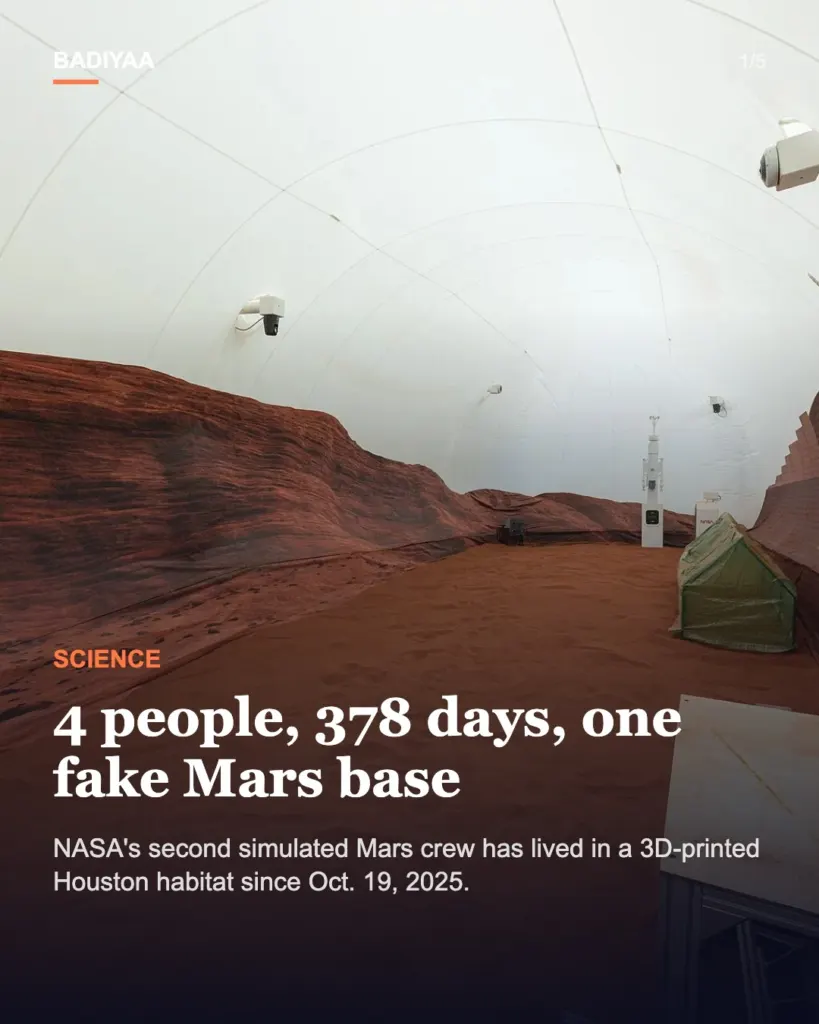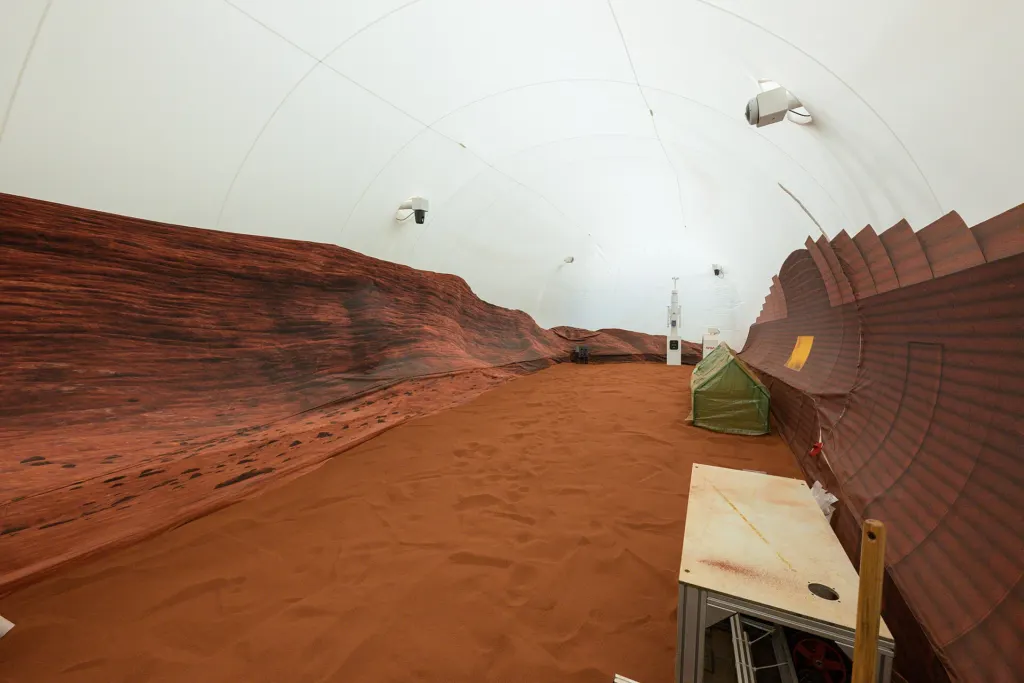
Four volunteers who have lived inside a 3D-printed mock Mars base in Houston since Oct. 19, 2025, are due to walk out on Saturday, Oct. 31, closing NASA’s second 378-day CHAPEA mission. NASA’s Human Research Program marked the crew’s first full year inside on Monday, Oct. 19, after 365 days of tending crops, stretching limited supplies and waiting out delayed messages from home.
CHAPEA is short for Crew Health and Performance Exploration Analog. In NASA’s vocabulary an analog is a ground-based stand-in that recreates mission conditions so researchers can watch how people cope. This one exists to measure how a small crew’s body, mind and teamwork hold up across a surface stay of Mars length, long before any astronaut makes the real trip.
Who the 4 members of CHAPEA mission 2 are
NASA named the crew on Sept. 5, 2025. Commander Ross Elder is a US Air Force major and experimental test pilot from Williamstown, West Virginia, with more than 1,800 flying hours in over 35 military aircraft. Medical officer Ellen Ellis is a US Space Force colonel from North Kingstown, Rhode Island, who earlier worked as an intercontinental ballistic missile operations officer and as a GPS satellite engineer. Science officer Matthew Montgomery is a Los Angeles hardware design consultant whose specialties include LED lighting, robotics and controlled-environment agriculture, handy skills on a crew that grows its own vegetables. Flight engineer James Spicer, an aerospace and defense technical director, has built satellite communications networks and holds commercial and glider pilot licenses. Marine Corps pilot Emily Phillips and airline pilot Laura Marie were named as alternates.
That lineup looks different from the first crew. Mission 1 was led by research scientist Kelly Haston, with structural engineer Ross Brockwell, emergency physician Nathan Jones and microbiologist Anca Selariu. Three of the four people in mission 2 come from flight testing, military space work or spacecraft engineering.
Life inside 1,700 square feet for 378 days
The habitat, Mars Dune Alpha, stands inside a hangar-like building at Johnson Space Center and measures roughly 1,700 square feet (158 square meters). The construction company Icon printed it, and it holds crew quarters, an exercise area, a work room, a recreation area and a crop area that earlier grew peppers and tomatoes. Divide the floor by four and each person gets about 425 square feet (39.5 square meters), counting every shared room, for more than a year.
The schedule mimicked surface operations. Crew members suited up for simulated Marswalks across a red-sand landscape outside the habitat, ran robotic tasks, did maintenance, exercised and farmed. NASA also tried out deep-space hardware on this mission, including a drinking-water dispenser and diagnostic medical equipment. On top of that came the stressors of a real expedition: scarce resources, equipment failures, isolation and communication delays of 22 minutes. Relatives could reach the crew only by email, with a Mars-like lag on every message.
Why that matters: a year of physiological, psychological and performance measurements taken under tight control can show NASA how a lean food supply and limited exercise gear would affect work such as spacewalks on the Martian surface.
“This mission has been incredibly valuable in starting to teach us how to understand requirements for year-long missions, including medical and psychological care, via communication delays,” said Michael Stenger, chief scientist for NASA’s Human Research Program.
How mission 2 lines up against mission 1
- June 25, 2023: the mission 1 crew enters Mars Dune Alpha.
- July 6, 2024: mission 1 ends after 378 days. At that point the second mission was expected to begin in spring 2025.
- Sept. 5, 2025: NASA announces the mission 2 crew.
- Oct. 19, 2025: the new crew moves into the same habitat.
- Oct. 19, 2026: the crew passes one year inside.
- Oct. 31, 2026: planned exit, then two weeks of evaluations and debriefs with NASA scientists.
Both missions come out at 378 days on NASA’s count, which includes the first and last days. Added together that is 756 days, and with four people per crew, 3,024 crew-days of observations gathered in one building.
What 2 crews of 4 people cannot tell NASA
The evidence has built-in limits. Each mission holds four people, so even after mission 2 the sample is eight volunteers, far too few to speak for every future astronaut. The habitat sits on Earth, and crew members stayed inside the same Houston building even during their Marswalks. NASA’s Oct. 19 update says its science teams were getting ready to process the crew’s health and performance data, so results from this mission have not yet been described. Principal investigator Grace Douglas called it “such a fast-paced, highly demanding mission.”
What follows the Oct. 31 exit
The next yearlong study changes format. In July 2026 NASA started recruiting volunteers for the Moon and Mars Exploration Analog, which begins no earlier than August 2027. It links two Johnson habitats: the HERA (Human Exploration Research Analog) module plays the spacecraft and the CHAPEA habitat plays the surface base, so one crew simulates the months-long flight as well as the stay. First, though, comes the egress ceremony on Saturday, Oct. 31, which NASA plans to stream live, and then two weeks of debriefs before the four volunteers are done.
Further reading
- NASA: NASA’s Simulated Mars Crew Marks One Year Inside Habitat
- NASA: NASA Announces CHAPEA Crew for Year-Long Mars Mission Simulation
- Wikipedia: Crew Health and Performance Exploration Analog
Image: NASA/Bill Stafford, Public domain via Wikimedia Commons
This article was produced with AI assistance and reviewed by our Editorial Desk. How we work.
Spot an error? Help verify this story
The story in 5 slides