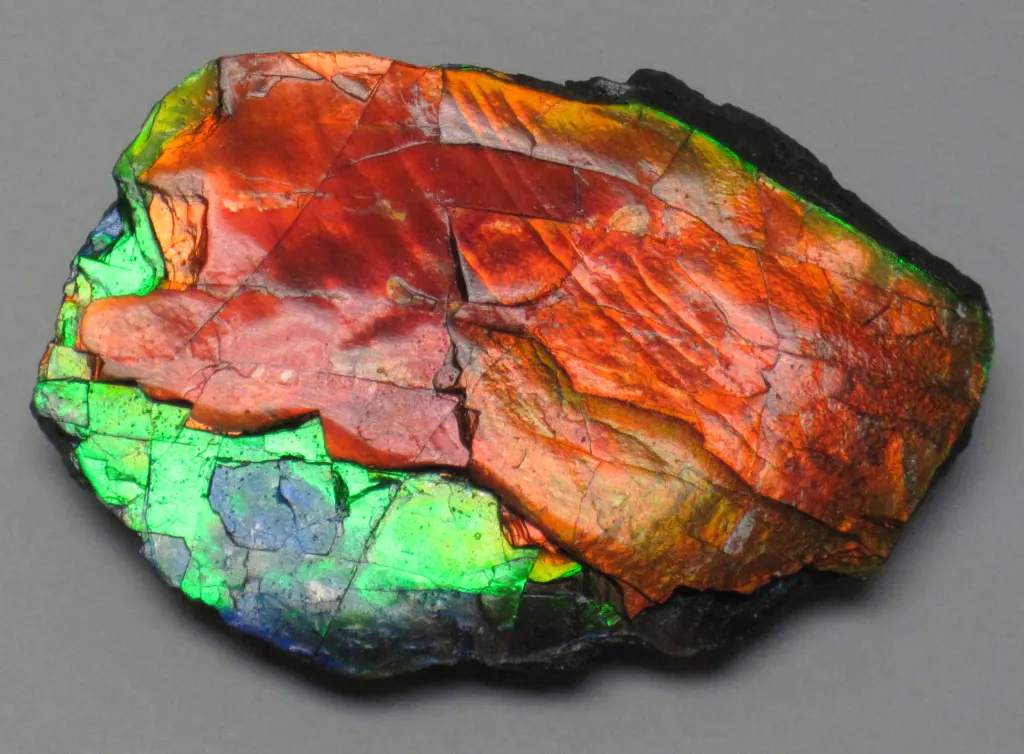
Ammolite flashes red, green and, on rare pieces, blue and violet, yet it contains no pigment that makes those colors. The gem is the fossil shell of a sea creature that sank to the floor of an inland North American ocean roughly 70 to 75 million years ago, and its rainbow is pure physics.
It is one of very few gemstones made by a living thing, alongside amber and pearl. The World Jewellery Confederation (CIBJO) recognized it as a gemstone in 1981, the year commercial mining began. The Canadian city of Lethbridge adopted it as its official gem in 2007, and the province of Alberta followed in 2022: Bill 6, the Emblems of Alberta Amendment Act, was tabled on March 17 and the designation took effect on April 21, making the gem the province’s 12th official emblem, according to Korite, the province’s largest ammolite miner. Ron Orr, then Alberta’s culture minister, called it “an important part of our heritage and economy.”
From squid cousin to jewelry case
Ammonites were shelled cephalopods, relatives of today’s squid, octopus and nautilus, that thrived in warm seas until they died out with the dinosaurs at the end of the Mesozoic. The gem comes mainly from two disk-shaped species, Placenticeras meeki and Placenticeras intercalare, plus, to a lesser extent, a straight-shelled relative called Baculites compressus.
Those animals lived in the Western Interior Seaway, a shallow subtropical sea that once split North America in two along the eastern flank of the Rockies. When they died, their shells were buried in fine volcanic mud that hardened into shale. That seal kept the shell mineral, aragonite, from converting into duller calcite, which is what happens to most fossil shells.
Gem-quality deposits turn up in the Bearpaw Formation, which runs from Alberta into Saskatchewan and south into Montana, with small finds as far as central Utah. The richest seams lie along the St. Mary River between Magrath and Lethbridge in southern Alberta, and roughly half of all deposits sit within the Kainai (Blood) reserve.
Why it shines
Most gems get their color by absorbing some wavelengths of light. Ammolite works differently. Its aragonite is stacked in microscopic platelets, and light bouncing off those layers interferes with itself, the same trick that colors a soap bubble. Thicker layers push the color toward red and green; thinner ones produce blue and violet. Because the thin layers break more easily, blue pieces are the scarce ones.
The colorful layer is astonishingly thin: about 0.5 to 0.8 millimeters in the ground, and only 0.1 to 0.3 millimeters after polishing. That is roughly the thickness of one to three sheets of printer paper, which run about 0.1 millimeters each. Weathering often cracks it into a mosaic that collectors call “dragon skin.”
How it reaches a ring
Because the layer is so fragile, most ammolite is soaked in clear epoxy before cutting, a process first sold in 1989. Most finished stones are composites: a doublet glues the ammolite to a dark backing, and a triplet adds a clear domed cap, often synthetic spinel or quartz, that acts as a lens. About half of what is mined is good enough for jewelry, and one Alberta producer, Korite, accounts for roughly 90% of the world’s supply.
Grades run from AAA down to A-minus, judged on how many colors appear, how they shift as the stone turns and how bright they are. The best stones hold their color through a full 360-degree turn; weaker ones show color only within about 90 degrees.
Older names
Long before it was a trade gem, the Kainai called it aapoak, “small, crawling stone,” and the Blackfeet knew it as iniskim, the “buffalo stone,” believed to draw buffalo within reach of hunters. Japan is now its largest market.
Badiyaa has covered other survivors of deep time, from Araucaria trees whose ancestors stand petrified in a Patagonian stone forest to Gerrothorax, an armored amphibian that went to sea 237 million years ago. For more fossil stories, see the Badiyaa science section.
The largest complete ammonite shells from these beds reach about 90 centimeters, or 35.5 inches, across.
Further reading
Image: James St. John, CC BY 2.0 via Wikimedia Commons
This article was produced with AI assistance and reviewed by our Editorial Desk. How we work.