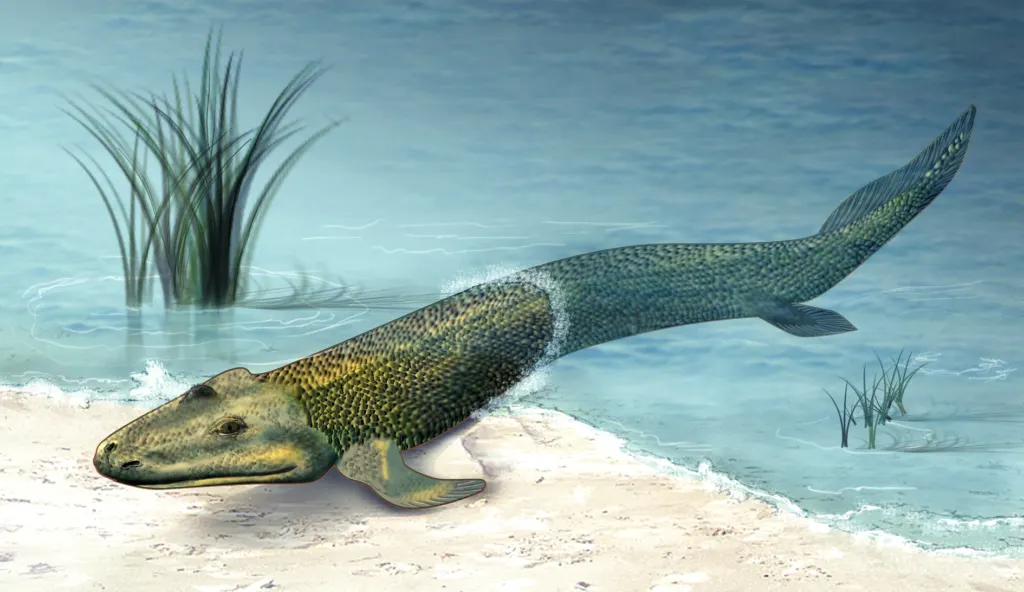
Tiktaalik, the 375-million-year-old “fishapod” often pictured as the first fish with a neck, could swing its head sideways by only about 5.5 degrees. That is the estimate from a new model published in Nature, and it undercuts a decades-old idea about why our distant ancestors grew necks at all.
The long-standing story went like this: when the shoulder bones of early four-limbed animals came loose from the skull, the newly freed head could move on its own, helping hunters in shallow water snap at prey without turning the whole body. The team behind the new paper, led by Dana Korneisel, now a postdoctoral researcher at Uppsala University in Sweden, says the numbers do not support it.
How do you bend a backbone that no longer exists?
The problem is that early tetrapods and their fishy cousins built their spines around a notochord, a thick rod of soft tissue ringed by small bony pieces. Soft tissue almost never fossilizes, so nobody could measure how stiff those necks were.
The researchers turned to a living stand-in: the lake sturgeon, a fish that keeps the same kind of notochord-centered spine into adulthood. According to the Swedish university’s announcement, the team dissected out sturgeon backbones and bent and twisted them on a materials-testing machine, three or four at a time over three days. They then scaled those stiffness values to the measured neck dimensions of six extinct animals: Eusthenopteron, Tiktaalik, Acanthostega, Whatcheeria, Greererpeton and Trimerorhachis.
Korneisel described the core of the method as “dividing out the sturgeon number and multiplying by the fossil number,” once the size and shape of both the test sample and the fossil neck are known.
The numbers, animal by animal
The paper reports that most stem tetrapods could move their heads less than 6 degrees to the side and less than 3 degrees upward, and could not rotate them at all. For scale, a 6-degree turn is roughly the angle a minute hand sweeps in one minute on a clock face.
- Eusthenopteron, a fish with its shoulders still joined to its skull: about 8.5 degrees of sideways bend.
- Tiktaalik, with its head and shoulders already separated: about 5.5 degrees, so slightly less, not more.
- Acanthostega, Greererpeton and Trimerorhachis: under 3 degrees sideways and under 1.5 degrees upward.
- Whatcheeria, the outlier: its longer neck gave it far more room to move than the rest.
The key finding is the second line. If freeing the head had been about mobility, Tiktaalik should have beaten its older relative. It did not. The authors conclude that neck mobility was not the functional driver of head-shoulder separation and point instead to forelimb-driven movement: as front fins and early limbs took on more of the work of pushing against the bottom, a shoulder girdle unhooked from the skull may simply have worked better.
“We know that tetrapods did eventually gain higher neck mobility so these results push that gain-of-function forward in time and up the evolutionary tree from where we previously thought it occurred,” Korneisel said.
Why it matters
Every animal reading this with a turnable head, from you to a barn owl, inherits a neck that first appeared in the Devonian Period. The study separates two events that textbooks often merge: the anatomical birth of the neck and the later arrival of a neck that could actually swivel. Badiyaa has followed other branches of this deep family tree, from lungfish that yawn underwater to Gerrothorax, an armored Triassic amphibian that took to the sea.
Limits
A sturgeon is a distant relative, not an ancestor, so its tissue is an analogue rather than a perfect match. The model also covers only the spinal column; muscles, skin, ribs and bony armor in the skin would have restricted movement further, so the real figures were probably lower. Korneisel said the twisting motion we use to shake our heads “was not feasible in any of these animals.” The team kept stiffness data for the sturgeon’s whole spine, which they say could be used to model the backs and tails of other extinct animals with notochord-based skeletons, provided their fossils are complete enough to rebuild.
Further reading
Image: Zina Deretsky, National Science Foundation, Public domain via Wikimedia Commons
This article was produced with AI assistance and reviewed by our Editorial Desk. How we work.