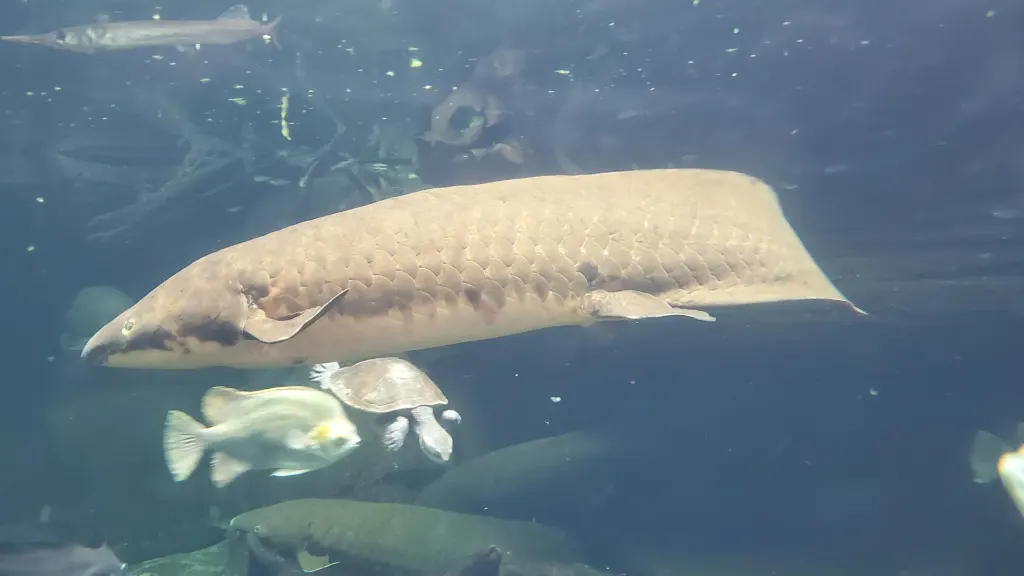
Lungfish yawn, and every yawn a team of Japanese researchers recorded happened underwater. In a study in the journal Behavioural Processes, the Australian lungfish, the one species that still relies mainly on its gills, yawned significantly more often than three African cousins that depend on gulping air.
The work, led by Akiko Enokizu of Kindai University with colleagues from Mie University, the Biohistory Research Hall and Toba Aquarium, asks a simple question with a deep-time twist: did yawning change its job when vertebrates began to breathe air?
Why lungfish make a good test
Lungfish are the closest living relatives of the four-limbed animals, the group that includes amphibians, reptiles, birds and mammals. Only six species survive, in Africa, South America and Australia, according to the overview of lungfish biology. They differ sharply in how they breathe.
The Australian, or Queensland, lungfish can get by on its gills without topping up from its single lung. The African species have gills too withered for that and must surface for air. That spread lets scientists compare a gill-first breather with lung-first breathers inside one ancient lineage.
What the team measured
The researchers watched one individual of each of four species: the gill-dominant Australian lungfish and three lung-dominant African species, the marbled, spotted and West African lungfishes. For each fish they logged how often it yawned, a combined score they call “yawning investment” (frequency multiplied by duration), and how active it was just before and after each yawn.
Three results stand out:
- All four fish yawned, and only underwater.
- The Australian lungfish yawned more often than the three air-reliant fish (p = 0.007 in a negative binomial model), yet total yawning investment was broadly similar across all four.
- After a yawn, the Australian lungfish became more active (p = 0.041), and that change was larger than in matched control periods (p = 0.006). No such post-yawn bump showed up in the two lung-dominant fish that were tested for it.
Why it matters
Yawning is found across vertebrates and is usually treated as a behavior with several functions, from stretching the jaw to shifting alertness. The authors write that “yawning function may vary with respiratory mode,” which points to a testable idea: in a gill breather, a yawn may act more like a wake-up signal, while in air breathers it may serve something else.
Lungfish history gives that question weight. Their lineage split from the line leading to land animals roughly 420 million years ago, and the Queensland lungfish has lived in Australia for at least 100 million years. Watching how such a fish yawns is about as close as biology gets to observing an early breathing transition in a living animal.
Limits
This is a tiny sample: one fish per species, so the result describes four individuals, not four species. The authors say so directly, noting their findings “cannot establish species-level differences.” Only two of the three air-breathers were analyzed for post-yawn activity, and the full paper sits behind a subscription, so details of tank conditions and observation hours are not given in the public summary.
For more on how fish behavior evolved, see our report on a study of schooling across 2,839 fish species, and on the bite-proof scales of the Amazon’s air-breathing arapaima.
The paper appears in Behavioural Processes volume 243, published online on October 10, 2026.
Further reading
Image: Jstuby, CC0 via Wikimedia Commons
This article was produced with AI assistance and reviewed by our Editorial Desk. How we work.