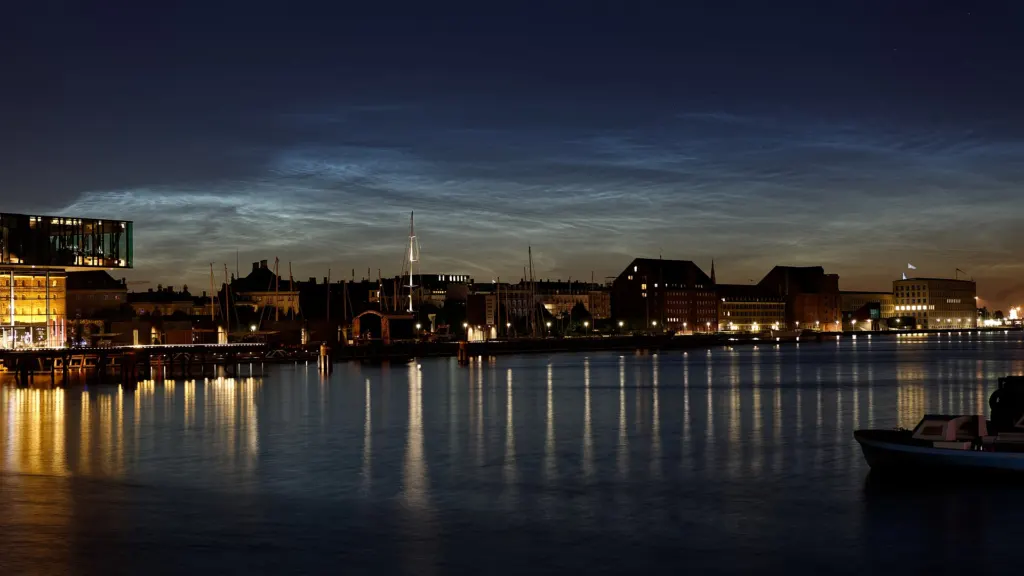
The highest clouds on Earth float about 47 to 53 miles (76 to 85 kilometers) up, roughly six times higher than a cruising airliner, and they only show themselves after sunset. Called noctilucent clouds, Latin for “night shining,” they are made of ice crystals no wider than 100 nanometers and form only where the air drops below about minus 184 degrees Fahrenheit (minus 120 degrees Celsius).
That temperature matters because it is the whole trick. The mesosphere, the layer of air where these clouds live, holds roughly one hundred-millionth the moisture of air over the Sahara, so ice can only freeze out when it is brutally cold.
Why the coldest air arrives in summer
Counterintuitively, the mesosphere over the poles is coldest in summer. According to the encyclopedia entry on noctilucent clouds, seasonal vertical winds lift air upward in summer, and rising air expands and cools. In winter the same circulation pushes air down and warms it.
So the clouds belong to summer: mid-May to mid-August in the Northern Hemisphere, and mid-November to mid-February in the Southern Hemisphere. That means the southern season is opening right now.
You also need the right geometry to see them. They are too faint for daylight. The trick is twilight, when the ground and the lower sky are already in Earth’s shadow but clouds 50 miles up still catch sunlight. The best window is when the solar disk sits between 6 and 16 degrees below the horizon, which is why they glow electric blue or silver against a darkening sky. That blue tint comes from ozone absorbing part of the light on its way to the cloud.
What a 16-year NASA satellite found
NASA launched AIM, short for Aeronomy of Ice in the Mesosphere, on 25 April 2007. It was the first satellite built just to study these clouds, and it orbited about 350 miles up. Planned for two years, it ran for 16, until its battery failed on 13 March 2023.
The NASA mission summary says AIM’s data has fed nearly 400 peer-reviewed papers. Among the findings: the clouds can be seeded by meteor smoke and by water vapor from rocket exhaust, and ripples in the air called atmospheric gravity waves carry energy from surface weather all the way up to them. “It has answered core questions that have helped us understand how noctilucent clouds and atmospheric gravity waves vary over time and location,” said principal investigator Scott Bailey of Virginia Tech.
The spacecraft itself fell back to Earth on 19 August 2024, re-entering near the Egypt-Sudan border.
Five open questions about the highest clouds
For all that data, a lot is still uncertain:
- Where the water comes from: some rises through gaps in the lower atmosphere, and some forms when methane reacts with other molecules high up.
- Where the dust comes from: mostly tiny meteors, researchers believe, though volcanic and lower-air dust are possible.
- Why the solar cycle lag: the clouds dim when solar ultraviolet output rises, but the change trails by about a year, and nobody knows why.
- Why they echo radar: one idea is a thin coat of sodium and iron on the ice, but that is still debated.
- Why the first sighting was 1885: no confirmed record exists before then, two years after Krakatoa erupted, and it is unclear whether the volcano helped or simply made more people watch the sky.
German astronomer Otto Jesse took the first photographs in 1887 and probably coined the name. Rockets have since made artificial versions, including a NASA flight over Alaska on 26 January 2018 that released water about 53 miles up.
Badiyaa has covered other features of the upper atmosphere this season, from the Antarctic ozone hole’s largest showing in a decade to the Northern Taurid meteors, whose dust is the kind that may seed these clouds.
To look for them, observers at latitudes of roughly 50 to 65 degrees south, such as southern Chile or Argentina, should face the twilight glow about an hour after sunset from now through mid-February; northern skywatchers get their turn again from mid-May 2027.
Further reading
Image: Marie-Lan Taÿ Pamart, CC BY 4.0 via Wikimedia Commons
This article was produced with AI assistance and reviewed by our Editorial Desk. How we work.