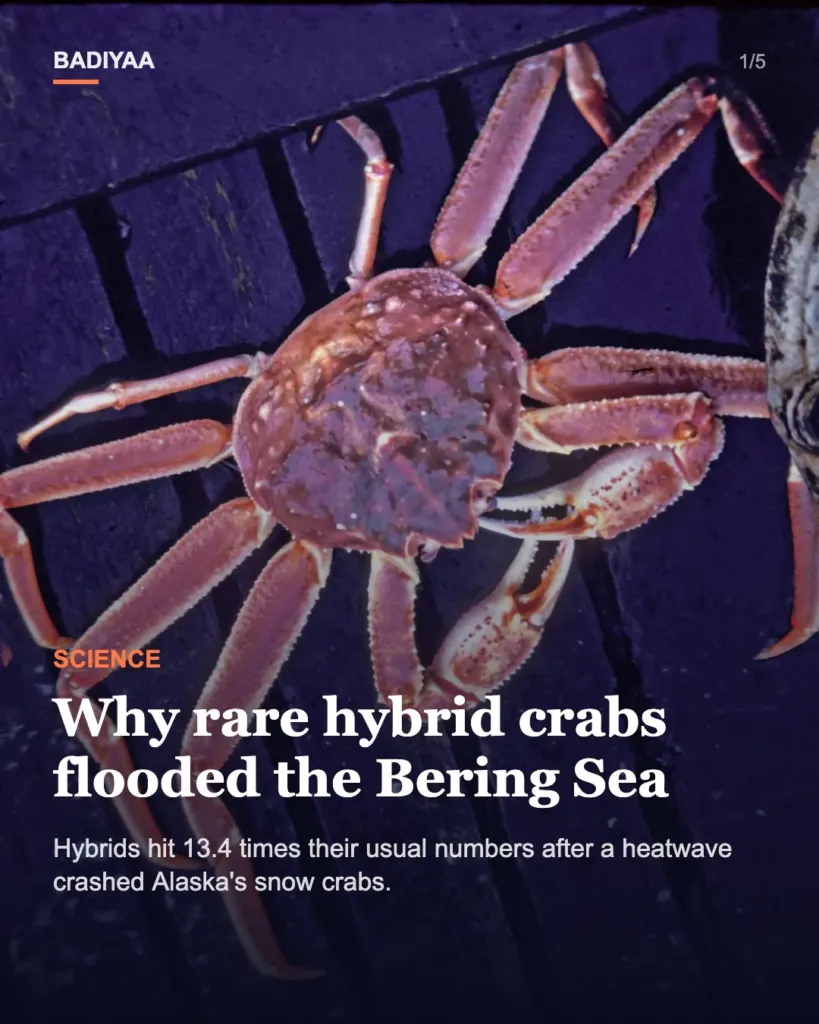
Hybrid crabs that were once a curiosity in Alaska’s eastern Bering Sea reached 13.4 times their long-term average abundance in 2025, according to a study by NOAA’s Alaska Fisheries Science Center published on October 19, 2026. The team, led by biologist Erin Fedewa at the center’s Kodiak Laboratory, found that 41.7% of the commercial-sized males in last year’s survey were hybrids of snow crab and Tanner crab, against a ceiling of about 10% in every earlier year on record.
That share matters because those hybrid males can legally be landed as snow crab, yet they sit outside the federal plan that sets the catch limit. Put simply, roughly two in every five legal-sized males that the snow crab fleet was targeting belonged to a category the quota system was never built to count.
How 38 years of trawl data pointed to the snow crab collapse
The two parent species split the Bering Sea shelf along a line set largely by winter sea ice. Snow crab (Chionoecetes opilio) is the cold-water specialist; Tanner crab (Chionoecetes bairdi) is a sub-Arctic relative that does better in warmer water. Where their ranges meet, the two occasionally mate, and the offspring carry in-between traits such as a curved mouth and an intermediate eye color.
The researchers drew on NOAA’s bottom trawl survey from 1988 to 2025, in which crews identify hybrids by those features. They then used dynamic structural equation models, a statistical method built to test cause and effect over time rather than simple correlation, with spring sea ice cover standing in for heatwave conditions. The results appear as a brief report in the Proceedings of the National Academy of Sciences.
The models ruled out two obvious explanations. Low ice had no measurable direct effect on hybrid survival, and the hybrid boom was not driven by snow and Tanner adults overlapping more often, which would have created extra chances to interbreed. What held up instead was an indirect chain: the 2018 to 2019 heatwave left March and April almost ice-free (under 15% cover), snow crab numbers crashed, and with far fewer snow crabs competing with or eating them, more young hybrids survived. That pathway explained 76% of the heatwave’s effect on hybrid numbers, the authors calculated.
A timeline of the Bering Sea crab crisis since 2015
- 2015: NOAA surveys record a record number of juvenile snow crabs on the eastern shelf.
- 2018 to 2019: a marine heatwave cuts winter sea ice; juvenile snow crab abundance falls by roughly half.
- 2021: the survey finds the fewest snow crabs since it began in 1975, with more than 10 billion gone since 2018, according to NOAA’s earlier analysis of the collapse.
- 2022: Alaska closes the commercial snow crab fishery for the first time.
- 2025: hybrids peak at nearly triple their previous record; state managers raise the snow crab limit, hoping fishermen will land the hybrids.
- 2026: the summer survey finds even more commercial-sized hybrid males than in 2025.
That earlier work had blamed starvation. In lab tests, snow crabs needed nearly twice the calories when water warmed from 32°F to about 37°F (0 to 3°C), the kind of change young crabs saw on the shelf between 2017 and 2018, while the area they occupied shrank to the smallest in the survey’s history.
The money is concrete too: the fishery averaged about $150 million a year from 2012 to 2021.
What the hybrid study cannot yet tell us
This is one study from one long-running survey, and it is a short brief report rather than a full paper. Its strength is the time series: nearly four decades of standardized trawls are rare in ocean science. Its weak points are ones the authors name themselves. These crabs cannot be aged, and each survey mixes several overlapping year groups, so the researchers had to test a range of plausible time lags between low ice and crab numbers. Their conclusions held across those lags, but the timing remains an estimate.
Hybrids are also sorted in the survey by their in-between body features, so some misclassification is possible. And the biggest unknown sits outside the model: whether these hybrids can breed. “Very little is [known] about the reproductive potential of snow-Tanner hybrid crab,” Fedewa said in an interview published this week, adding that it is unclear whether they can sustain themselves apart from the parent species.
Co-author Emily Ryznar said the problem is not fading. “Given that we saw even more commercial-sized male hybrids on this year’s eastern Bering Sea bottom trawl survey than in 2025, it’s clear this will continue to be a pressing management challenge for decision makers,” she said in a NOAA statement.
Why a bigger snow crab quota is a risky fix
Raising the overall snow crab limit to cover hybrids, as the state did in 2025, is the only tool available today. Fedewa warned that it is generally not ideal because boats may simply catch more true snow crab, a population still rebuilding after the collapse. The authors argue for management rules flexible enough to add a hybrid component when the data demand it.
The next decisions will be made with two straight years of hybrid-heavy survey results in hand, since the 2026 trawls found more legal-sized hybrid males than the record 2025 count. NOAA’s summary of the work is on the Alaska Fisheries Science Center site.
Further reading
- PNAS: A Bering Sea marine heatwave triggers unprecedented crab hybridization
- NOAA Fisheries: Marine Heatwave Triggered a Hybrid Crab Surge in the Bering Sea
- NOAA Fisheries: Research Confirms Link Between Snow Crab Decline and Marine Heatwave
Image: U.S. Fish and Wildlife Service, Public domain via Wikimedia Commons
This article was produced with AI assistance and reviewed by our Editorial Desk. How we work.
Spot an error? Help verify this story
The story in 5 slides