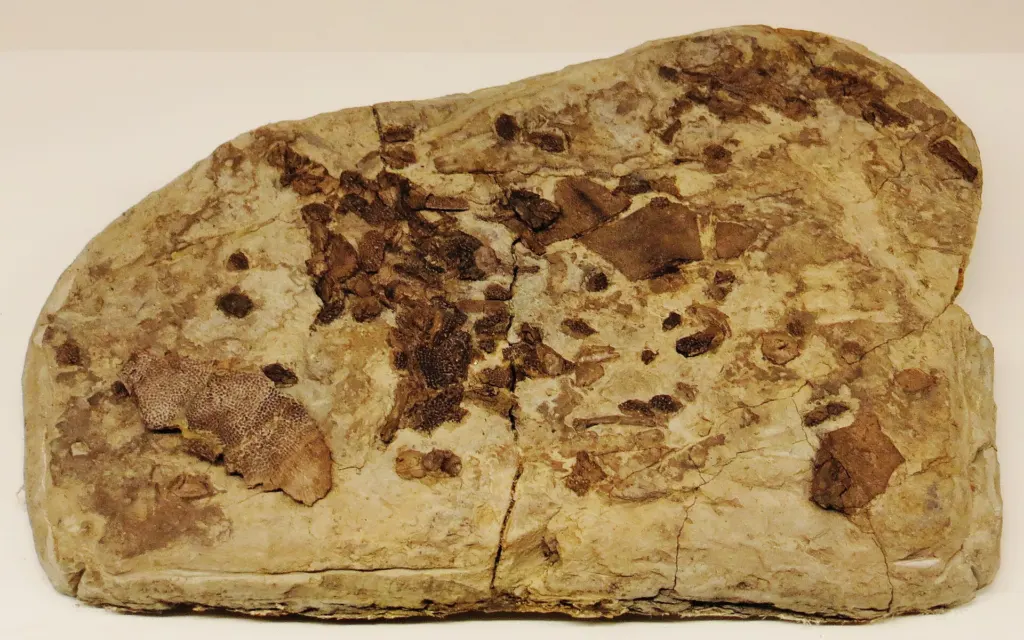
No living amphibian can survive in the ocean, yet one did 237 million years ago. Two nearly complete skeletons from Guizhou province in southern China belong to Gerrothorax maritimus, an armored, flat-bodied animal almost three feet long that researchers say is the first fully marine amphibian on record. The species was described on October 26 in Nature Ecology & Evolution.
“If you think about today’s amphibians, this animal is unusual because it’s big,” said corresponding author Ryosuke Motani, a professor of Earth and planetary sciences at the University of California, Davis. He put its body mass near that of a giant salamander, but “really chunky” rather than long.
A rule this fossil breaks
Mammals, reptiles and birds have all produced species that live at sea without needing food or fresh water from land. Amphibians never did. Of more than 8,000 modern species, none is fully marine, and fewer than 2% tolerate any salt at all. That works out to fewer than about 160 species with even partial salt tolerance (2% of 8,000).
The reason is skin. Amphibians breathe and take in water through a thin, permeable skin, Motani explained, so they neither drink nor breathe mainly through the mouth. Salt water ruins that system. Even the crab-eating frog, which handles some salt, loses weight in brackish water and has to recover in fresh water.
How the team showed it lived at sea
The researchers, from UC Davis, Peking University and the Geological Museum of Guizhou, used three lines of evidence:
- Location: the fossils lay in sediments from an ancient sea, far from any large landmass.
- Completeness: carcasses drifting at sea tend to dry out and shed limbs before sinking, but these animals kept their finger bones, suggesting they died close to where they lived.
- Chemistry: the strontium isotope ratios in the fossils matched what is expected of Late Triassic seawater.
Armor as a survival kit
The team thinks the bony armor did more than fend off predators such as ichthyosaurs. By sealing the skin, it would have forced the animal to drink seawater and absorb it through the gut, while its gills, a feature of the Gerrothorax genus, filtered out the salt. In the paper’s words, the armored lineage “probably prepared them for marine adaptation.”
Its skull shape and armor point to a lurking, bottom-dwelling suction feeder. “They would probably just wait at the bottom and then when prey comes around, they would just suck it in,” Motani said, comparing it to the wobbegong, a carpet shark that hunts the same way today.
Limits
The species rests on two specimens. Its feeding style is inferred from anatomy, and the gill-and-gut salt strategy is a proposal based on its biology, not something the fossils record directly.
For scale in time, Gerrothorax maritimus is about 17 million years older than the 220-million-year-old bone that may be Iberia’s oldest dinosaur. Its living relatives still stick close to fresh water, much like the lungfish caught yawning underwater in a Japanese study. The fossils are kept at the Geological Museum of Guizhou in Guiyang.
Image: Ghedoghedo, CC BY-SA 4.0 via Wikimedia Commons
This article was produced with AI assistance and reviewed by our Editorial Desk. How we work.