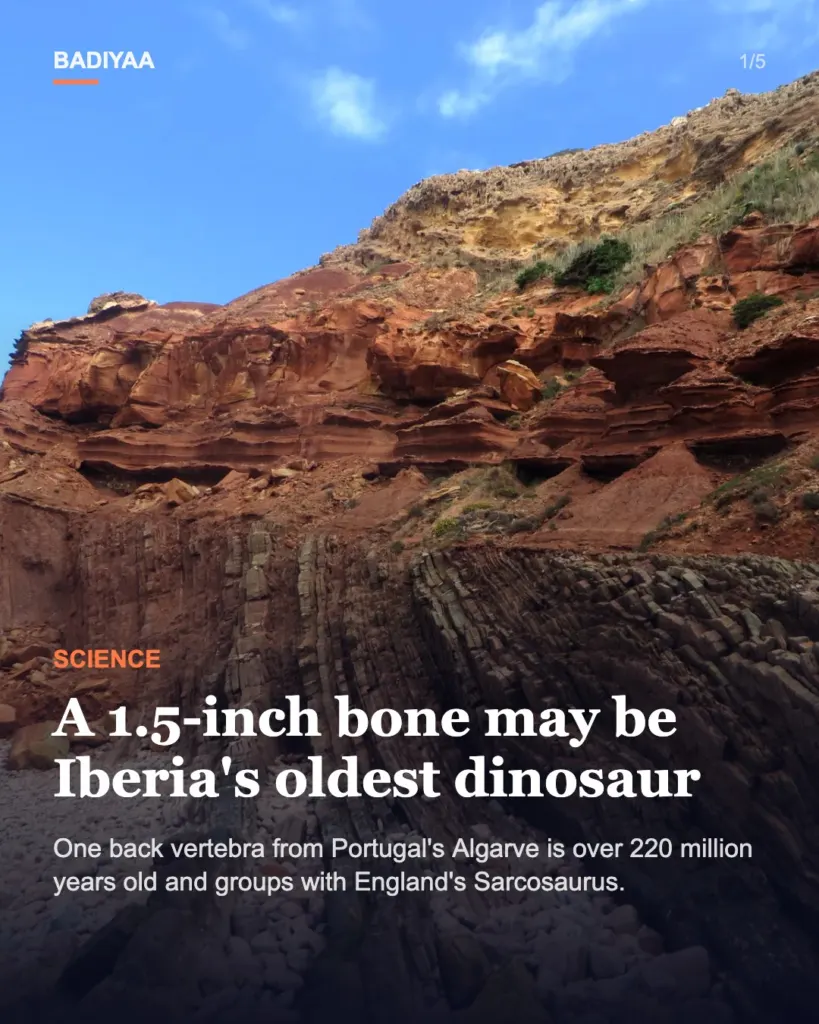
A single back bone 1.5 inches (37 mm) long, found in rock near the village of Penina in Portugal’s Algarve, may be the oldest dinosaur fossil yet found on the Iberian Peninsula. Paleontologists Rui Tiago Santos-Matos and Octávio Mateus of NOVA University Lisbon date it to the Late Triassic, more than 220 million years ago, and their analysis places it among the earliest neotheropods, a branch of early predatory dinosaurs.
Until this bone, Portugal had dinosaur footprints from the Triassic but not a single described dinosaur bone from that period. The new specimen also marks the first fully land-dwelling animal with a backbone to be described from these Algarve deposits, which had so far yielded water-bound creatures only.
How researchers tested one 37-millimeter vertebra
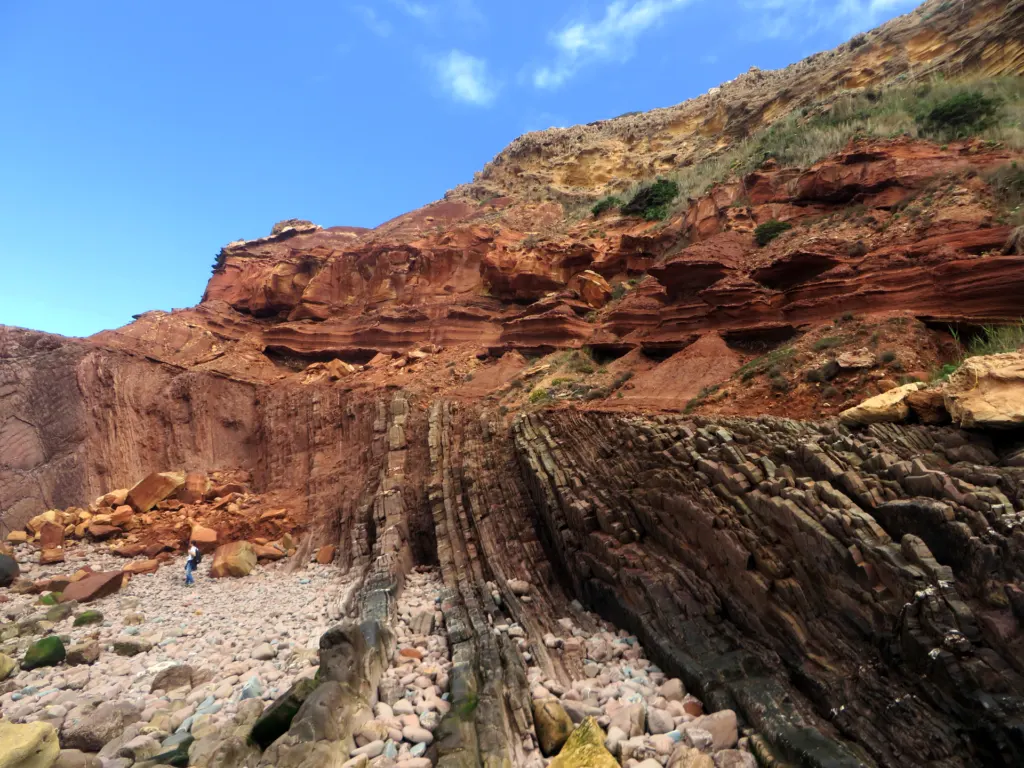
The fossil, catalogued as NOVA-FCT-DCT-5562, is a centrum, the main body of a vertebra from the animal’s back. It came from the AB2 unit of the Silves Group, a band of Late Triassic rock in the municipality of Loulé. The study appears in the 2026 volume of the journal Fossil Imprint as “Theropod vertebra from the Late Triassic of Algarve, Portugal – evidence of the oldest Iberian dinosaur”, on pages 98 to 109.
A lone centrum carries little information, so the pair did two things. First, they compared its shape with vertebrae of many early dinosaurs and their close relatives. Then they ran a phylogenetic analysis, which builds a family tree from coded anatomical traits, using an updated data set focused on early theropods. They added 13 new characters, meaning scored features of the back vertebrae, and tested the tree under two weighting schemes, known as equal and implied weights.
The results put the bone inside Neotheropoda as the closest relative of Sarcosaurus woodi, a predator known from Early Jurassic rocks in England. That matters for timing, because the Portuguese bone is at least 20 million years older than Sarcosaurus. If the placement is right, the lineage leading to Sarcosaurus reaches back from the very end of the Triassic into its early-to-middle part, and the Algarve animal becomes one of the oldest neotheropods known anywhere.
A watery Triassic world that now has a land predator
The fossil also changes the picture of the ancient Algarve. Earlier finds in the Silves Group had built up a fauna of metoposaurids and mastodonsaurids, two families of large amphibians, plus the reptile groups known as phytosaurs and placodonts, and fish. All of them were aquatic or semi-aquatic. A theropod is the first animal from those beds that lived fully on land, so the picture of that ecosystem now includes a land-living predator.
For readers following European dinosaur finds, the ages here are worth placing side by side:
- More than 220 million years: the Algarve centrum, Late Triassic
- At least 20 million years younger: Sarcosaurus woodi, Early Jurassic England
- Earlier evidence in Portugal for Triassic dinosaurs: footprints only, no bones
Why one bone cannot name a new species
The authors are careful about what a single centrum can and cannot show. In the paper’s abstract they write that the specimen “may represent an unknown theropod species, however it lacks autapomorphies and the remains are too fragmentary to attribute to any known species or to erect a new one.” Autapomorphies are features unique to one species, the anatomical fingerprints that let paleontologists name something new. Without them, the bone stays a numbered specimen rather than a named dinosaur.
There are other limits. This is one study of one bone, with no second specimen yet to test the result. Family trees built from a handful of vertebral traits can shift when new fossils or characters are added, which is why the team tested two weighting schemes; agreement between them strengthens the case but does not settle it. The dinosaur identification itself rests on that comparison and analysis, not on any single diagnostic feature.
The work has also been refined over time. The same specimen appears in Santos-Matos’s master’s thesis at the University of Évora, dated December 2024 and supervised by Mateus and Ausenda Balbino. That version described 12 new characters; the published paper uses 13. Both versions reach the same conclusion, a neotheropod close to Sarcosaurus, which suggests the result held up after a character was added between thesis and journal.
What would make the case stronger
The clearest test is more bone. A second vertebra, a limb element or a piece of skull from the same AB2 unit near Penina could supply the unique features this centrum lacks and allow the animal to be named. Until then, the Algarve fossil stands as specimen NOVA-FCT-DCT-5562: 37 millimeters of evidence that a predatory dinosaur lived in what is now southern Portugal more than 220 million years ago.
Further reading
Image: André Cortesão, CC BY 3.0 via Wikimedia Commons
This article was produced with AI assistance and reviewed by our Editorial Desk. How we work.
Spot an error? Help verify this story
The story in 5 slides