A YouTube Short from the fact channel @Factopus-Daily, titled “Why Did Massive Animals Got Smaller In Size”, has drawn roughly 57,000 likes with a 60-second tour of the ice-age giants that are no longer with us. One thing to say up front: the clip carries YouTube’s AI label, so the narration and visuals are generated, not footage or a scientist on camera. The question it raises, though, is one of the longest-running arguments in palaeontology, and it has a real answer.
Here is the finding. A review in the journal Science in October 2004, led by Anthony Barnosky of the University of California, weighed the evidence from palaeontology, climatology, archaeology and ecology and concluded that humans contributed to the extinctions on some continents, but that hunting alone “was not solely responsible for the pattern of extinction everywhere”. In the Northern Hemisphere, the authors wrote, it was the intersection of human arrival with pronounced climate change that set the timing and geography of the die-off. Two decades and 860 citations later, that is still the mainstream position.
What went missing
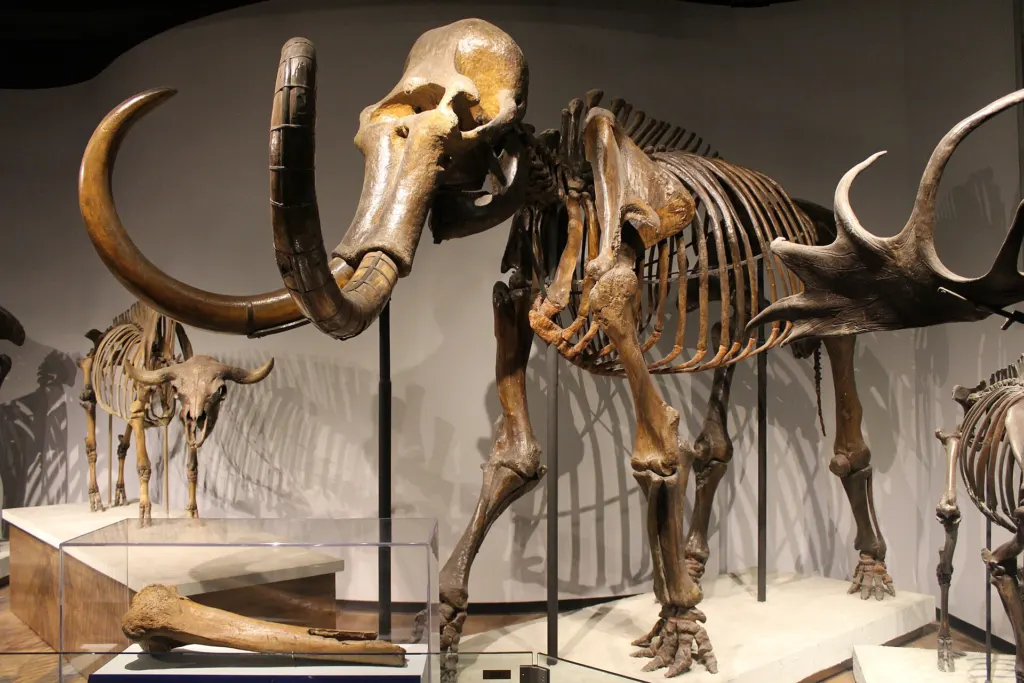
The losses are known as the Quaternary extinction event, and they fell overwhelmingly on the large. In North America alone, around 35 genera of big mammals disappeared at the end of the Late Pleistocene, roughly 13,800 to 11,400 years ago, including mammoths, mastodons, giant ground sloths and the long-horned bison. Australia and New Guinea lost their giants earlier, beginning around 50,000 years ago. Northern Eurasia lost its animals in a staggered sequence spread across tens of thousands of years, between about 50,000 and 10,000 years ago.
The woolly mammoth is the poster species because its ending is so well dated. Mainland Siberian populations hung on until about 10,000 years ago. Island holdouts lasted far longer: St. Paul Island in the Bering Sea until about 5,600 years ago, and Wrangel Island in the Arctic until roughly 4,000 years ago, by which time the pyramids at Giza were already standing.
The two suspects
The “overkill” case is the older one. Paul Martin’s edited volume Quaternary Extinctions: A Prehistoric Revolution (University of Arizona Press, 1984) built the argument that newly arrived humans with projectile weapons met animals that had never learned to fear them. The timing fits in the Americas and in Australia, where the big extinctions coincide with the first firm evidence of people. Earlier modelling by Mosimann and Martin in American Scientist in 1975 showed that a fast-moving human front could, on paper, sweep a continent of naive prey.
The climate case points at the rest of the record. The end of the last glacial period rearranged vegetation on every continent, and the North American extinctions line up with the onset of the Younger Dryas cold snap as closely as they do with the Clovis hunters. In Eurasia the pattern is drawn out and patchy, which is hard to pin on any single human wave. Papers such as Dale Guthrie’s 2003 study in Nature (volume 426) on Alaskan and Yukon fossils, cited by Barnosky’s team, argued that changing plant communities reshaped which grazers could survive.
The 2004 review’s method was to put both suspects in the same room. The authors compared continent-by-continent chronologies of human arrival, climate shifts and last-appearance dates for each lost genus. Where only one factor was present, extinctions were muted; where both overlapped, they were severe. For the Southern Hemisphere, the team was more cautious: Australian evidence supported a human role, but the correlation with climate there was “weak or contested”.
Why it matters now
The debate is not antiquarian. The same journal page that hosts the Barnosky review points readers to a 2015 Science paper titled “Abrupt warming events drove Late Pleistocene Holarctic megafaunal turnover”, which used ancient DNA to tie individual population collapses to rapid warming pulses rather than to cold. The lesson researchers draw is that big, slow-breeding animals are fragile precisely when a shifting climate and an expanding human footprint coincide, which describes the position of elephants, rhinos and large cats today.
Ancient DNA is also rewriting how far back we can look. In 2021, researchers sequenced DNA more than a million years old from two mammoth teeth found in eastern Siberia, the oldest genetic material ever recovered, revealing a previously unknown mammoth lineage.
Limits
The Barnosky review is a synthesis, not a new dataset, and its authors said plainly that firmer chronologies and more realistic ecological models were still needed. Radiocarbon dates for last appearances are patchy on every continent, and a species’ last fossil is never its last individual. The Short itself is an AI-generated summary with no sources shown, so treat its specific claims about animal sizes as a prompt to read further rather than a reference. And “smaller” is a loose framing: the giants did not shrink so much as vanish, leaving the survivors, from bison to moose, to look small by comparison.
Further reading
- Barnosky et al., Assessing the Causes of Late Pleistocene Extinctions on the Continents, Science (2004)
- Wikipedia: Quaternary extinction event
- Wikipedia: Woolly mammoth
Image: Jonathan Chen, CC BY-SA 4.0 via Wikimedia Commons
This article was produced with AI assistance and reviewed by our Editorial Desk. How we work.