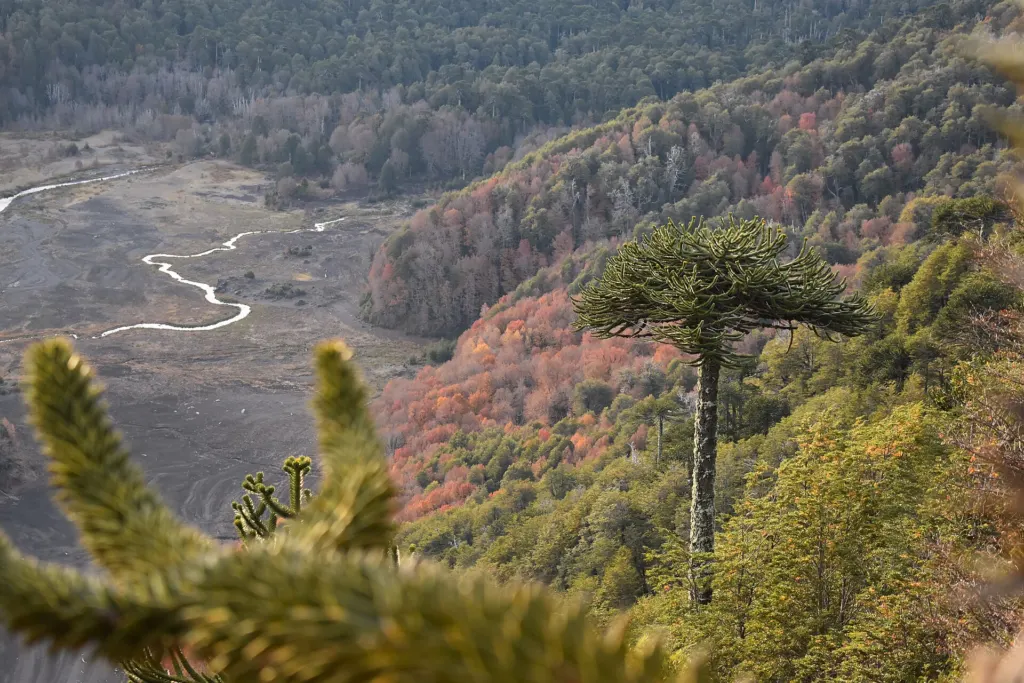
The monkey-puzzle tree in a suburban front yard belongs to a lineage that was already standing when sauropods roamed: Araucaria, a genus of conifers whose fossil record reaches back to the Middle Jurassic, roughly 165 million years ago. Twenty species survive today, all in the Southern Hemisphere, and the genus is trending on Reddit this week as a “living fossil.”
What the fossils show
According to the Wikipedia entry for the genus, the oldest records come from two Middle Jurassic species: Araucaria mirabilis in Argentina and Araucaria sphaerocarpa in England. Through the Jurassic and Cretaceous, the trees grew worldwide, including across the Northern Hemisphere, before vanishing from the north at the end of the Cretaceous, the period that also closed the age of dinosaurs.
The best evidence sits in Patagonia. At the Cerro Cuadrado Petrified Forest, a volcanic eruption around 160 million years ago buried a forest dominated by A. mirabilis. Many trunks are still upright, turned to stone in volcanic ash; some are 3.5 meters (11 feet) across and are estimated to have stood at least 100 meters (330 feet) tall. The fossil species’ entry says the deposit belongs to the La Matilde Formation, dated to between 164.7 and 155.7 million years ago.
How scientists pieced it together
The site was found because farmers were keeping petrified cones as souvenirs. Botanist Anselmo Windhausen noticed them, explored the area and located the forest in 1923; an American expedition from the Field Museum reached it around the same time. The cones are so well preserved that some seeds still hold fully formed embryos. In 1953, Scottish paleobotanist Mary Gordon Calder compared them with living trees and placed the species in Araucaria, noting a striking resemblance to Australia’s bunya-bunya pine.
Fossil bark from the same forest even preserves tunnels from beetle larvae, likely ancestors of the bark beetles that still attack conifers today.
Why it matters: the sauropod connection
One hypothesis links the trees to dinosaur evolution. The long necks of sauropods may have evolved, at least partly, for browsing tall Araucaria canopies. Analyses of modern Araucaria leaves show they are high in energy but slow to ferment and low in protein, which suggests they suited big adult sauropods with long digestion times, while growing juveniles probably needed other plants.
To put that time span in perspective: if the 165 million years since the genus appeared were squeezed into a single 24-hour day, modern humans, at roughly 300,000 years, would show up only in the last 2 minutes and 37 seconds.
Where they grow now
- New Caledonia: 14 of the 20 living species, all found nowhere else
- South America: the monkey-puzzle (A. araucana) of Chile and Argentina, and the Paraná pine of Brazil
- Australia and New Guinea: the bunya-bunya, hoop pine and klinki
- Norfolk Island: the Norfolk Island pine, a common houseplant
The Mapuche of Chile and Argentina call the monkey-puzzle pewen and treat it as sacred; its large seeds have long been a staple food.
Limits
“Living fossil” is shorthand, not a scientific claim that nothing changed. Modern species differ from their Jurassic relatives; the bunya-bunya’s seeds, for instance, are far larger than those of A. mirabilis, and later studies have questioned whether the fossil truly belongs in the bunya group. The sauropod-neck link is also a hypothesis, and a diet of Araucaria alone would likely have left dinosaurs short of protein.
Badiyaa has written about another Southern Hemisphere survivor in the same plant family, the Wollemi pine found in a canyon near Sydney in 1994, and about spider relatives that lived 380 million years ago.
In New Caledonia, many of those 14 endemic species now grow on nickel-rich soils that are prime targets for mining, and several are listed as threatened.
Further reading
Image: Delahimalaya-alosandes, CC BY-SA 4.0 via Wikimedia Commons
This article was produced with AI assistance and reviewed by our Editorial Desk. How we work.