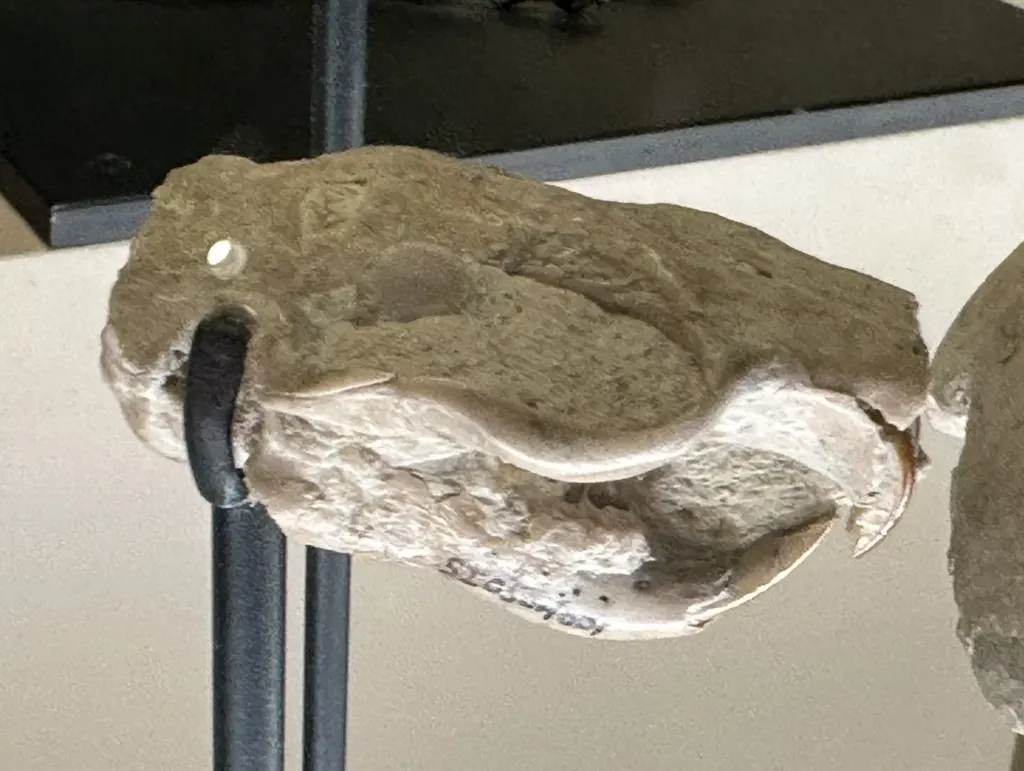
Two teeth dug out of a coal mine in southern Thailand belonged to a rodent that weighed around 30 kilograms, about 66 pounds, some 34 million years ago. The animal, now named Yakamys sirindhornae, is the largest early rodent of its family ever found in Asia, and its molar is more than twice the length and width of the previous record holder from the continent.
The species is described in a paper published November 4 in Scientific Reports by researchers from Thailand’s Department of Mineral Resources, France’s University of Poitiers and University of Montpellier, and Canada’s McGill University. The name mixes the Thai word yak, meaning “giant,” with the Greek mys, for mouse or rat. The species name honors Princess Maha Chakri Sirindhorn for her long support of paleontology in Thailand.
How two teeth became a species
All the team had was a right lower second molar and a broken left lower incisor, found close together in a clay layer inside the main coal seam at the Bang Mark pit of the Krabi lignite mine. Fossil mammals and magnetic signals in the rock date that layer to the late Eocene, about 35.1 to 33.7 million years ago.
Geologist Pannipa Tian, a co-author, found the incisor in 2004 and has said in an interview that she first mistook it for a piece of bone. The tools to pin down the species came much later. The team scanned the molar with X-ray micro-CT in Montpellier and sliced the incisor to study its enamel under an electron microscope. That enamel showed a layered pattern typical of the Ischyromyidae, an extinct family that was among the first big branches of the rodent family tree.
The molar measures 11.56 by 11.27 millimeters. Here is how that compares, using figures from the paper:
- Yakamys (Thailand, late Eocene): lower second molar 11.56 x 11.27 mm, about 130 square millimeters of chewing surface.
- Manitsha tanka (South Dakota, Oligocene): about 8.2 x 8.9 mm, roughly 73 square millimeters.
- Hulgana (China): previously the largest Asian ischyromyid, with molars less than half the length and width of Yakamys.
By our calculation, the Thai tooth offers about 1.8 times the chewing area of the American giant’s, which until now was one of the few large-bodied rodents known from this era.
Why it matters
Giant rodents are best known from South America, where much later relatives grew huge. One, Josephoartigasia monesi, is now estimated at about 350 kilograms. Outside South America, rodents this large are rare before the last ice ages. Yakamys shows that a lineage of early rodents had already scaled up by the end of the Eocene, long before those South American giants spread.
The teeth came from lake clay, so the animal lived in a landscape with lakes. The authors compare that setting with today’s capybara, the largest living rodent, but stress that two teeth cannot show whether Yakamys was semi-aquatic.
Limits
The 30-kilogram figure is a rounded middle value. Seven different equations gave estimates from 21.4 to 47.3 kilograms, and with prediction errors added, the individual ranges stretched from about 10.8 to 69 kilograms. The researchers also say the material is too scant for a formal family-tree analysis. They mention an unpublished, very large rodent incisor from the Pondaung Formation in Myanmar that may be older, but it has not been identified yet.
Isolated teeth keep rewriting the story of ancient mammals in Asia and beyond, much as four teeth from Peru suggested that monkeys rafted across the Atlantic from Africa. More finds like this are collected in our Science section. The specimens, numbered TF 2942 and TF 2943, are kept at the Department of Mineral Resources in Bangkok, and the team says a 3D model of the molar will be posted to the open MorphoMuseuM repository.
Further reading
Illustrative image. Image: Geekgecko, CC BY 4.0 via Wikimedia Commons
This article was produced with AI assistance and reviewed by our Editorial Desk. How we work.