Babies as young as 7 months old watched videos of snakes while hearing a frightened voice, and they did not act scared at all. That finding sits at the center of research by developmental psychologist Vanessa LoBue and her colleagues, who concluded that humans are not born afraid of snakes or spiders, but are primed to learn those fears unusually fast.
LoBue, now at Rutgers University in Newark, wrote the paper with David Rakison of Carnegie Mellon and Judy DeLoache of the University of Virginia, and it ran in the review journal Current Directions in Psychological Science. Rutgers summed it up as infants not being born afraid of snakes and spiders but learning those fears quickly. The research keeps resurfacing because the idea of an inborn snake terror is so widely repeated.
What the babies did
The setup was simple. Each infant faced a pair of clips playing together, one showing a snake and one showing a harmless animal like an elephant, while a speaker played a voice that sounded either scared or cheerful. When the voice was scared, the babies’ eyes lingered on the snake. Their own faces and behavior stayed calm.
Older children got a search task. Three-year-olds looked at a grid of nine pictures and had to find a target. Snakes were found quicker than flowers, and quicker than look-alikes such as caterpillars and frogs. A child’s own fear made no difference: snake-fearing kids and fearless ones were equally fast.
“What we’re suggesting is that we have these biases to detect things like snakes and spiders really quickly, and to associate them with things that are yucky or bad, like a fearful voice,” LoBue said in a release from the journal’s publisher.
Why it matters
The older view held that snake fear is wired in because so many snakes are venomous. Earlier work backed half of that story. In Sweden, Arne Ohman paired pictures with a mild shock and found the learned dread stuck around longer when the pictures were snakes or spiders rather than flowers or mushrooms. In the US, Susan Mineka worked with monkeys raised in a lab: they had no snake fear to start with, yet picked it up much faster than a fear of flowers or rabbits.
The infant studies fit that pattern. Here is the chain the researchers describe, in order:
- Detection: even toddlers find a snake in a crowd of images faster than other things.
- Association: babies link a snake with a frightened voice more readily than they link a harmless animal with one.
- Learning: actual fear arrives later, from experience and from the people around a child.
In other words, the fast part is noticing; the fear is taught. That is a different claim from “babies love snakes,” and a more useful one for parents who wonder where a toddler’s phobia came from.
Limits
These were lab studies using videos and photos, not real encounters in the wild. Looking time is an indirect measure, and the authors themselves said the next step was to test how the detection bias turns into fear learning. A 2019 review by LoBue and Karen Adolph of New York University, published in Developmental Psychology, went further, arguing that many infant reactions labeled “fearful” really depend on context, learning and what the stimulus looks like.
Snakes keep landing in our coverage, from Florida’s tree-climbing Burmese pythons to why predators have slit-shaped pupils. The 3-year-olds in this research needed only a screen of nine pictures to show how quickly a snake grabs human attention.
Further reading
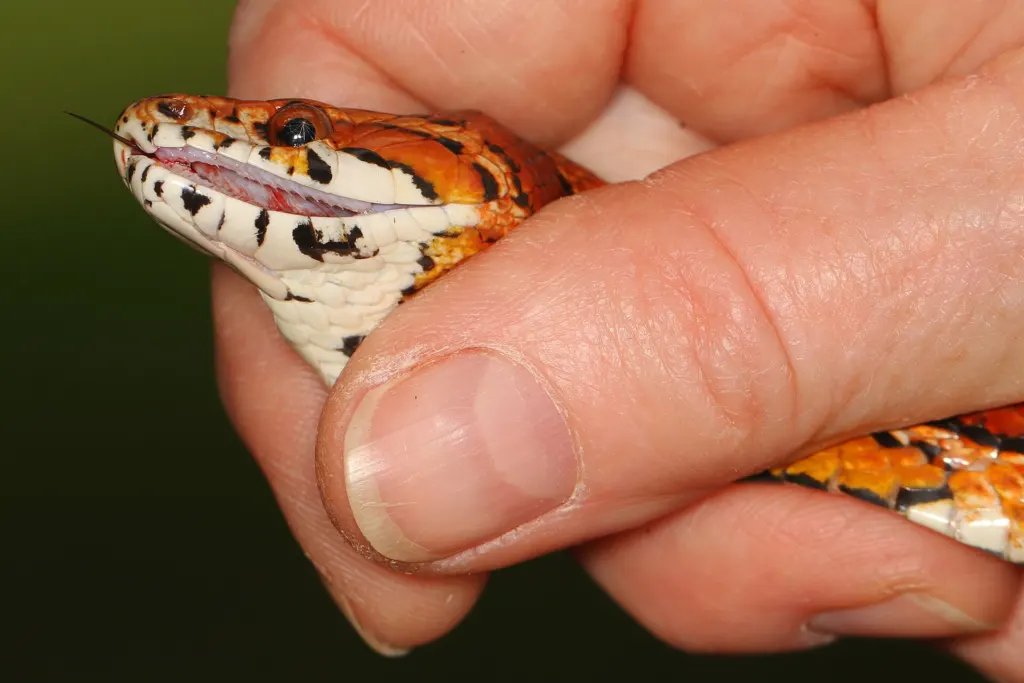
Illustrative image. Image: Judy Gallagher, CC BY 2.0 via Wikimedia Commons
This article was produced with AI assistance and reviewed by our Editorial Desk. How we work.