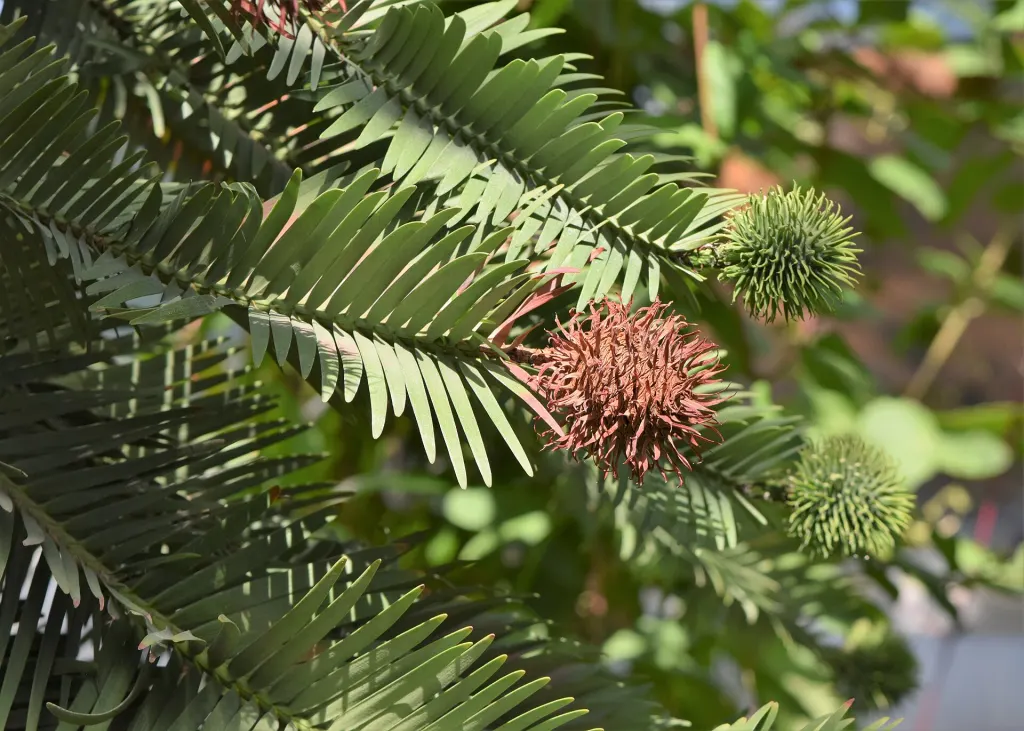
Only 46 adult Wollemi pines and 43 juveniles remain in their original wild home, a canyon in the Blue Mountains whose location New South Wales still keeps secret. Thirty-two years after a group of canyoners stumbled on them roughly 150 kilometers northwest of Sydney, the species survives mainly because people have spent three decades copying it, hiding it and, once, flying in to hose it down.
A tree in the wrong era
On or about 10 September 1994, David Noble, an off-duty officer with the NSW National Parks and Wildlife Service, was exploring canyons in Wollemi National Park with Michael Casteleyn and Tony Zimmerman. Noble noticed a tree with strange, knobbly bark and sent samples for identification. Wyn Jones of National Parks and Jan Allen of the Botanic Gardens confirmed it was new to science, and in 1995 it was named Wollemia nobilis, the species name honoring Noble. Officials sat on the news for about six months.
The viral framing, that these were trees “known only from fossils,” needs a caveat. The Wollemi pine belongs to the Araucariaceae, a conifer family about 200 million years old, and NSW parks material says Wollemia fossils go back 91 million years and that the tree was thought to have died out around two million years ago. Botanical reference works are more cautious: they describe “living fossil” as a popular label and say no unambiguous Wollemia fossil has been identified. The family is ancient; whether this exact genus sits in the rock record is still debated.
What is not in doubt is how thin the wild population is. Genetic testing found every specimen essentially identical, a sign that the species squeezed through a bottleneck somewhere between 10,000 and 26,000 years ago, possibly down to one or two trees.
From secret grove to global insurance policy
The pine’s recent history reads like a series of near misses and countermeasures:
- 1994–95: discovery, secrecy and formal naming.
- November 2005: wild trees are found infected with the root-rot pathogen Phytophthora cinnamomi, which rangers blame on unauthorized visitors.
- 2006–07: a propagation program begins in Australia and a recovery plan is written; cuttings later go to botanic gardens abroad and, eventually, to commercial nurseries.
- 2019: two new wild populations are planted elsewhere in Wollemi National Park.
- Late 2019–early 2020: the lightning-sparked Gospers Mountain fire, which burned more than 512,000 hectares, closes in. Air tankers lay retardant, and specialist firefighters are winched into the gorge to set up irrigation.
- January 2021: the site becomes the first Asset of Intergenerational Significance in NSW, the strongest legal protection the state’s parks offer.
- September 2024: 379 more saplings go into each translocated population, taking the total past 835, and a cool-climate backup collection is planted at Mount Tomah.
The 2020 rescue was kept quiet while it happened so as not to reveal the grove’s location. Matt Kean, then the state’s environment minister, later called it “a military-style operation.”
Where the species lives now
Cloning has turned one of the rarest trees in the wild into one of the more widely planted curiosities in temperate gardens. Kew’s specimens, planted in 1997, produced their first cones in 2008. A 2023 survey reached more than 1,500 growers in 31 countries, and in 2023 the Botanic Gardens of Sydney shipped genetically diverse young trees to gardens in the UK, Ireland, mainland Europe and one in the United States. The tree has handled frosts of minus 7 °C at Inverewe Garden in Scotland, and reports suggest it can survive minus 12 °C.
For anyone with a potted one, the field data from that grower survey point to temperate climates with rain spread across the year and well-drained, loamy soil. What growers cannot do is visit the original: the wild site is closed to everyone except essential staff, because visitors can carry in the same kind of pathogen that reached it in 2005.
The latest twist came last month in Canberra. The Australian National Botanic Gardens, which normally refuses plant donations on biosecurity grounds, asked locals for their potted Wollemi pines; about 10 gardeners offered trees. “We wanted plants that have been growing in this environment and are accustomed to the Canberra environment,” said director Matthew Parker. The donated trees are headed for beds around the visitor center and the garden’s Gondwana collection.
Further reading
Image: Krzysztof Ziarnek, Kenraiz, CC BY-SA 4.0 via Wikimedia Commons
This article was produced with AI assistance and reviewed by our Editorial Desk. How we work.