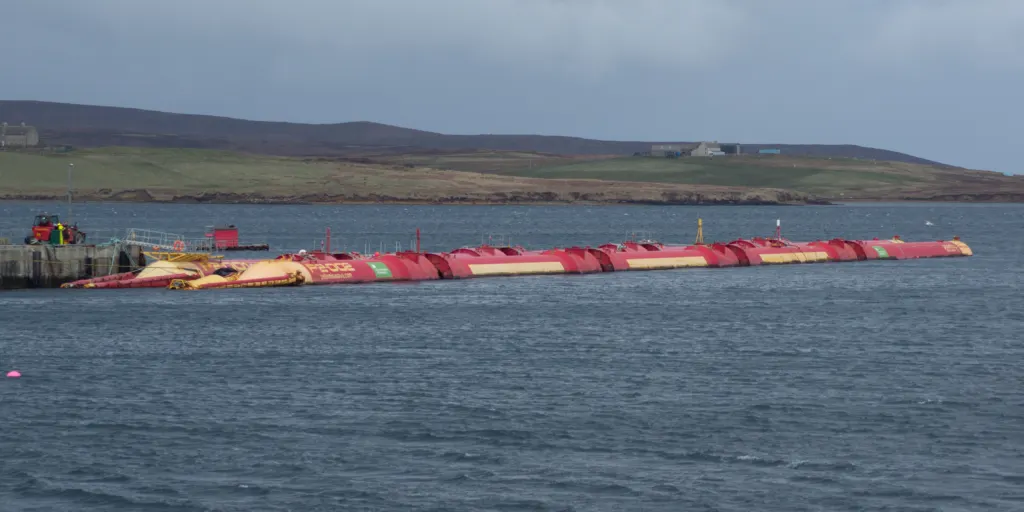
A Danish wave machine shaped like a giant V can fold itself shut when a storm comes; its maker, Weptos, claims it turns more than 60 percent of wave energy into power after 16 years of development and testing.
That figure comes from the company, which describes “over 60% wave-to-power conversion efficiency” on its website. A US Department of Energy marine database repeats the number, along with a levelized cost of €30 per megawatt-hour, and lists the design at 1,000 kilowatts. Levelized cost spreads a project’s lifetime building and running expenses over every unit of power it produces. The pages we read do not tie either figure to a commercial machine at sea, and we found no report of a full-size unit in service.
How the V works
The Weptos converter floats on the surface. Two long arms meet at a point, and along them sits a row of rotors based on Salter’s duck, the nodding cam from 1974 also known as the Edinburgh Duck. Each passing wave rocks the rotors, and all of them feed a shared axle tied directly to a rotary generator.
The trick is the angle between the arms. In calm water the V opens wide and reaches across more wave front. As the sea builds, the arms close, and in the worst weather the structure shuts completely, shrinking the load it has to survive. Behind it the water is left calmer, which gives maintenance crews a sheltered spot to work.
The rotors also capture motion in both directions, which the database entry credits with limiting energy loss.
Why that hinge matters
Wave power has a brutal record. The physics is tempting: just under the surface, the flow of wave energy averages about five times the density of wind energy 20 meters up, and 10 to 30 times that of sunlight. Storms are the catch. A moderate swell carries around 36 kilowatts per meter of wave crest, while the largest storm seas carry about 1.7 megawatts.
Work that ratio through and a machine at sea can face about 47 times the power of a moderate swell. Folding shut is one direct answer to that problem.
The idea is old. The first known patent for taking energy from ocean waves was filed in Paris in 1799, and estimates put the worldwide theoretical resource above 2 terawatts. Past attempts show how hard it has been to collect. Scotland’s £10 million Saltire prize, offered for 100 gigawatt-hours from waves over two years, was never awarded. A 2017 study looked at why market-ready devices had failed to appear after more than £200 million in UK public money. As of 2023 wave power still was not widely used commercially.
How the number compares
In small-scale tests decades ago, Salter’s original duck stopped 90 percent of wave motion and converted 90 percent of that, for 81 percent overall. Weptos’s claim of over 60 percent is lower than that laboratory peak, but it describes a whole system built around the same rotor idea. The figures are not measured the same way, so they are not a straight contest.
The cost claim is easier to picture. A price of €30 per megawatt-hour works out to three euro cents per kilowatt-hour.
The limits
Every performance number here originates with the developer. The US database rated the design at technology readiness level 6 of 9 in its last assessment, dated February 2024, which sits well short of a proven commercial product.
Scale is the unfinished part. A Danish energy research program, EUDP, backed a 2024 to 2026 project to design and build the first full-scale rotors and power unit for a 1 MW machine, with lab models tested under production and extreme conditions first. The budget was 20.43 million Danish kroner, of which 12.01 million was grant money, a 59 percent funding rate. Aalborg University and Sigma Energy & Marine are among the partners.
The company’s own story has also shifted. Its website now leads with an autonomous offshore power system, the ANMG, aimed at defense, maritime autonomy and critical offshore infrastructure, rather than at feeding national grids. The company’s case is that fuel deliveries and frequent servicing are impractical at such remote sites.
The EUDP project is scheduled to end in 2026, and its full-scale rotors are the next hard evidence to look for.
Further reading
Image: Drnoble, CC BY 4.0 via Wikimedia Commons
This article was produced with AI assistance and reviewed by our Editorial Desk. How we work.