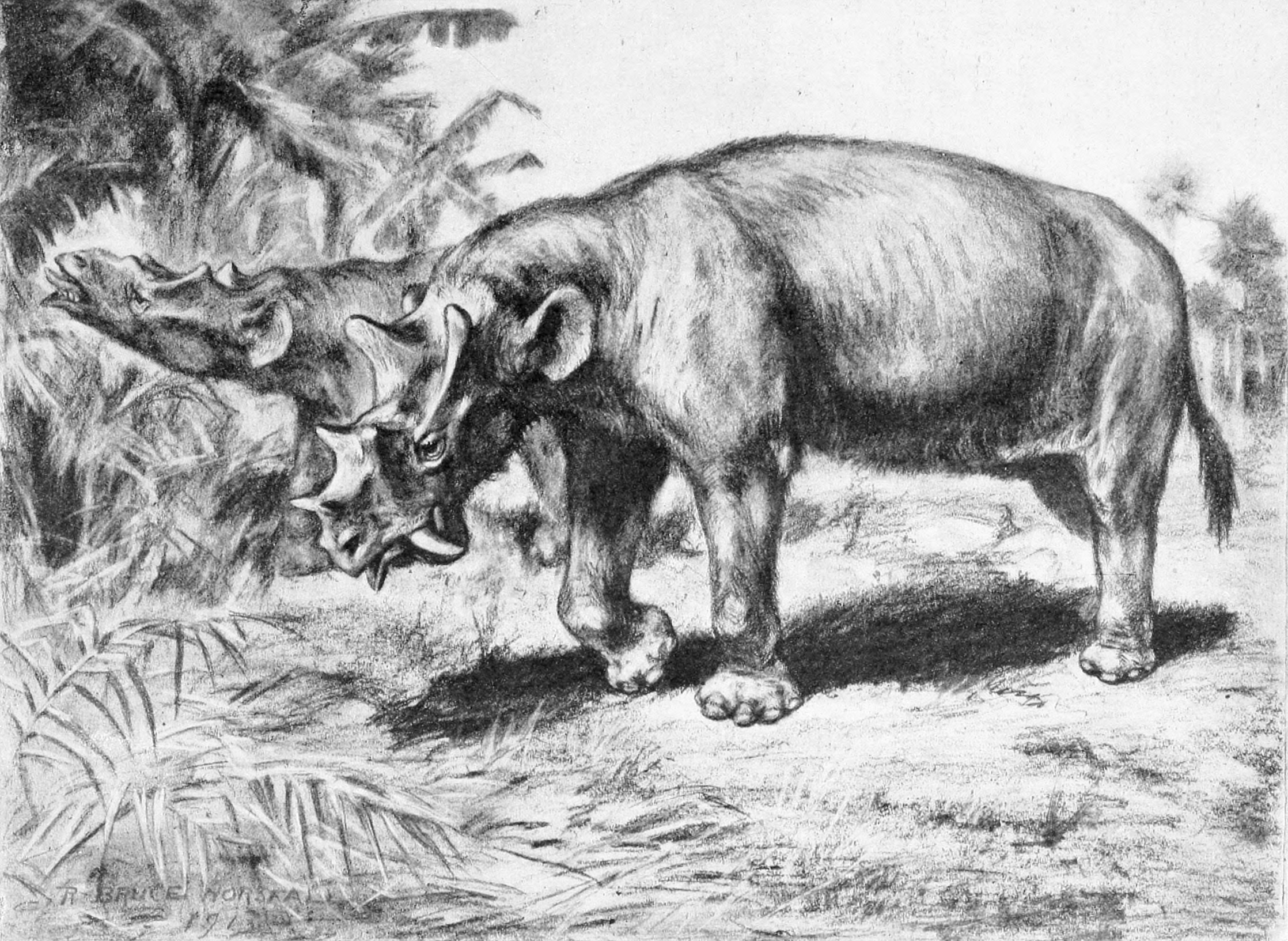
For more than 150 years, Uintatherium has been the textbook pin-up for showy males. Six bony knobs on a skull nearly a meter long, saber-like upper fangs, a hulking, rhino-like body: the biggest, most heavily armed skulls were labeled male, the smaller, plainer ones female. A new count of those skulls says the evidence for that split was never really there.
The work comes from Kevin D. Mulcahy of the University of Kansas Biodiversity Institute and Natural History Museum, published as a 2026 study in PLOS One. His conclusion is unusually direct for a paleontology paper: "extreme sexual dimorphism should not be treated as the null hypothesis for this clade."
Measuring the skulls of a horned giant
Sexual dimorphism means males and females of one species look different, like a peacock's showy tail next to a plainer peahen, and male rivalry often drives weapons such as battle teeth. If male and female Uintatherium anceps really differed as much as claimed, their skull measurements should fall into two clear clusters. Mulcahy measured most of the known skulls, from collections including the American Museum of Natural History and Yale's Peabody Museum, and ran a battery of statistical tests on them.
He found some sign of a difference, mainly in canine length. But the strong, two-humped pattern expected from dramatic dimorphism was largely missing. One caveat cuts the other way, too: after damaged specimens were removed, canine length could be measured in only 10 of 26 skulls, which limits what any test can show.
The bison test
To check that his methods could spot dimorphism at all, Mulcahy ran the same analyses on 23 American bison skulls held at the university, nine female, seven male and seven of unknown sex. In bison, the signal came through clearly. Compared with other living plant-eaters, the skull-length difference estimated for Uintatherium was not especially large.
The paper suggests a wider lesson: horns and big canines may show up in both sexes of a species even when selection mostly favors them in one.
A beast born in the Bone Wars
Uintatherium had a rowdy start. According to the genus overview for Uintatherium, an army lieutenant dug up the first partial skeleton in Wyoming's Bridger Basin in September 1870, and Othniel Charles Marsh described it in 1871. Joseph Leidy coined the name in 1872, after the Uinta Mountains plus the Greek word for beast.
Then the feud kicked in. Marsh, the Yale paleontologist behind the Peabody Museum's fossil collections, and his arch-rival Edward Drinker Cope raced to name the same animals, firing off hasty telegrams east. One of Cope's names was garbled in transmission into "Lefalophodon." In the end, the many genera and species the two men coined were folded into a single species, Uintatherium anceps.
The history of the Bone Wars records how far the rivalry went: bribery, theft, smashed fossils and public attacks in scientific journals. It also records that many of Marsh's names for these horned mammals stood, while none of Cope's did.
What the animal really looked like
Uintatherium anceps lived in North America from about 50.5 million to 37 million years ago, in the Eocene. It stood around 1.5 meters at the shoulder, and weight estimates run from under a ton to as much as 4,500 kilograms. Its "horns" were probably covered only in skin, not keratin, and damage on some of them suggests the animals used them in fights. Its brain, by one estimate, weighed just 290 grams.
Badiyaa has covered other fossils that spent decades with the wrong label, including a glyptodont skull misidentified since 1875 and Westlothiana, the Scottish fossil hailed as the oldest reptile.
Sources
- “Linear morphometrics fail to support strong sexual dimorphism in…”, PLOS One (University of Kansas), 2026
- “Uintatherium”, Wikipedia, 2026
- “Bone Wars”, Wikipedia, 2026
- “Othniel Charles Marsh”, Wikipedia, 2026
- “Sexual dimorphism”, Wikipedia, 2026
Image: R. Bruce Horsfall, Public domain via Wikimedia Commons
This article was produced with AI assistance and reviewed by our Editorial Desk. How we work.