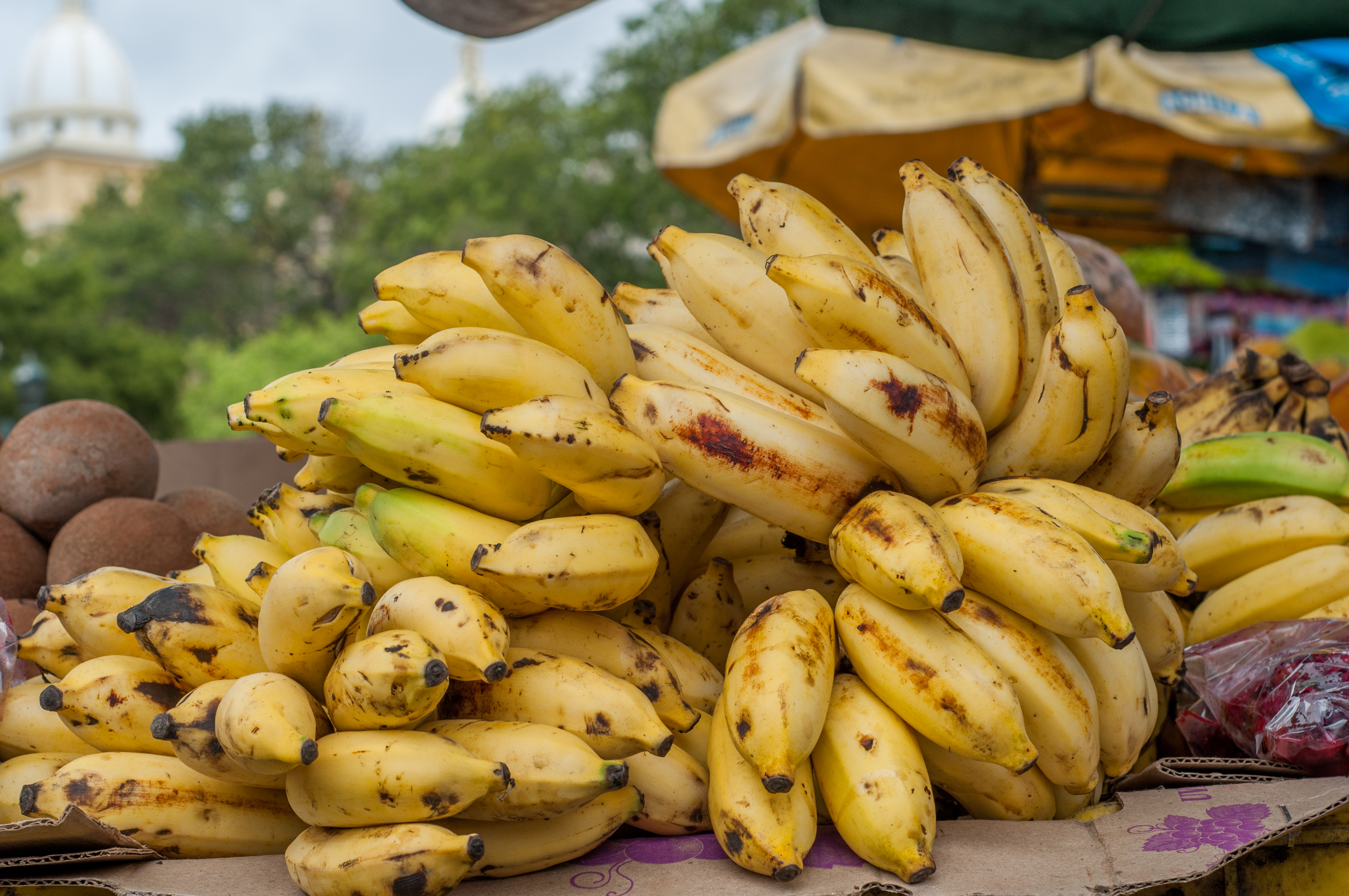
The banana on your kitchen counter is radioactive. Not dangerously, the EPA says, but genuinely, physically radioactive: roughly 15 of its atoms decay every second.
The culprit is potassium, the very thing bananas are famous for. A small slice of all natural potassium is the unstable isotope potassium-40, and a typical banana carries about half a gram of potassium in total. According to the reference entry on the banana equivalent dose, that works out to an activity of around 15 becquerels, the unit for one decay per second.
How much radiation is in a banana
The US Environmental Protection Agency puts a number on it. The EPA's page on natural radioactivity in food says eating one banana delivers about 0.1 microsieverts, or 0.01 millirem, and that you would need to eat about 100 bananas to match the dose you get every day from natural radiation in the United States environment. The agency is blunt: these foods do not pose a radiation risk.
That daily figure fits the bigger picture. Tables of background radiation put the average American's natural dose at about 3.1 millisieverts a year, mostly from radon in the air, with cosmic rays, rocks and soil, and food making up the rest. Divide by 365 and you get roughly 85 bananas' worth a day, close to the EPA's round 100.
The banana unit was invented to calm people down
The "banana equivalent dose" is not an official unit. Its earliest known mention came in 1995 on a nuclear safety mailing list, where Gary Mansfield of the Lawrence Livermore National Laboratory described using it to explain tiny doses to the public. It caught on because it turns an abstract microsievert into something you can hold.
It also has a flaw that physicists love to point out. Your body keeps its potassium level steady, so when you eat a banana, the kidneys flush out an equal amount. The extra radioactivity lasts only hours, which means bananas do not stack up over a lifetime.
You are more radioactive than your fruit bowl
Here is the twist. Potassium-40, the isotope's own entry notes, is the largest source of natural radioactivity in animals, humans included. A 70-kilogram adult carries about 16.7 milligrams of it, producing roughly 3,850 to 4,300 decays every second for life. The EPA's overview of radiation sources and doses agrees that the traces of radioactive material in our bodies are mainly potassium-40, which arrives in the food and water we take in.
Set that against a banana's 15 and the average person is about as radioactive as 270 bananas. Sit next to someone on the bus and you are, technically, swapping radiation.
Potassium-40 decays with a half-life of about 1.25 billion years, mostly into calcium-40, and sometimes into argon-40. That second route is why argon makes up nearly 1% of Earth's atmosphere: much of the air's argon was once potassium.
The banana truck that may never have tripped an alarm
One famous claim says a truckload of bananas can set off the radiation portal monitors that scan cargo at US ports. Reference sources do not agree. The entry on radiation portal monitors says bananas have been wrongly blamed, because fruit is packed too loosely to give a strong signal, while cat litter, granite, ceramics and fertilizer are real nuisance triggers.
Brazil nuts are the more surprising snack. Besides potassium, they can soak up radium from the soil, the EPA notes.
For more on how living things cope with radiation, read Badiyaa's story on Deinococcus radiodurans, the bacterium that shrugs off 5,000 grays, and our look at why sweet potatoes are naturally genetically modified.
Sources
- “Natural Radioactivity in Food”, US Environmental Protection Agency (RadTown), 2026
- “Radiation Sources and Doses”, US Environmental Protection Agency, 2026
- “Banana equivalent dose”, Wikipedia, 2026
- “Potassium-40”, Wikipedia, 2026
- “Background radiation”, Wikipedia, 2026
- “Radiation portal monitor”, Wikipedia, 2026
Image: Wilfredor, CC0 via Wikimedia Commons
This article was produced with AI assistance and reviewed by our Editorial Desk. How we work.