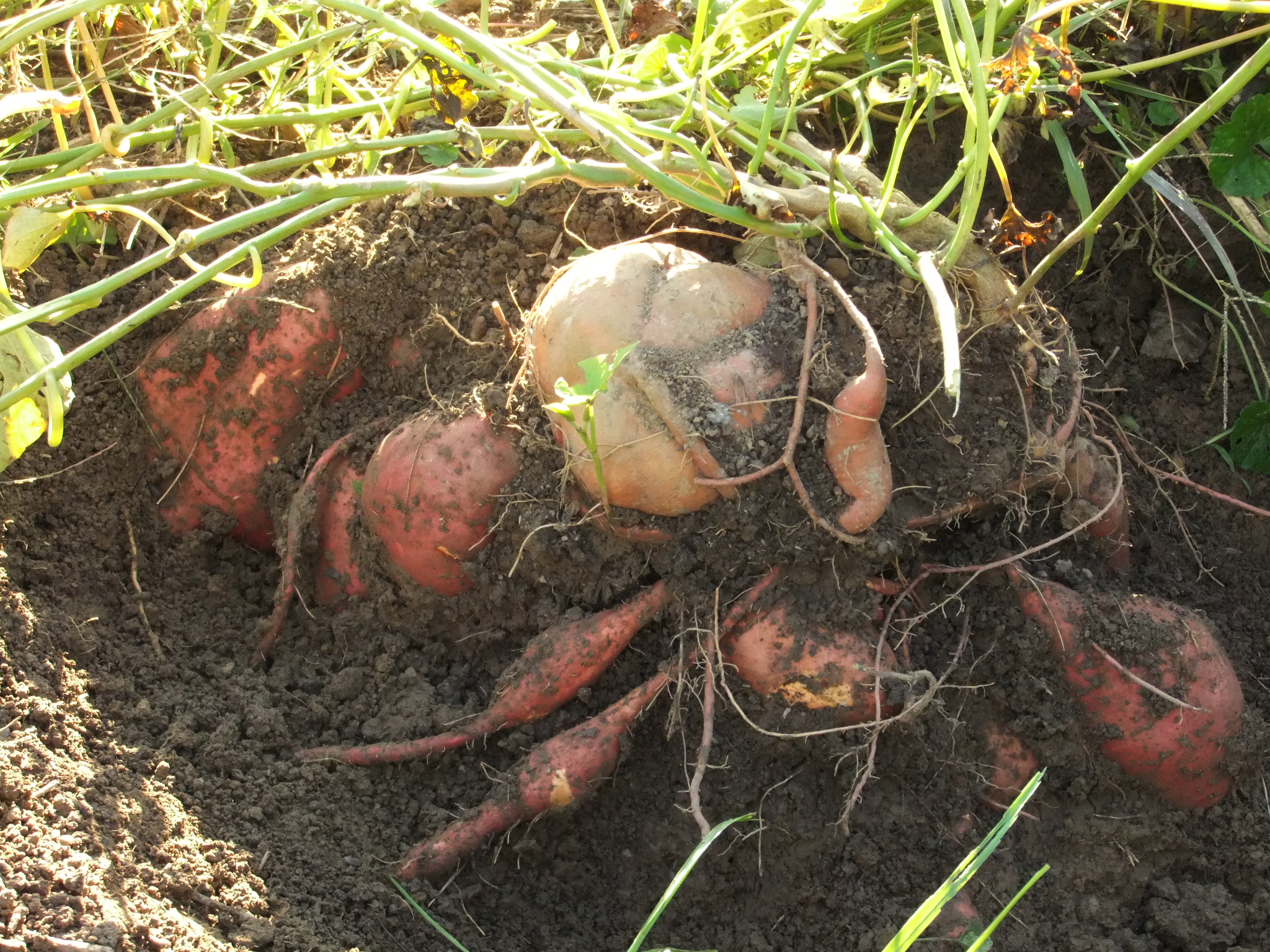
Every one of 291 cultivated sweet potato varieties that scientists screened carried bits of bacterial DNA in its genome. Long before any lab spliced a gene, a soil bacterium had already slipped its own genes into the plant, and people have been eating the result for thousands of years.
That was the finding of a study in the Proceedings of the National Academy of Sciences by Tina Kyndt and colleagues, a team from Ghent University in Belgium, the International Potato Center in Lima, China Agricultural University and the US Department of Agriculture. Their title did not hedge: the sweet potato is "an example of a naturally transgenic food crop."
How a bacterium edits a plant
The culprit belongs to Agrobacterium, a group of soil bacteria famous for moving DNA into plants. One species causes crown gall disease, a tumor-like swelling where root meets shoot. It does this by shipping a stretch of DNA called T-DNA out of a ring-shaped plasmid and into the plant cell's genome, where its genes rewire the cell's hormones, as the Wikipedia entry on Agrobacterium explains.
Scientists have known the bacterium causes plant tumors for well over a century. Erwin F. Smith and C. O. Townsend of the US Department of Agriculture described it in "A Plant-Tumor of Bacterial Origin," published in Science in April 1907.
That same DNA-moving talent later made Agrobacterium the workhorse of genetic engineering. Disarm the tumor genes, load in the gene you want, and the bacterium delivers it. Wikipedia lists it as the vector behind US genetically modified soybean, cotton, maize, canola and other crops.
What the sweet potato team found
The researchers looked at a sweet potato clone called Huachano in detail and found that the bacterial sequences were not just junk riding along: the genes were expressed, meaning the plant actually uses them. One of the T-DNA pieces turned up in every cultivated clone they tested but not in the crop's close wild relatives.
That pattern is the juicy part. The authors write that it suggests "the T-DNA provided a trait or traits that were selected for during domestication." In other words, early farmers may have unknowingly picked plants that a bacterium had already tweaked.
A timeline from soil to Thanksgiving plate
Put the dates side by side and the irony is hard to miss:
- Thousands of years ago: an Agrobacterium-type infection leaves T-DNA in sweet potato ancestors; domesticated sweet potatoes were present in Central America at least 5,000 years ago, according to the sweet potato's Wikipedia entry.
- 1907: USDA scientists link a bacterium to plant tumors.
- 1970s and 1980s: Marc Van Montagu and Jozef Schell at Ghent work out the gene-transfer mechanism, and Mary-Dell Chilton's team shows the disease genes can be stripped out (1983).
- 2015: another Ghent-led team finds the bacterium had done the job in sweet potatoes first.
The same Belgian university that helped turn Agrobacterium into a lab tool also showed nature had beaten the lab to it.
The limits
The paper shows that the bacterial genes are present and active; it does not pin down exactly which trait they gave the plant, and it cannot date the infection precisely beyond "evolutionary times." The authors suggest the finding "may change the paradigm governing the 'unnatural' status of transgenic crops," but that is a framing for debate, not a ruling on any modern crop.
The sweet potato itself is a botanical oddball: it sits in the morning glory family and is only distantly related to the potato. Badiyaa has covered why Thanksgiving's candied yams are really sweet potatoes, and how ancient Neanderthal DNA still shapes Europeans' genomes, another case of borrowed genes riding along for millennia.
In 2020, farmers worldwide grew about 89 million tonnes of sweet potatoes, every one of them, by this study's logic, carrying a little bacterial souvenir.
Sources
- The genome of cultivated sweet potato contains Agrobacterium T-DNAs, Proceedings of the National Academy of Sciences (Ghent University et al.), 2015
- A Plant-Tumor of Bacterial Origin, Science (US Department of Agriculture), 1907
- Agrobacterium, Wikipedia, 2026
- Sweet potato, Wikipedia, 2026
Image: Vmenkov, CC BY-SA 3.0 via Wikimedia Commons
This article was produced with AI assistance and reviewed by our Editorial Desk. How we work.