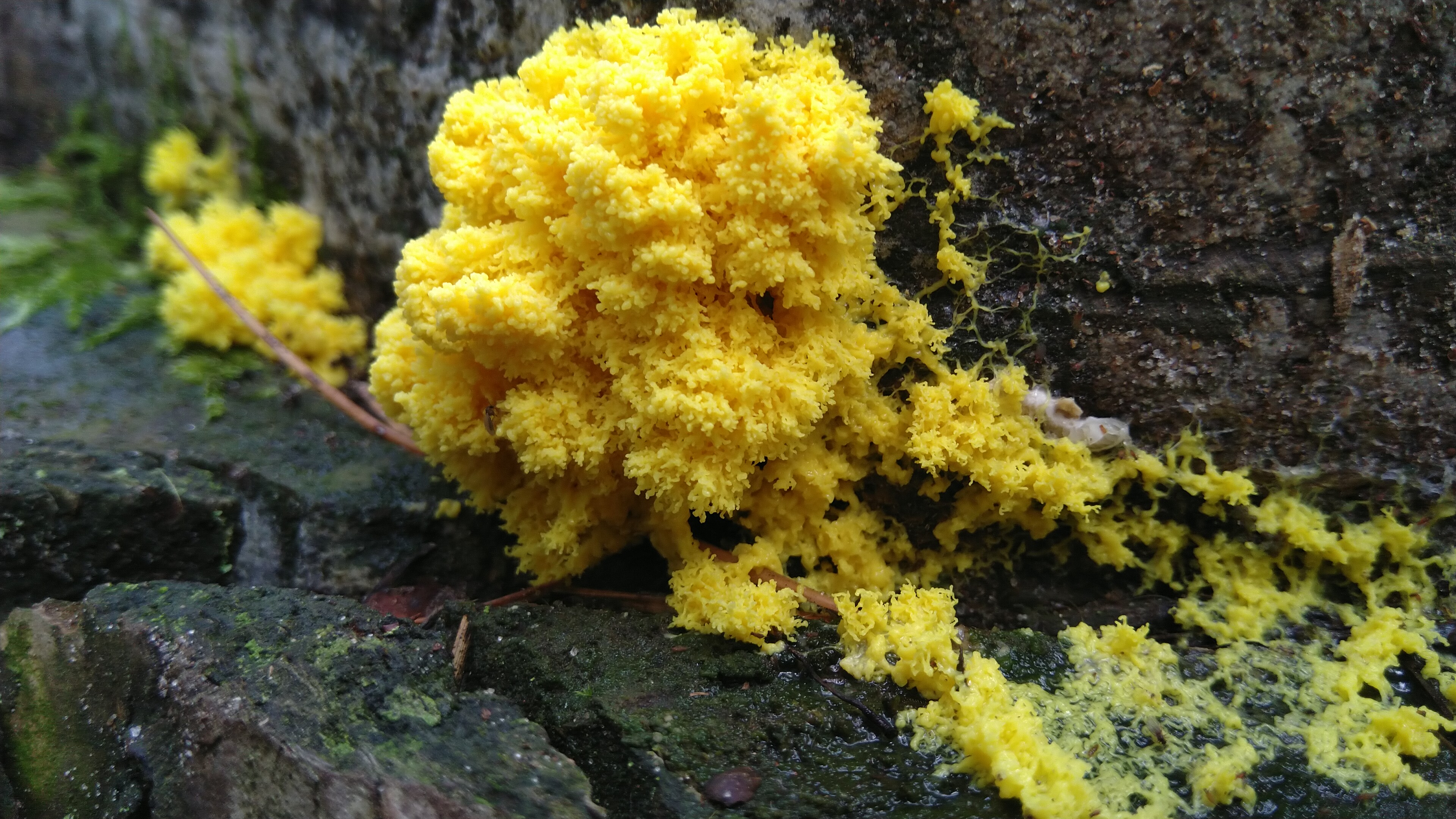
A bright yellow blob with no brain, no nerves and not a single neuron keeps finding the shortest way through a maze. Now two researchers argue the slime mold Physarum polycephalum is not really thinking its way to the answer at all: it is obeying one of the oldest rules in physics.
In a preprint titled "Cognition as least action: the Physarum Lagrangian", posted to arXiv by Ricard Solé and Jordi Pla-Mauri, the pair recast the organism's famous problem-solving as a least-action problem, the same kind of math physicists use to describe how a ball rolls or how light picks its path.
What the slime mold actually does
Physarum spends part of its life as a plasmodium: one enormous cell holding many nuclei, laced into a network of tubes that can spread a foot or more across, according to the species' Wikipedia entry. Cytoplasm sloshes back and forth through those tubes, reversing direction roughly every 100 seconds and moving at up to 1 millimeter per second.
That plumbing is the trick. Put oat flakes at two points in a maze and the plasmodium spreads everywhere, then pulls back from every corridor except the shortest one linking the food. Toshiyuki Nakagaki, Hiroyasu Yamada and Ágota Tóth reported the feat in a 2000 Nature paper, "Maze-solving by an amoeboid organism".
Ten years later the stunt got bigger. A team led by Atsushi Tero at Hokkaido University laid out food in the pattern of Tokyo and its surrounding cities, and the slime mold grew a tube network strikingly close to the real railway map. Their 2010 Science study on biologically inspired network design turned the result into a model engineers could borrow for transport systems that survive local failures.
The physics idea, in plain terms
The new work builds a Lagrangian, a single quantity that sums up a system's costs, for the slime mold's tube network. Two pressures pull against each other: keeping thick tubes alive burns energy, while thin tubes move food badly. The steady network the organism settles into, the authors write, sits at an extremum of that functional, balancing "metabolic dissipation and transport efficiency."
Put another way, the "smart" route is simply the arrangement that wastes the least energy, given where the food sits. The authors tested the framework on ring, tree and lattice layouts and report that it reproduces the tube thicknesses and flows seen in lab experiments.
Their conclusion is blunt: Physarum's problem-solving on constrained layouts "follows a physics-based variational principle."
Why a brainless solver matters
Here is the context the maze headlines usually skip. Since 2000, the story of Physarum has swung between two readings: a primitive mind, or a clever pipe system. This paper lands firmly on the second, and that is not a put-down. If a single cell can hit near-optimal answers just by minimizing energy, then a lot of what looks like decision-making in nature may be physics doing the heavy lifting. Fair warning: the blob is still smarter at route planning than most of us at a highway interchange.
The limits
The study is a preprint and has not been peer reviewed. It works on predefined graphs, meaning the researchers fix the possible paths and boundary conditions in advance; a real plasmodium crawling across open ground faces a messier problem. The Wikipedia entry also notes that earlier models of the organism are "externally consistent but not internally explanatory," and that attempts to chain Physarum logic gates into larger computers stopped giving reliable results once the circuits grew more complex.
For more on how bodies wire up decisions, read Badiyaa's look at why the right brain runs the left side of the body, and our explainer on octopus skin that can sense light, another case of a body solving problems outside a central brain.
The Tokyo rail experiment used food at 36 surrounding towns, and the slime mold matched the real network on efficiency, fault tolerance and cost.
Sources
- Cognition as least action: the Physarum Lagrangian, arXiv (Solé and Pla-Mauri), 2025
- Maze-solving by an amoeboid organism, Nature, 2000
- Rules for Biologically Inspired Adaptive Network Design, Science (Hokkaido University et al.), 2010
- Physarum polycephalum, Wikipedia, 2026
Image: Le Bernemi, CC BY-SA 4.0 via Wikimedia Commons
This article was produced with AI assistance and reviewed by our Editorial Desk. How we work.