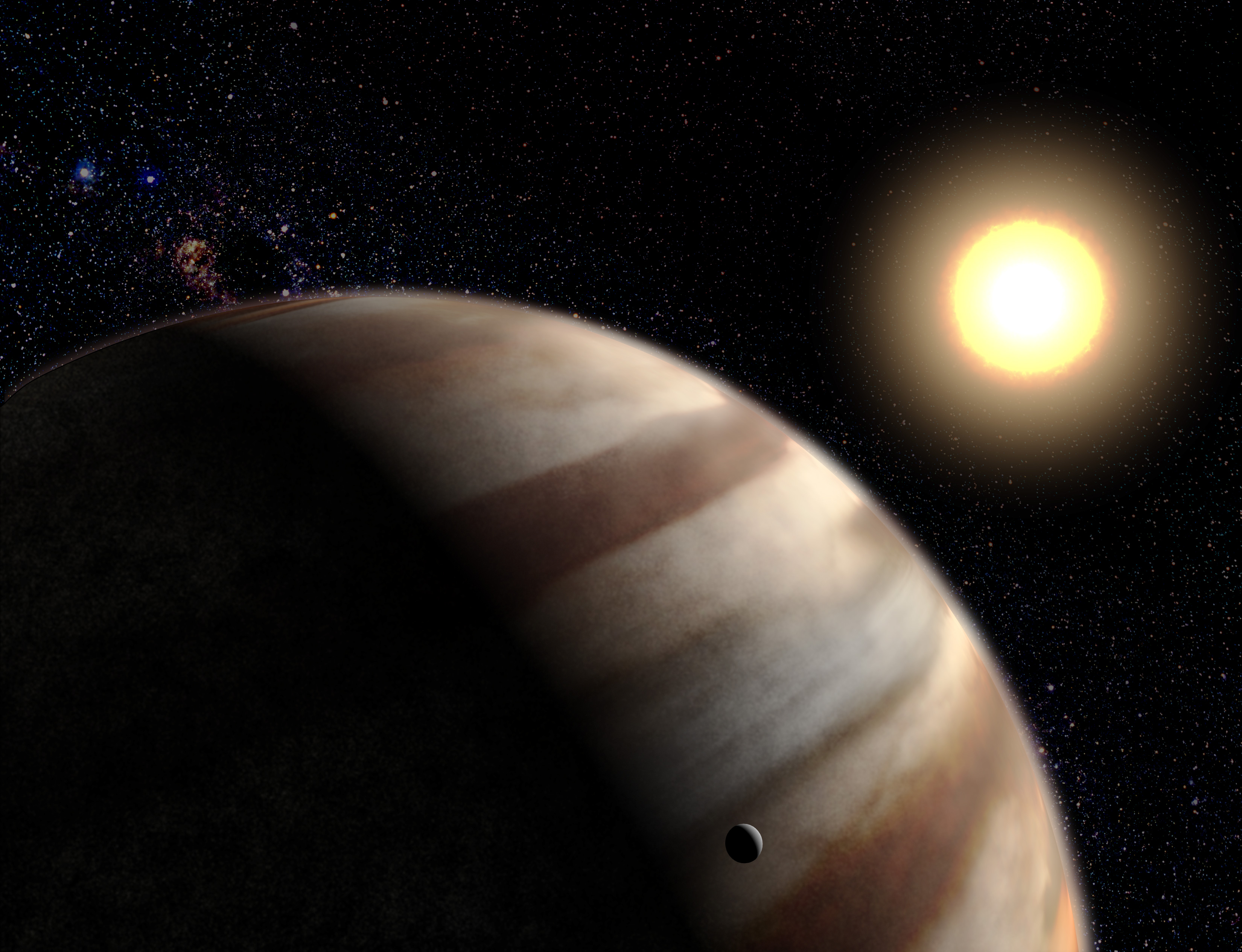
"If you visited this planet the first thing that would happen is the change in your pockets would melt." That was astronomer Timothy Brown describing HD 209458 b, the scorching gas giant that became the first world beyond our solar system to have its atmosphere detected. The announcement came 25 years ago, on November 27, 2001.
The tool was the Hubble Space Telescope, which, as NASA's own account of the discovery noted, was never built to hunt planets around other stars.
A hot Jupiter that crosses its star
HD 209458 b circles a Sun-like star in the constellation Pegasus, about 150 light-years away according to NASA Astrobiology's feature on the discovery (the planet's Wikipedia entry now puts it at 157). It is a "hot Jupiter": roughly 70% of Jupiter's mass, or 220 times Earth's, racing around its star every 3.5 days at just four million miles from the star's surface. NASA put its atmosphere at about 1,100 degrees Celsius (2,000 degrees Fahrenheit).
What made it special was geometry. Its orbit is tilted so that, seen from Earth, it passes in front of its star. In 1999 it became the first known transiting exoplanet, dimming its star by about 1.7%, according to the HD 209458 b Wikipedia entry.
How Hubble sniffed out sodium
During a transit, a sliver of starlight filters through the planet's atmosphere on its way to us. David Charbonneau, then at Caltech and the Harvard-Smithsonian Center for Astrophysics, led a team that watched four transits with Hubble's Space Telescope Imaging Spectrograph and looked for sodium, which absorbs two colors in the yellow part of the spectrum.
The catch: the star has sodium too. So the team looked for a change. When the planet crossed the star, the sodium lines deepened. The difference was tiny. "This subtle contrast in the sodium signature when the planet blocks the star is only one part in ten thousand," said Bruce Margon of the Space Telescope Science Institute.
Why sodium, of all things? Brown had the best line: "It's the spectrum equivalent of a skunk. You don't need very much of it in the air before you notice it."
The results were published in March 2002 as "Detection of an Extrasolar Planet Atmosphere" in The Astrophysical Journal by Charbonneau, Brown, Robert Noyes and Ronald Gilliland.
Twenty-five years of firsts
Here is how fast one planet kept rewriting the rulebook, based on the Wikipedia record:
- 1999: first exoplanet seen transiting its star.
- 2001: first exoplanet atmosphere detected, via sodium.
- 2003 and 2004: Hubble finds a giant envelope of hydrogen, carbon and oxygen boiling off the planet, which later earned it the nickname Osiris.
- 2005: Spitzer makes the first direct detection of light from an exoplanet, using this system.
- 2010: a superstorm with winds up to 7,000 km/h is measured in its atmosphere.
That is five headline firsts from a single hot Jupiter in about a decade.
The limits
Even in 2001 the result came with a puzzle. "We actually measured less sodium than we expected," Charbonneau said, offering high clouds or sodium locked into other molecules as possible reasons. Later work complicated things further: Wikipedia notes that additional data reported in 2020 did not confirm the presence of sodium in the planet's atmosphere. The atmosphere itself is not in doubt; the hydrogen escaping from it has been measured directly. The sodium signal that started it all is what is now under question.
For more on how astronomers read distant light, see Badiyaa's explainer on why stars twinkle while planets stay steady and the story of how Urbain Le Verrier found Neptune with math.
The planet is estimated to be losing 100 million to 500 million kilograms of hydrogen every second, yet it is expected to lose only about 7% of its mass over its lifetime.
Sources
- Atmosphere of an Extrasolar Planet Detected for the First Time, NASA Astrobiology, 2001
- Detection of an Extrasolar Planet Atmosphere, The Astrophysical Journal (Charbonneau et al.), 2002
- HD 209458 b, Wikipedia, 2026
Image: G. Bacon (STScI/AVL), Public domain via Wikimedia Commons
This article was produced with AI assistance and reviewed by our Editorial Desk. How we work.