Sirius, the brightest star in the night sky, can jump 7.5 arcminutes sideways in 29 seconds when it sits 20 degrees above the horizon. Nothing is happening to the star. The shimmy is made by the air over your head, and it is the same effect that makes every star twinkle while the planets beside them shine almost steadily.
That Sirius measurement comes from a time-lapse described in Wikipedia's article on twinkling, which astronomers also call scintillation.
What the air does to starlight
Light bends a little when it passes from one patch of air into another of a different temperature, because warmer air is thinner. The atmosphere is full of such patches, and they drift constantly. Each one acts like a weak, wobbling lens.
The Hong Kong Observatory makes the point neatly in its explainer on twinkling: astronauts in orbit have not reported seeing stars twinkle, so the cause has to be our atmosphere. It adds that air typically cools by about 6.5 degrees Celsius for every kilometer of height, roughly 3.6 degrees Fahrenheit per 1,000 feet, which keeps the layers uneven.
A star is so far away that it reaches us as a single point. When a pocket of air steers that thin thread of light away from your eye, the star dims for an instant. When the next pocket steers it back, the star brightens. The flicker can show up in color and position as well as brightness.
What a telescope sees
Through a big telescope the effect looks even stranger. NASA's Astronomy Picture of the Day on why stars twinkle showed Betelgeuse breaking into a swarm of tiny repeated images, called speckles, that rearrange themselves as the clumpy air shifts. Above the atmosphere, the same star looks like one steady dot.
Astronomers call this blurring "seeing." According to Wikipedia's entry on astronomical seeing, the distortions change more than 100 times a second, and on good nights the air behaves like a set of smooth cells only 10 to 20 centimeters across.
Why planets hardly twinkle
Planets are close enough to show a tiny disk rather than a point. Light from many parts of that disk takes many slightly different routes through the air, and their wobbles average out. That is why Venus, Mars and Jupiter, the three planets Badiyaa covered in this month's pre-dawn planetary lineup, look calm beside the stars around them.
A quick guide for the backyard
- Look high for a steady view. Twinkling is strongest near the horizon.
- Use it to spot planets. A bright point that barely flickers is probably a planet.
- Expect more sparkle on windy, cold nights. Mixed air layers mean more pockets to bend the light.
Here is why the horizon is worse. Treating the atmosphere as a flat slab, light from a star 20 degrees up crosses about 1 divided by the sine of 20 degrees, or roughly 2.9 times as much air as light from straight overhead. Low stars simply pass through nearly three times as many wobbling lenses.
How observatories fight back
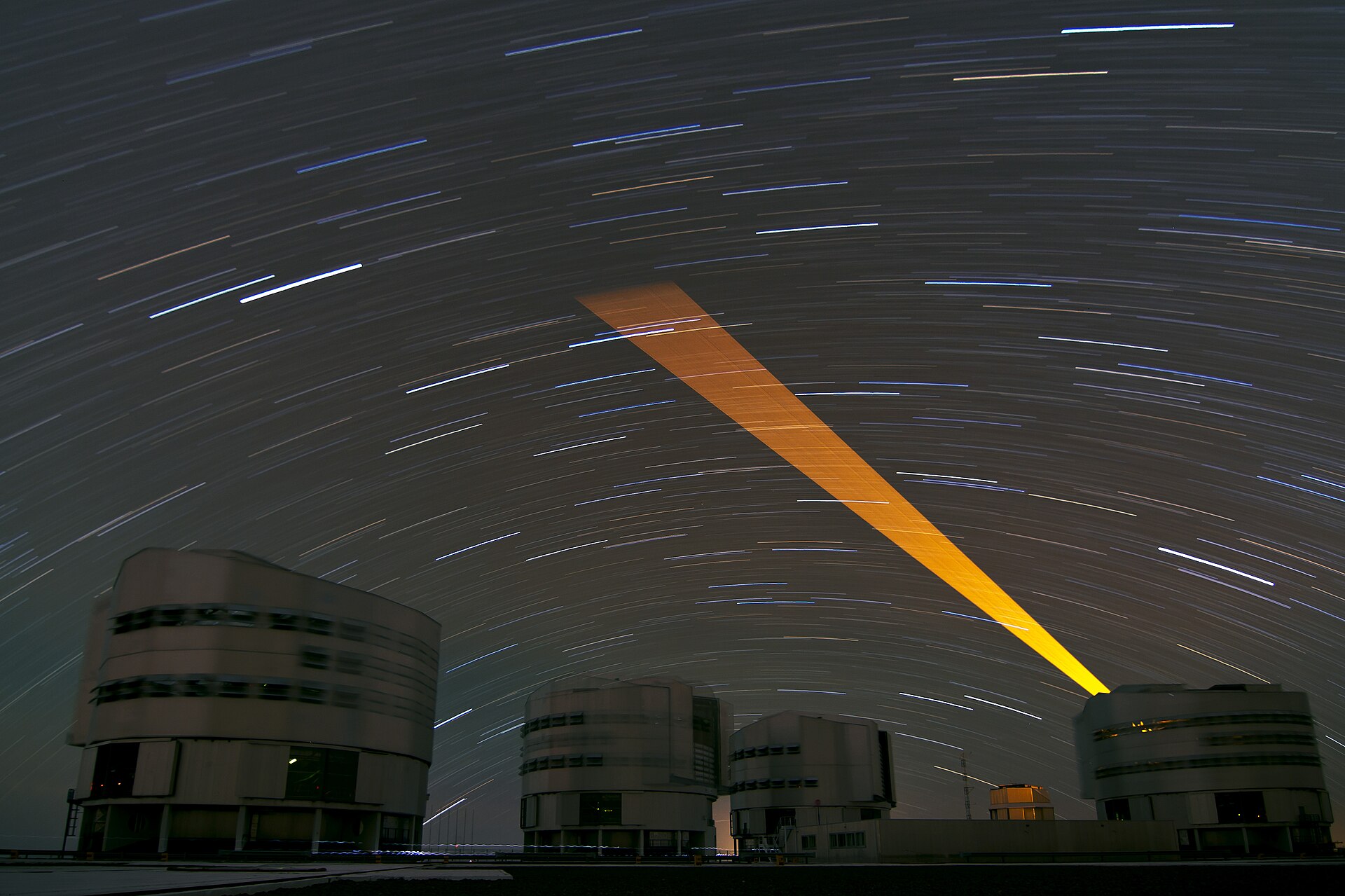
Professional telescopes use adaptive optics, first proposed by astronomer Horace Babcock in 1953. A sensor measures the distortion every few milliseconds and a flexible mirror changes shape to cancel it, sometimes guided by an artificial star made with a laser. The other fix is to leave the air behind entirely, which is what the Hubble Space Telescope does.
The horizon plays a different trick on the Moon, which only looks bigger there, as our piece on the Moon illusion before the November 24 supermoon explains. Sirius rises in the east on winter evenings, which makes it the easiest star to watch twinkle in color this season.
Sources
- Twinkling, Wikipedia, 2026
- Why do stars twinkle?, Hong Kong Observatory, undated
- APOD: Why Stars Twinkle, NASA Goddard Space Flight Center and Michigan Tech, 2000
- Astronomical seeing, Wikipedia, 2026
- Adaptive optics, Wikipedia, 2026
Image: ESO/J. Girard, CC BY 3.0 via Wikimedia Commons
This article was produced with AI assistance and reviewed by our Editorial Desk. How we work.