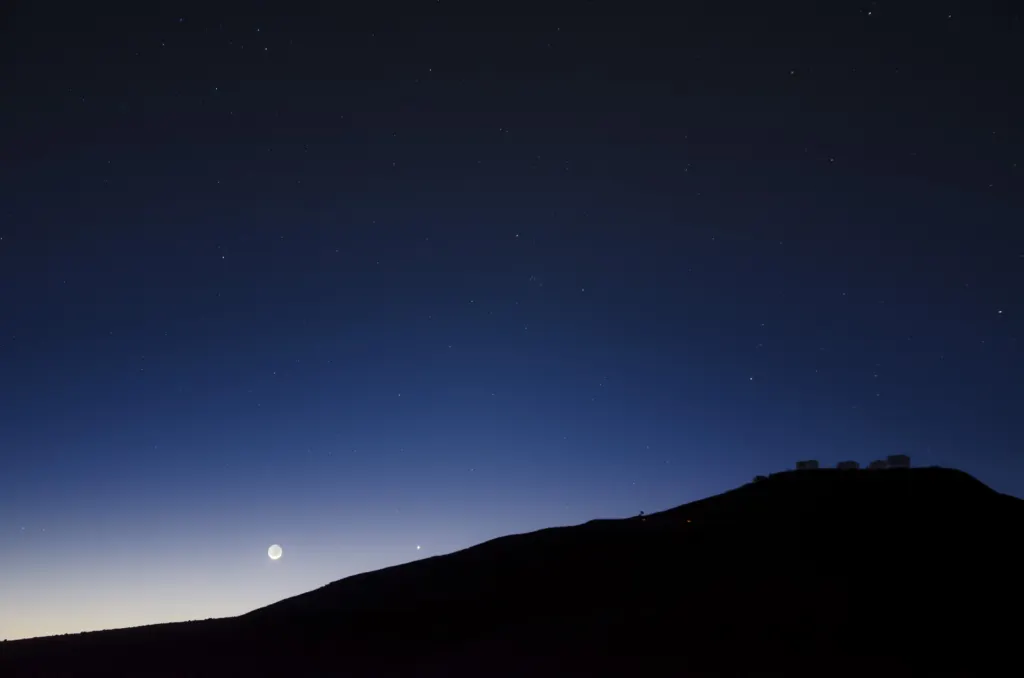
A rising full Moon can look enormous above rooftops, yet it is about 1.5% farther from you on the horizon than it is when high overhead, according to the Moon illusion entry. The swelling is in your head. Researchers who surveyed the problem put the apparent growth at roughly 50 percent in diameter, and the effect will be on show again when the November 24 full Moon rises in the east around sunset.
That evening’s Moon is also a supermoon, the first of three in a row through November, December and January, according to NASA’s What’s Up guide for November 2026. NASA’s own skywatching script warns that it may look even bigger near the horizon, and names the culprit: the Moon illusion. Our earlier piece on the November 24 supermoon and the run of three covers the orbital side of the story; this one covers the brain side.
How to prove it is an illusion
The test needs nothing but a small stone. Hold a pebble about 8.4 millimeters wide at arm’s length, around 64 centimeters from one open eye, and slide it over the Moon when it rides high. Repeat the trick when the Moon sits fat and low on the skyline. The same pebble covers it both times.
Instruments agree. A theodolite measures the same angular width at any height, and photographs taken at different elevations show a disk of the same size. The real changes come from the Moon’s oval orbit: across different full Moons its apparent width ranges from 29.43 arcminutes at its farthest to 33.5 arcminutes at its closest.
Put the two numbers side by side and the trick looks even stranger. The physical gap between the smallest and largest full Moons is around 14 percent in diameter, while the perceived boost on the horizon is about 50 percent, more than three times the real swing that gives a supermoon its name.
Why the brain inflates the horizon Moon
There is no agreed answer. In their 2002 book The Mystery of the Moon Illusion, Helen Ross and Cornelis Plug reviewed the competing explanations and concluded: “No single theory has emerged victorious.”
The explanation that turns up most often in textbooks is apparent distance. Near the horizon the Moon sits beyond a long stretch of land, trees and buildings, all cues that it is far away. Because its image on the retina stays the same size, the brain corrects for that assumed distance and decides the object must be larger. Lloyd Kaufman and Irvin Rock tested this in a long series of experiments in 1962 and found that changing distance cues changed the illusion, much like the Ponzo illusion with its converging rail lines.
A rival idea, relative size, points to context. Fine detail along the skyline makes the Moon look big by comparison, while an empty sky shrinks it, the same effect that makes a circle ringed by small dots look larger than one ringed by big ones.
The puzzle is old. Ptolemy blamed the atmosphere, and Ibn al-Haytham, writing his Book of Optics between 1011 and 1022, added the idea of intervening objects. By the 17th century the effect was generally treated as psychological. Immanuel Kant wrote in 1781 that “the astronomer cannot prevent himself from seeing the moon larger at its rising than some time afterwards, although he is not deceived by this illusion”.
Limits of the explanations
The apparent distance theory has a snag. Only about 5% of people say the horizon Moon looks both larger and farther away; roughly 90% say it looks larger and closer. Some researchers argue that people simply know the Moon cannot have moved, and that this knowledge colors their answer.
Looking at the low Moon upside down, through your legs, does shrink it noticeably, though that may be because the image is inverted. Raising your eyes or tilting your head has only a small effect.
For a quick experiment, watch the November 24 moonrise, keep a pebble in your pocket, and check it again a few hours later when the Moon is high. For more sky dates this season, see our guide to the Orionid meteors and October’s Hunter’s Moon.
Further reading
- Wikipedia: Moon illusion
- Wikipedia: Ponzo illusion
- Kaufman and Kaufman, Explaining the moon illusion (PNAS, 2000)
Image: G. Lambert/ESO, CC BY 4.0 via Wikimedia Commons
This article was produced with AI assistance and reviewed by our Editorial Desk. How we work.