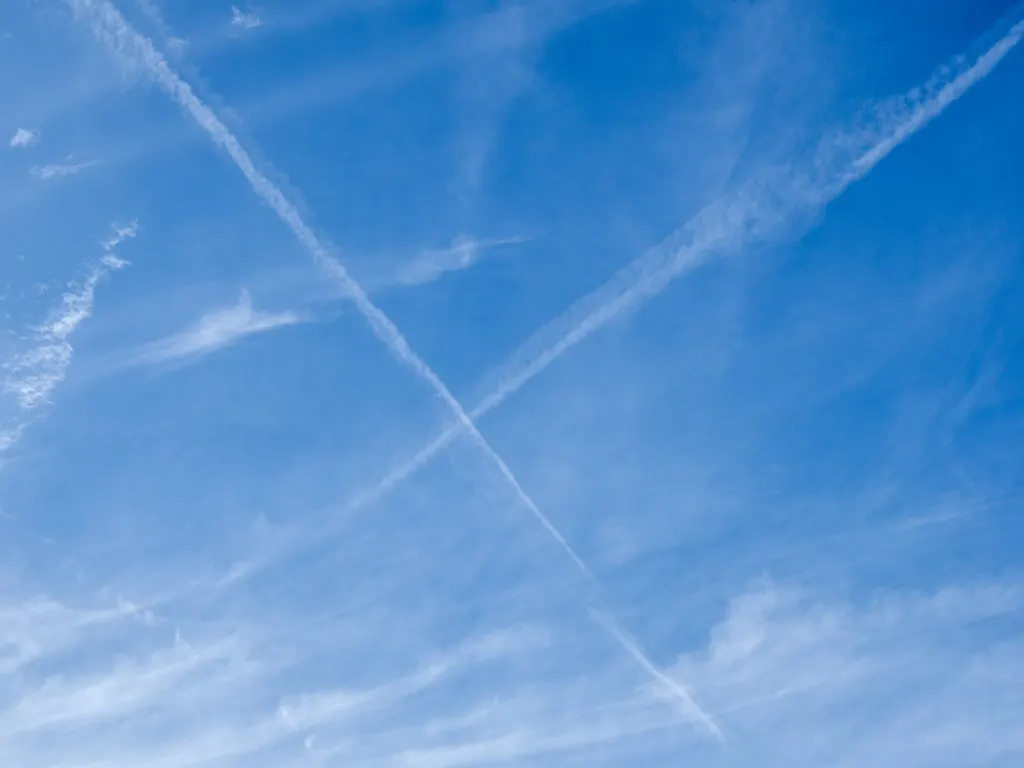
A jet can paint a white line across the sky that lasts for hours, or none at all, and a few degrees of air temperature decide which one you get. Contrails, short for condensation trails, usually form above 26,000 feet where the air sits below minus 34°F (minus 36.5°C). Below that altitude the same engine, burning the same fuel, leaves nothing behind.
The trail is made of ice. Jet exhaust is mostly water vapor and carbon dioxide, and when that hot, wet plume meets very cold air, the local humidity shoots past saturation. The vapor condenses into droplets that freeze into crystals. Formally, the cloud type is classed with cirrus and gets the name homogenitus, meaning a cloud made by people.
Why a trail starts a short way behind the plane
Look closely at a high jet and the white line begins some distance behind the engines. That gap is cooling time: the exhaust needs a moment to drop to the temperature at which vapor can condense. Supercooled vapor also needs something to condense onto, and the exhaust supplies it. Soot and sulfur compounds in jet fuel, about 0.05% by weight, act as the seeds that water grabs onto.
Not every white line comes from exhaust. Falling air pressure can do the same job. Propeller tips and wingtips spin up vortices where pressure drops, and the thin curling streamers from a propeller tip on a humid day are condensation of exactly that kind.
Minutes or hours: what decides
Humidity at cruising altitude settles how long the line survives. In dry air the ice crystals turn straight back into vapor and the trail fades in seconds. In air already close to ice saturation, they persist and spread sideways, sometimes miles wide, until they pass for natural cirrus. Meteorologists call those spread-out versions homomutatus.
So the next clear-sky question answers itself: a quick stub of a trail means dry air up high, while a sky crosshatched with lines that stay put means the upper air is damp. Pilots and forecasters read it the same way.
The climate side
Persistent contrails matter beyond looks. They trap more outgoing heat from the Earth than they reflect from incoming sunlight, which gives a net warming of roughly 0.03 to 0.06 watts per square meter. Their effect also depends on the hour, lowering daytime temperatures and raising nighttime ones. Most of the heating is concentrated over Europe, North America and the North Atlantic; flights over East Asia often cross warmer air that does not form trails at all.
When air traffic collapsed in 2020, researchers found no significant change in the annual global figure, because reduced summer cooling offset reduced warming in spring and fall. Some land regions did cool measurably, by up to 0.2 K below what baseline aviation would have produced.
Since 2025 the European Union has required contrail warming to be monitored. One proposed fix is to reroute a small share of flights, often just a slight change of altitude, around the damp patches where trails persist. A joint study by several German research institutes in November 2025 concluded that the climate effects cannot yet be pinned down well enough to justify rerouting strategies.
The trail that became a missile
A contrail from a plane flying straight at you can look like an object climbing vertically. On November 8, 2010, one over California was widely reported as a mystery missile, and it took more than a day for the contrail explanation to be accepted.
There is also the opposite phenomenon. Fly a jet through a thin cloud layer and the warm exhaust and churned air can evaporate the droplets in its path, cutting a clear lane through the cloud. That is a distrail, short for dissipation trail.
Our guide to telling a Taurid fireball from a contrail covers the night-sky version of the same puzzle, and more sky and atmosphere stories sit in our Science section. The EU’s coordinated European research effort on non-carbon aviation effects runs to 2027.
Further reading
Image: David Ratledge, CC BY 4.0 via Wikimedia Commons
This article was produced with AI assistance and reviewed by our Editorial Desk. How we work.