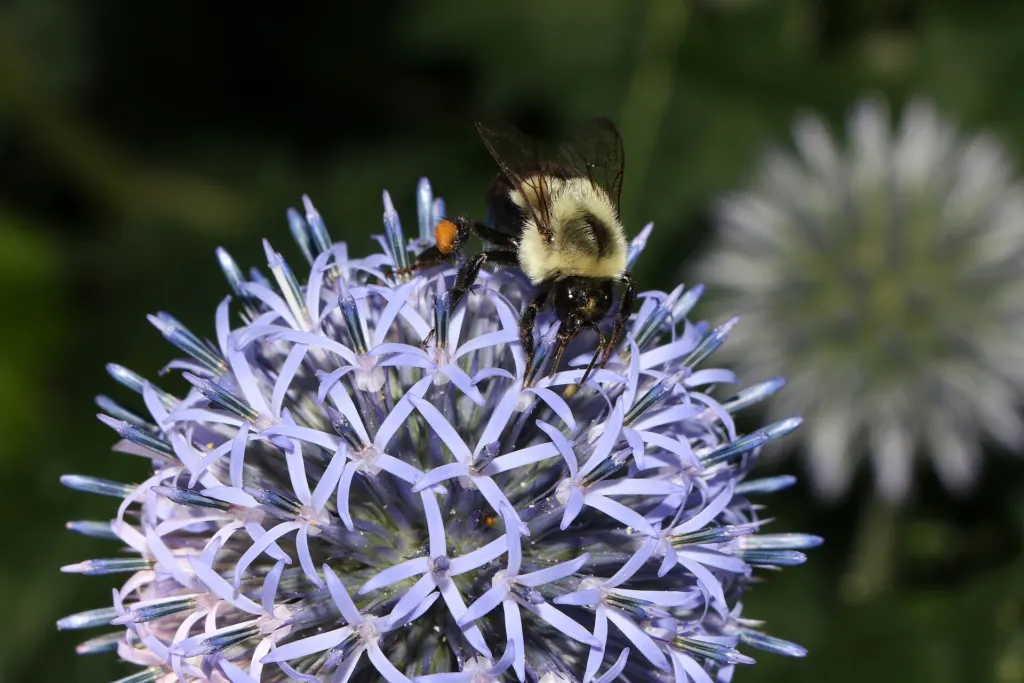
A bumblebee shaking pollen out of a flower hums at roughly 270 vibrations per second, a pitch close to the C-sharp just above middle C on a piano. That average comes from recordings of more than 350 foraging bumblebees made by Harvard researcher Callin Switzer.
Switzer, then a graduate student in Stacey Combes’s lab at Harvard University, spent over a month in the summer of 2013 at the Arnold Arboretum in Boston, holding a microphone a few centimeters from bees at work. He reported the results in an article for the arboretum’s journal, Arnoldia, in 2014.
Two different hums
The buzz you hear as a bumblebee flies past is not the one Switzer was chasing. In flight, the bees beat their wings at about 190 cycles per second, which sounds like the F-sharp below middle C. The flower buzz is different: the bee folds its wings flat over its abdomen, unhooking them from the flight muscles, and then fires those muscles anyway.
Those muscles are anchored to the walls of the thorax, not the wings. One set squeezes the top and bottom together, the other squeezes front to back, and the thorax flexes rapidly while the wings stay still. Switzer wrote that the flexing usually runs faster than in flight, and one bumblebee species has been measured buzzing at accelerations nearly 20 times the pull of gravity.
How the bees were recorded
Most of the work happened in the arboretum’s Leventritt Shrub and Vine Garden. Switzer recorded each bee flying, then buzzing on a flower, then, after catching it in a net and jostling it, making an annoyed defensive buzz. A Fast Fourier Transform, a standard way to pull frequencies out of a sound, turned each clip into a number.
The bees made it easy. They ignored the microphone and tended to return to the same flowers, so a startled bee usually came back. Out of nearly 400 bumblebees, 375 were common eastern bumblebees, about 95 percent.
Why the note matters
The technique is called buzz pollination, or sonication. Many flowers keep their pollen sealed in tube-shaped anthers that open only through a tiny pore, and the vibration shakes it out. About 9 percent of the world’s flowers depend mainly on this method, according to the reference summary of buzz pollination.
Blueberries, cranberries, tomatoes and eggplants are among them, and honeybees cannot do it. That is why greenhouse tomato growers bring in bumblebee colonies, up to 50 per hectare during the growing season.
Here is how close the bees come to the note. A tuned C-sharp above middle C sits at about 277.2 Hz. A 270 Hz buzz is around 45 cents flat, roughly a quarter of a semitone, so a musician would hear it as a slightly flat C-sharp. Their flower buzz is also about 1.4 times their wingbeat rate.
The limits
The 270 Hz figure is an average, not a fixed note. Switzer found individual bees could raise their buzz by at least 90 Hz without opening their wings. Humidity and time of year had the biggest effect: buzzes ran higher in humid weather and early in summer, while bee size, temperature and time of day mattered less.
He also cautioned that differences between plant species might come from the plants flowering at different times under uncontrolled humidity, and that more controlled experiments were needed. Nearly all the bees were one species in one garden.
Bees have turned up in Badiyaa’s science coverage before, in a Cornell trial where fewer sheep on solar farms meant more bees. For another case of sound made visible, see the Rubens tube that turns a jazz solo into flames.
The open question Switzer left: whether different flowers need different buzz frequencies to release the most pollen.
Further reading
Image: ImagePerson, CC BY 4.0 via Wikimedia Commons
This article was produced with AI assistance and reviewed by our Editorial Desk. How we work.