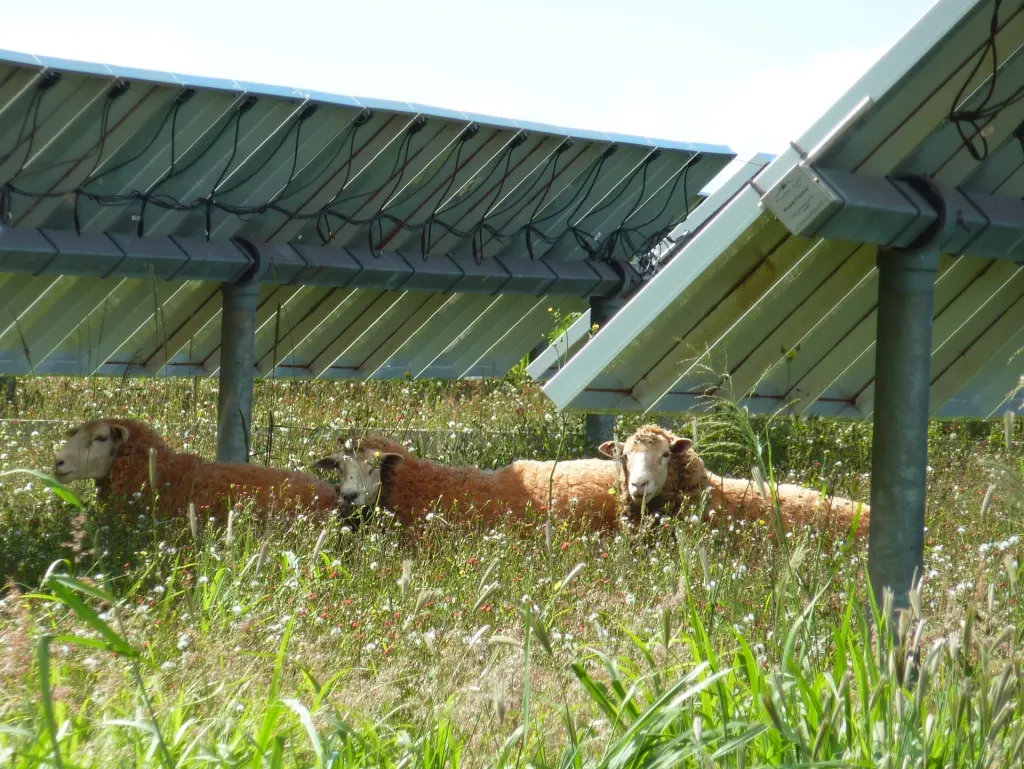
Grazing about 0.8 sheep per acre (2 per hectare) around solar panels lifted the number of bees and lady beetles by 38% compared with plots that were not grazed, a three-year Cornell University experiment has found. Most of that gain came from honey bees, which rose 83%. The result matters because solar farms are spreading onto farmland, and site owners have to pick how hard to graze the grass between the rows.
The team, led by postdoctoral researcher Leana Zoller and ecologist Steven Grodsky, who also works with the U.S. Geological Survey, reported the work in “Low solar grazing densities support beneficial insects in agrivoltaic systems”, posted as an accepted manuscript in Environmental Research Letters on October 7, 2026. Agrivoltaics means using the same land for solar power and farming at once.
How Cornell tested 6 stocking rates on an 18-megawatt site
The trial ran at the Cascadilla Community Solar Farm in Dryden, New York, an 18-megawatt array owned by the university. Using Cornell’s teaching flock, the researchers compared six stocking rates, from no sheep at all to 10 sheep per hectare (about 4 per acre). Stocking rate is simply how many animals graze a given patch of land. They sampled bees and lady beetles over three years and four grazing rotations each year. Bees pollinate crops; lady beetles eat aphids.
The full picture was mixed:
- At 2 sheep per hectare, beneficial insect abundance was 38% higher than the ungrazed control, and flock health was high.
- At 4 per hectare (about 1.6 per acre), insect numbers were statistically no different from the control, but the sheep kept the vegetation down better than at 2.
- At 8 or more per hectare, grass control was at its best, yet bee abundance fell by 42% to 68% and the mix of insect species shifted.
That last row is the trade-off the authors highlight. A companion study had named 8 sheep per hectare as the best rate for managing vegetation. This one puts the ecological sweet spot at 2. “We zeroed in on stocking rates because that’s a concrete number that sheep farmers understand and work with every day,” Grodsky said in a university statement. The 4-per-hectare middle setting is the closest thing to a compromise: no measurable loss of insects, with better mowing-by-mouth.
What the numbers mean on a 20-acre solar site
For a sense of scale, take a hypothetical 20-acre (8.1-hectare) array. At the insect-friendly rate of 2 per hectare, that site would carry about 16 sheep; at 4 per hectare, about 32; and at the vegetation-control optimum of 8, about 65. A grazier choosing the lightest rate may therefore need to fill the gap with some mowing, which is exactly the cost the second Cornell paper tries to model.
That paper, “Flock Management for Solar Grazing” by Vincent Slaugh, Linwei Xin and Shane Henderson, appeared on September 28, 2026, in Manufacturing & Service Operations Management. It treats a flock as a population with births, deaths and sales, and works out whether a farmer building up to a target size should breed sheep or buy them. In steady state, the model’s best plan keeps ewes up to a maximum age and sells only lambs and final-year ewes. The authors say a spreadsheet version has helped dozens of farmers plan purchases, forecast cash flow and in some cases secure loans to buy a flock.
Slaugh sees a wider market effect: about half the lamb and mutton eaten in the United States is imported, mainly from New Zealand and Australia. Nikola Kochendoerfer, a co-author on the insect paper who grazes 700 ewes on solar sites in New York and Vermont, put the economics plainly: “With solar grazing, you get paid to graze as opposed to having to pay to graze.”
Limits: one 18-megawatt site and one region
The insect result comes from a single facility in upstate New York, and the authors themselves describe 2 sheep per hectare as the optimum “in our study region”. Soils, plant mixes and native bee species differ in Texas or Arizona. The paper is still an accepted manuscript rather than the final typeset version. It counted insects, not pollination delivered to nearby crops or honey yields, and the comparison was with ungrazed plots, not with a sown wildflower meadow.
A larger field survey points the same way on soil, though it measured different things. Researchers from the American Solar Grazing Association and American Farmland Trust sampled 28 grazed and 3 ungrazed solar sites in New York, Pennsylvania, Connecticut and Massachusetts from 2022 to 2024. Organic matter, soil protein and active carbon were all significantly higher where sheep grazed, while overall pasture condition scores did not change over the study period. That paper also found grazing costs could fall to roughly the level of mowing, but only with long-term contracts. It counted roughly 113,050 sheep on 129,000 acres (about 52,000 hectares) at more than 500 US solar sites in 2024, about 7% to 11% of installed solar capacity.
For farmers, the practical takeaway from the Cornell trial is a range rather than a single figure: 2 to 4 sheep per hectare (0.8 to 1.6 per acre) if bees are a goal, and 8 if the contract is judged purely on grass height.
Further reading
- Low solar grazing densities support beneficial insects in agrivoltaic systems (Environmental Research Letters, 2026)
- Flock Management for Solar Grazing (Manufacturing & Service Operations Management, 2026)
- Cornell Chronicle: Sheep grazing in solar fields offers farmers economic, ecological gains
- Sheep grazing as sustainable vegetation management for solar energy production in the northeastern USA (2025)
Image: Merrill Smith, U.S. Department of Energy, Public domain via Wikimedia Commons
This article was produced with AI assistance and reviewed by our Editorial Desk. How we work.