A virtual Earth with every living thing deleted still ends up looking a lot like the real one. University of Washington astronomers ran a lifeless copy of our planet forward for 5 billion years, and the simulation matched 19 measured properties of the pre-industrial Earth, from the heat leaking through the mantle to the state of the atmosphere, all without a single microbe, plant or animal in the code.
The model, described in a paper announced by the university on Monday, November 2 and published September 18 in The Planetary Science Journal, is built to answer an awkward question: if a distant world looks habitable, how would anyone know whether it is actually inhabited?
How the lifeless Earth was built
Lead author Samantha Gilbert-Janizek did the work as a UW astronomy doctoral student and has since moved to a postdoc at UC Riverside. Her starting point was an older code from the group of senior author Rory Barnes, an associate professor in the same department. That version tracked the core, mantle, crust and the host star’s radiation, then stopped at the surface. Gilbert-Janizek bolted on the missing pieces: the surface and the atmosphere, and the flow of chemicals between all of them.
The team’s paper describes the result as a coupled interior-atmosphere evolution model that runs from 50 million years after the planet formed out to 5 billion years, which is the real Earth’s 4.5-billion-year history plus roughly 500 million years of its future. At the 4.5-billion-year mark, the output was checked against 19 observed properties of the pre-industrial Earth and landed inside the estimated measurement uncertainties on all of them. The group also produced a reflected-light spectrum of this dead Earth, spanning the wavelengths that the proposed Habitable Worlds Observatory could one day cover. The research was funded by NASA.
Why a planet with no life matters
The exoplanet count passed 6,000 some time ago, and the next step is sniffing the atmospheres of the best candidates for gases that life might produce. The catch is that geology and starlight can produce many of the same gases. On Earth, living things pump out both oxygen and methane, two gases that destroy each other when mixed, so an alien astronomer might guess that something keeps topping both up. But oxygen alone can build up through non-biological routes, which is why a biosignature is formally defined as a phenomenon that can only be explained by biology once every plausible abiotic cause has been ruled out.
That is where a lifeless Earth earns its keep. Feed a real exoplanet’s bulk properties into the model and ask whether the atmosphere astronomers see can be reproduced with no life at all. A match means geology is enough. A mismatch is the interesting case.
“This model can help us see how habitable but non-living planets might mimic living planets,” Gilbert-Janizek said in the university’s announcement. Barnes said it took more than a decade and many hands before one version of the model could reproduce the core, mantle, surface and atmosphere together, and that this calibration is what gives him confidence in future exoplanet runs.
The paper’s own wording on the big-picture result is careful: the findings suggest life may not be required to keep a planet’s surface habitable over the long term. Put plainly, a world does not seem to need a biosphere to stay a world worth looking at.
The limits
A model that matches Earth is still a model of one planet. The authors describe it as a first step and say the main payoff is an abiotic baseline for reading future biosignature observations, not a verdict on any particular exoplanet. The telescope it is designed for, the Habitable Worlds Observatory, is still a proposal, and Gilbert-Janizek herself said realizing its goals requires decades of work across generations of scientists. The 19 checked properties are also compared at a single moment, the pre-industrial Earth, rather than across the planet’s whole history.
The team’s own timeline shows how slow this kind of science is: a preprint of the paper appeared in February, a revised version followed on August 24, the journal published it on September 18, and the university announced it on November 2. Two more former UW doctoral students share the byline: Jessica Birky, who has since moved to a postdoc at the University of Oklahoma, and Rodolfo Garcia, who now teaches high school near Seattle.
Further reading
- UW News: UW scientists build whole-Earth simulation to help find life on other planets
- Paper (arXiv/DOI): A whole-planet model of the Earth without life for terrestrial exoplanet studies
- Wikipedia: Biosignature
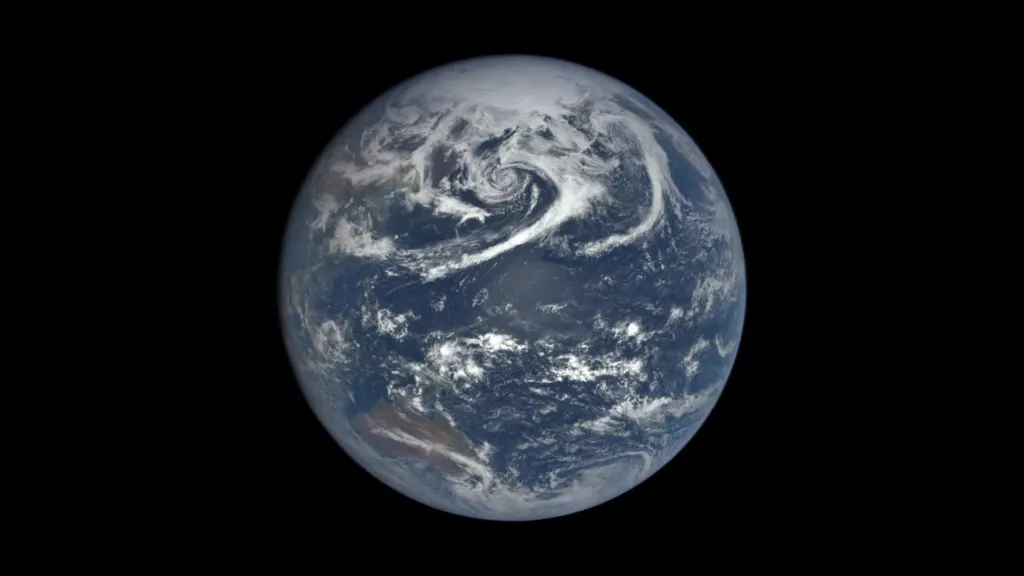
Image: NASA Goddard Space Flight Center, Public domain via Wikimedia Commons
This article was produced with AI assistance and reviewed by our Editorial Desk. How we work.