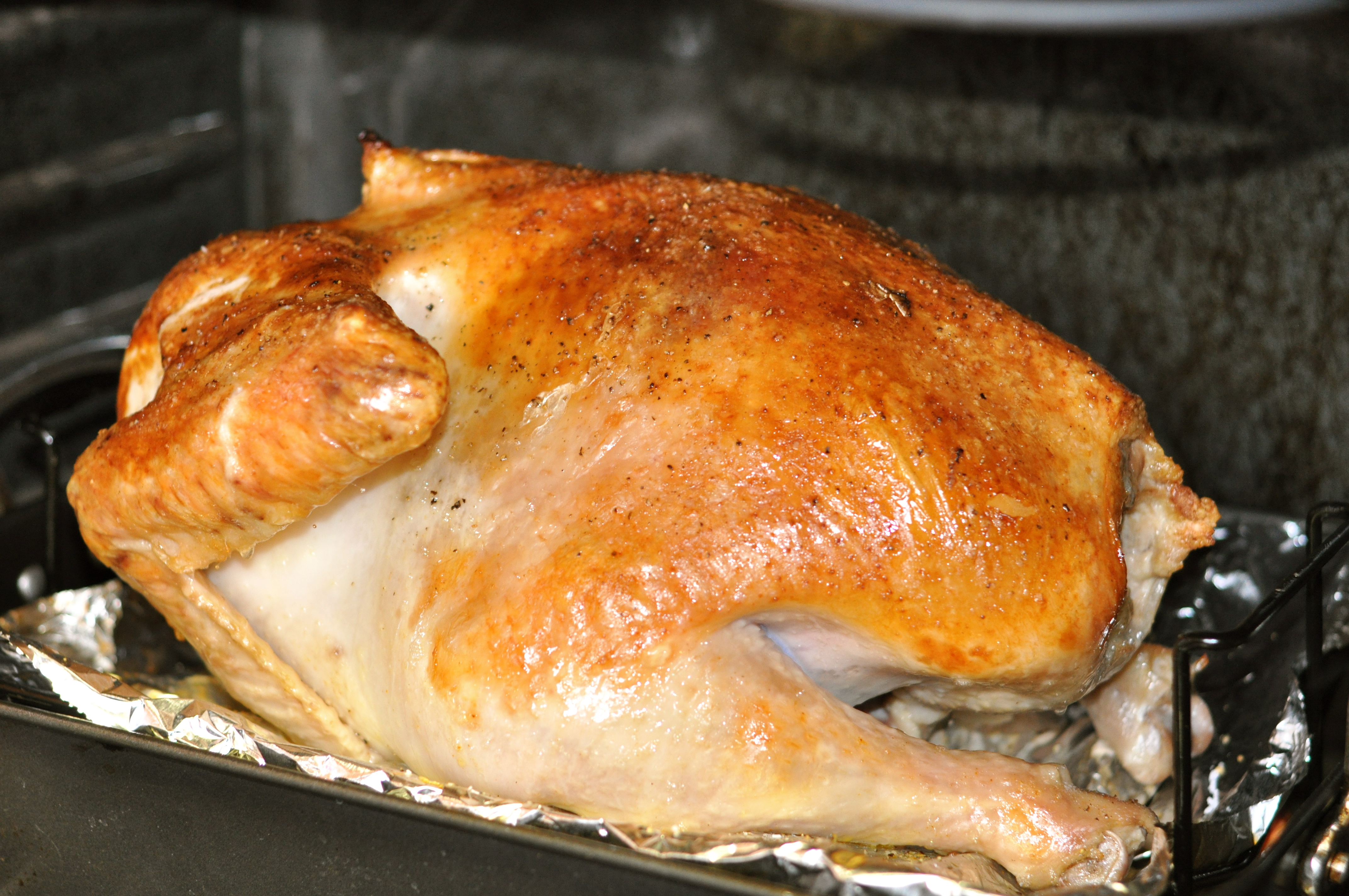
The golden-brown skin on Thursday's Thanksgiving turkey is a chemistry experiment more than a century old. It is the Maillard reaction, a chain of reactions between sugars and amino acids that French chemist Louis Camille Maillard first described in 1912, and it kicks in fast once food surfaces reach about 280 to 330 degrees Fahrenheit.
That temperature window, roughly 140 to 165 degrees Celsius, comes from Wikipedia's article on the Maillard reaction, which credits it with the flavor of seared steak, toasted marshmallows, bread crusts and roasted coffee.
What actually happens on the turkey skin
The reaction starts when a reactive part of a sugar molecule, its carbonyl group, grabs the amino group of an amino acid. The result is unstable and rearranges itself into compounds called ketosamines. From there the chemistry branches out in many directions at once.
Some pathways throw off small, aromatic molecules that give roasted food its smell. Others link up into large brown polymers called melanoidins, which supply the color. Depending on the food, the heat and the cooking time, the reaction can produce hundreds of different flavor compounds, and many of those break down into still more.
Water is the enemy here. Boiling food tops out at 212 degrees Fahrenheit, far below the Maillard range, which is why a boiled turkey stays pale while a roasted one turns bronze. A University of Illinois Extension explainer makes the same point with potatoes: roasting browns them, while boiling or steaming leaves too much water in the food for the reaction to take off. Badiyaa's rule of thumb: the reaction needs a dry surface roughly 70 to 120 degrees Fahrenheit hotter than boiling water.
A doctor's side project
Maillard was not chasing flavor. Born in Pont-à-Mousson, France, in 1878, he trained in medicine at Nancy and made his name studying kidney disorders, according to Wikipedia's biography of Louis Camille Maillard. His 1912 work on amino acids and sugars began as an attempt to mimic how living things build proteins.
The step-by-step mechanism came four decades later. John E. Hodge, a chemist at the US Department of Agriculture, laid it out in his 1953 paper in the Journal of Agricultural and Food Chemistry on browning reactions, a study food scientists still lean on.
Not the same as caramel
Browning has a look-alike. Caramelization is what happens when sugar alone breaks down under heat, with no amino acids involved. Wikipedia's caramelization article lists table sugar starting to caramelize at about 338 degrees Fahrenheit, while fructose starts at about 221 degrees. Both are forms of browning that do not need enzymes, but only the Maillard reaction needs protein building blocks.
The same slow chemistry turns up in odd places. In cold, acidic peat bogs, Maillard-type browning over centuries tans the skin and reddens the hair of preserved ancient bodies, the kind described in Wikipedia's article on bog bodies.
Limits of the kitchen science
Chemists still describe many Maillard products as poorly characterized, and roast meat browning also involves the breakdown of the muscle protein myoglobin, so the reaction is not the whole story. Exact results shift with acidity, moisture and timing.
For more holiday science from Badiyaa, read why onions make you cry because of one enzyme, how American Thanksgiving falls 45 days after Canada's, and how espresso traces back to an 1884 steam patent in Turin.
Thanksgiving falls on Thursday, November 26, when millions of ovens will run the 1912 experiment again.
Sources
- Maillard reaction, Wikipedia, 2026
- Louis Camille Maillard, Wikipedia, 2026
- John E. Hodge, chemistry of browning reactions in model systems, Journal of Agricultural and Food Chemistry, 1953
- Maillard reactions change the tastes of your food, University of Illinois Extension, 2021
- Caramelization, Wikipedia, 2026
- Bog body, Wikipedia, 2026
Image: Kimberly Vardeman, CC BY 2.0 via Wikimedia Commons
This article was produced with AI assistance and reviewed by our Editorial Desk. How we work.