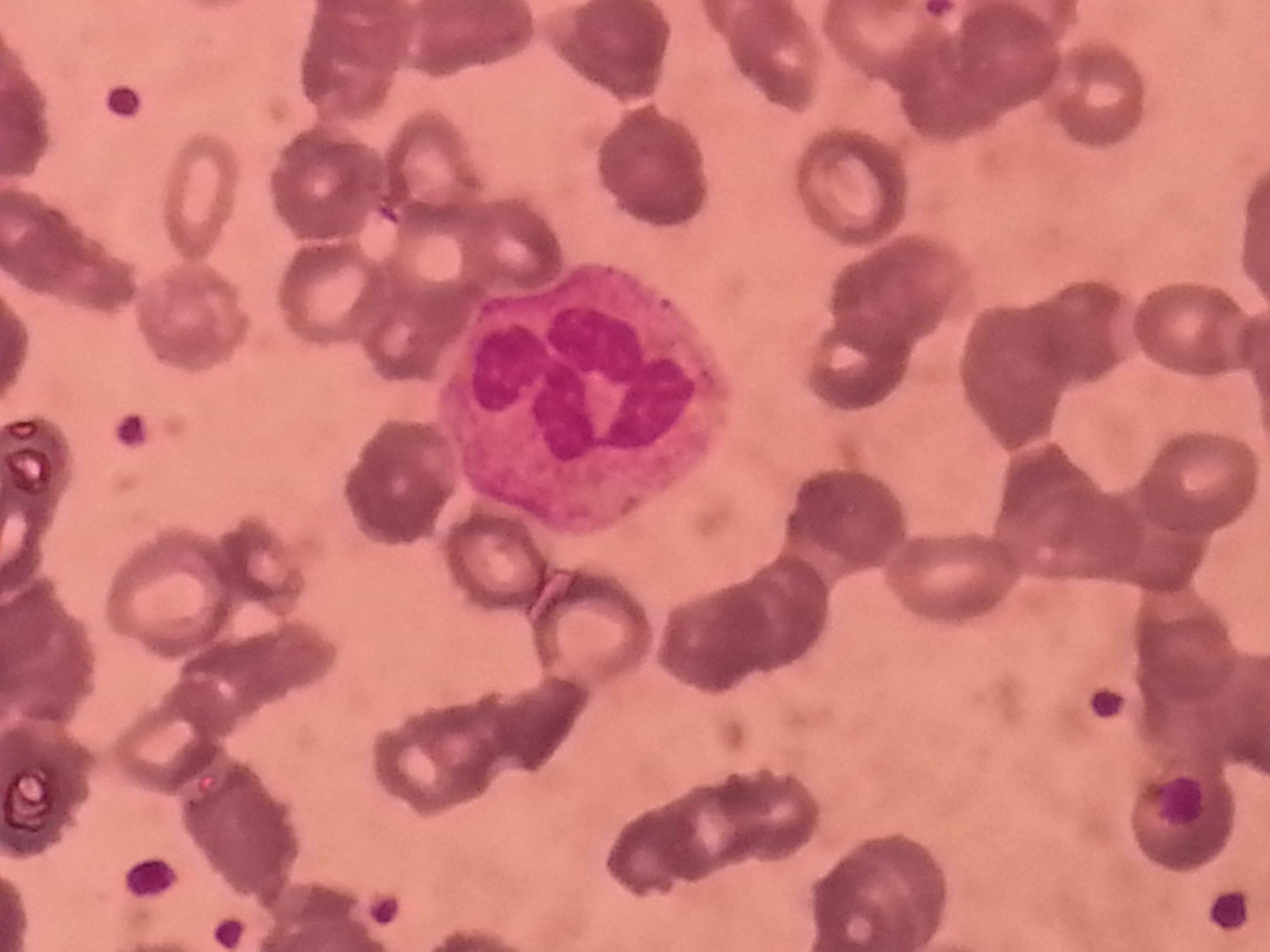
Every drop of human blood owes its color to a single atom of iron, repeated billions of times over. Iron sits at the heart of the heme groups in hemoglobin, the protein packed into red blood cells, and when oxygen latches on, that heme glows bright red.
Strip the water out of a red blood cell and roughly 96% of what remains is hemoglobin, according to Wikipedia's hemoglobin article. Each molecule carries four heme groups, and each heme is an iron ion held in the middle of a ring-shaped molecule called a porphyrin. That iron is where oxygen binds.
Bright red, dark red, never blue
Hemoglobin soaks up different wavelengths of light depending on whether it is carrying oxygen. Wikipedia's article on blood explains that blood in arteries and capillaries is bright red because oxygen gives the heme group a strong red color, while blood returning in veins is a deeper, darker red.
The numbers behind that shift are modest. Hemoglobin leaving the lungs of a resting adult is about 98% to 99% loaded with oxygen, and blood coming back to the lungs is still roughly 75% saturated. So even "used" blood keeps about three quarters of its oxygen, which helps explain why it stays red rather than turning some dramatically different color.
Why your veins look blue anyway
If blood is always red, the blue lines on the inside of your wrist need another explanation. A team of seven physicists tackled exactly that in a 1996 Applied Optics paper titled "Why do veins appear blue? A new look at an old question".
The short version: skin and tissue scatter and absorb red and blue light differently, and the brain judges color by comparing a vein with the skin around it. Wikipedia's blood article sums up the consensus that the blue look comes from light scattering in skin and from how the visual cortex processes the scene, not from the color of the blood inside.
Other animals, other colors
Red is not the only option nature has tried. Octopuses, crabs and spiders carry oxygen with hemocyanin, a protein built around two copper atoms instead of iron. Wikipedia's hemocyanin article notes it turns blue when it carries oxygen and goes colorless without it. The protein was first found in the common octopus in 1878.
Some lizards break the rules in a different way. A 2018 study in Science Advances by researchers at Louisiana State University and the American Museum of Natural History found that green blood evolved several separate times in New Guinea skinks. Their blood still uses hemoglobin, but it is flooded with biliverdin, a green waste pigment that most animals clear away.
Here is the Badiyaa comparison in one line: iron-based hemoglobin makes blood red, copper-based hemocyanin makes it blue, and a buildup of green bile pigment can drown out the red entirely.
Limits of the simple answer
"Iron makes blood red" is a handy shortcut, but it is not the whole story. The exact shade depends on what is bound to the heme, and the same iron-containing heme shows up in other proteins too. Almost every vertebrate uses hemoglobin, but the icefish family Channichthyidae has none at all, so its blood is not red.
Color in living things often comes from blood showing through skin. Badiyaa has looked at the bald uakari, whose red face comes from blood vessels rather than pigment, and at lobsters, which keep growing for life. For a different kind of color science, read why the sky looks blue because air scatters blue sunlight.
The structure of hemoglobin itself was worked out by Max Perutz in 1959, work that earned him a share of the 1962 Nobel Prize in Chemistry.
Sources
- Hemoglobin, Wikipedia, 2026
- Blood, Wikipedia, 2026
- Kienle and colleagues, why veins appear blue, Applied Optics, 1996
- Hemocyanin, Wikipedia, 2026
- Multiple origins of green blood in New Guinea lizards (Rodriguez, Perkins and Austin), Science Advances, 2018
Image: Ajay Kumar Chaurasiya, CC BY-SA 4.0 via Wikimedia Commons
This article was produced with AI assistance and reviewed by our Editorial Desk. How we work.