A lobster never stops growing. Unlike people, who stop getting taller in their late teens, clawed lobsters keep molting and adding new muscle for as long as they live, and in the wild that can be an estimated 45 to 50 years.
That has earned them an internet reputation as “immortal.” They are not, but the real biology is almost as strange.
Old lobsters do not seem to slow down
Research suggests lobsters may not weaken, slow down or lose fertility as they get older, and older lobsters may even be more fertile than young ones. Scientists have pointed to an enzyme called telomerase as one possible reason.
Telomerase repairs telomeres, the repeating stretches of DNA that cap the ends of chromosomes. Most vertebrates use the enzyme as embryos and then largely switch it off in adulthood. Adult lobsters keep producing it in most of their tissues, and that has been suggested as a link to their long lives.
Age is hard to pin down, though. A lobster’s age is usually estimated from its size and other clues, because there is no simple ring or tooth to count, and newer techniques may sharpen those estimates.
The catch: growing gets dangerous
Lobsters wear their skeletons on the outside, so the only way to get bigger is to shed the old shell and build a new one. Every molt costs energy, and the bigger the lobster, the higher the bill. Between 10 and 15% of lobsters die of exhaustion during a molt.
The oldest, largest animals eventually stop molting altogether. Their worn-out shell then breaks down or collapses, and the lobster dies. In other words, the very trait that makes lobsters seem ageless, endless growth, is also what sets the limit on their lives.
A rough way to see the risk: if one lobster in eight dies each time it molts, a midpoint between 10 and 15%, then only about 59% of lobsters would come through four such molts in a row (0.875 multiplied by itself four times). Real odds vary with size and age, but the arithmetic shows why few lobsters ever reach giant proportions.
How big can they get
Some do. The largest lobster on record, caught in Nova Scotia, Canada, in 1977, weighed 20.15 kilograms, or 44.4 pounds. Most lobsters measure 25 to 50 centimeters (10 to 20 inches) and plod across the seabed, but when frightened they curl and flick their tails to shoot backward, a move clocked at 5 meters per second, about 11 mph.
They are odd in other ways too. Lobster blood is blue, because it carries oxygen with copper-based hemocyanin instead of iron-based hemoglobin. A lobster’s shell turns from brown to orange when cooked because heat breaks down a protein called crustacyanin that normally hides the orange pigment astaxanthin.
Size rules also shape the fishery. In the United States, federal law bars possessing American lobsters with a carapace shorter than 3 1/4 inches or longer than 5 inches, and egg-bearing females must be released, so the very biggest animals stay in the sea.
For more ocean oddities, read about the Humboldt squid that swarm in shoals of 1,200, the sand tiger shark embryos that eat their siblings in the womb, and why Chilean sea bass is not a bass at all.
Further reading
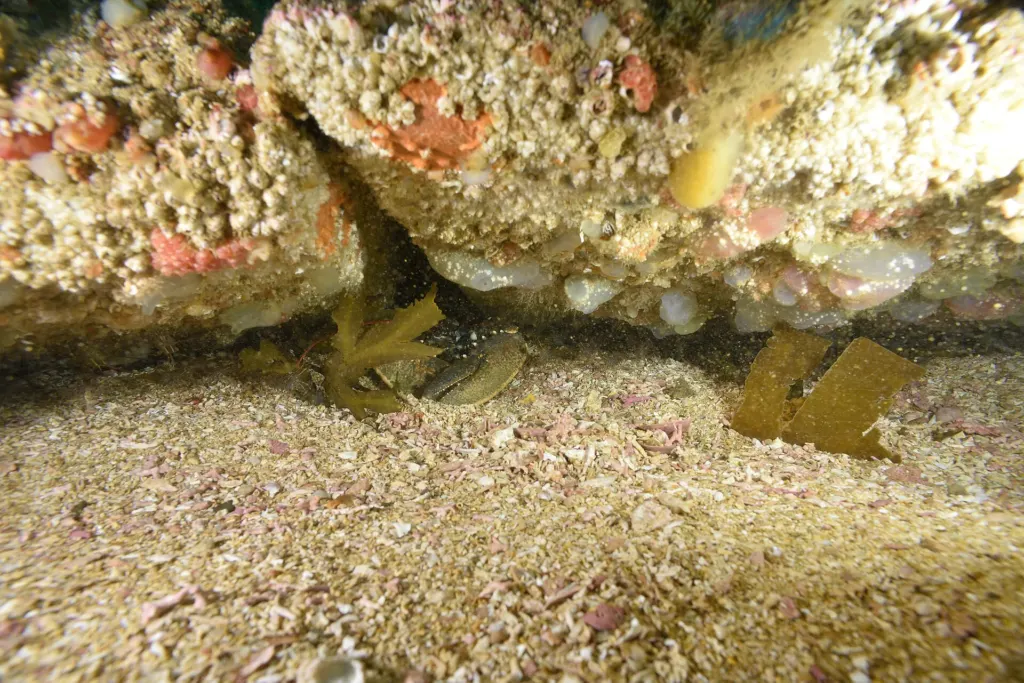
Image: Olivier Dugornay (Ifremer), CC BY 4.0 via Wikimedia Commons
This article was produced with AI assistance and reviewed by our Editorial Desk. How we work.