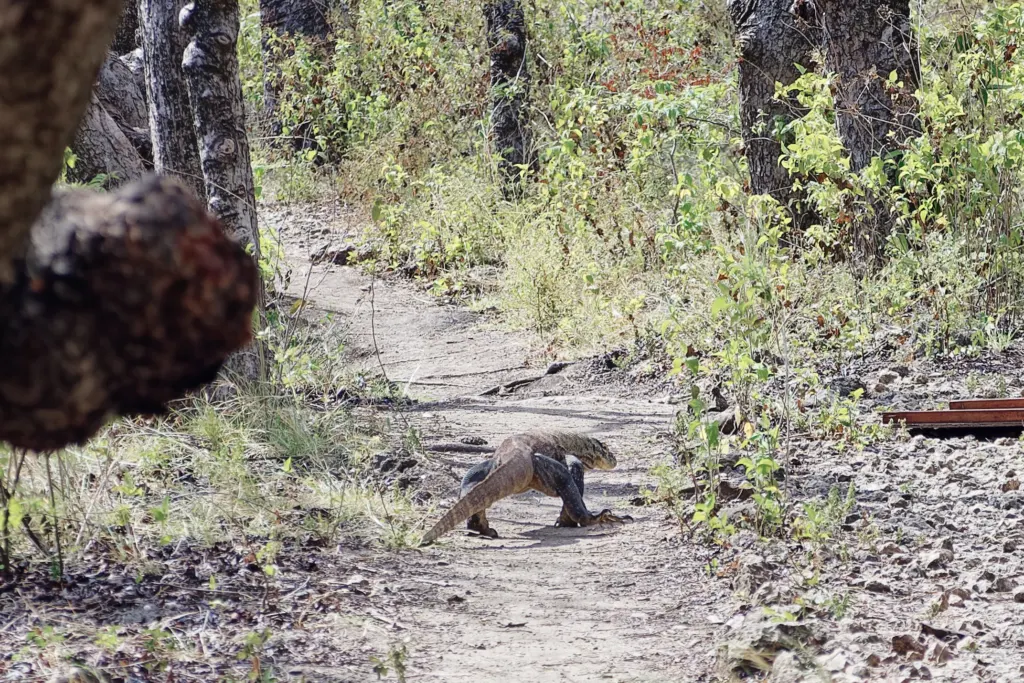
A female Komodo dragon does not always need a male to have babies. In 2006, Flora, a Komodo dragon at Chester Zoo in England that had never been in physical contact with a male, laid 11 eggs, and seven of them hatched. Every one of the hatchlings was male.
The process is called parthenogenesis, a kind of virgin birth, and it has since been documented in the world’s largest lizard on both sides of the Atlantic.
Three zoos, one surprise
The story began at London Zoo, where a female named Sungai laid a clutch in late 2005 after more than two years apart from any male. Keepers first assumed she had stored sperm from an earlier mating. Then Flora’s case came to light in December 2006. Geneticists at Liverpool University tested three of her eggs that had collapsed in an incubator and confirmed she had never mated. Follow-up tests showed Sungai’s eggs had also developed without a father.
The Americas recorded their first case in early 2008. At the Sedgwick County Zoo in Wichita, Kansas, a female laid about 17 eggs in May 2007; only two were incubated because of space limits, and both hatched as males on January 31 and February 1.
Why the babies are always boys
The answer lies in the sex chromosomes, which work the opposite way from ours. In mammals, females are XX and males XY. Komodo dragons use a ZW system: males are ZZ and females are ZW.
When a female reproduces alone, each egg receives just one of her two sex chromosomes, and that single set is then doubled. An egg that gets a Z becomes ZZ, which is male. An egg that gets a W becomes WW, which cannot develop at all. So a virgin mother can only ever produce sons.
Researchers think this may be a survival trick. A lone female washed onto an empty island could hatch sons, mate with them and found a mixed population. Zoos are warned, though, that relying on it would shrink genetic diversity.
The dragon in numbers
Komodo dragons live only on a handful of Indonesian islands, including Komodo, Rinca and Flores. Males can reach 3 meters (10 feet) and 150 kilograms, although wild adults usually weigh around 70 kilograms. They can sprint at up to 20 km/h, smell carrion from as far as 9.5 kilometers away with their forked tongues, and swap out their roughly 60 serrated teeth about every 40 days. A 2024 study found the cutting edges of those teeth are coated with orange, iron-rich enamel that helps keep them sharp.
A single meal can equal up to 80% of the lizard’s body mass. For a typical 70-kilogram wild adult, that works out to roughly 56 kilograms of food in one sitting, which helps explain how big dragons can get by on as few as 12 meals a year.
The species is listed as Endangered. Counts of wild dragons fell from 3,222 in 2013 to 3,014 in 2015, a loss of 208 animals, or about 6.5%, in two years, with the steepest drops on small islands where prey is running out.
For more on animals with surprising chemistry, read how slow lorises make venom from a gland on the arm and how mongooses carry a receptor that snake neurotoxins cannot grip. Another island oddity is the kagu, New Caledonia’s near-flightless ghost of the forest.
Further reading
Image: Jakub Hałun, CC BY 4.0 via Wikimedia Commons
This article was produced with AI assistance and reviewed by our Editorial Desk. How we work.