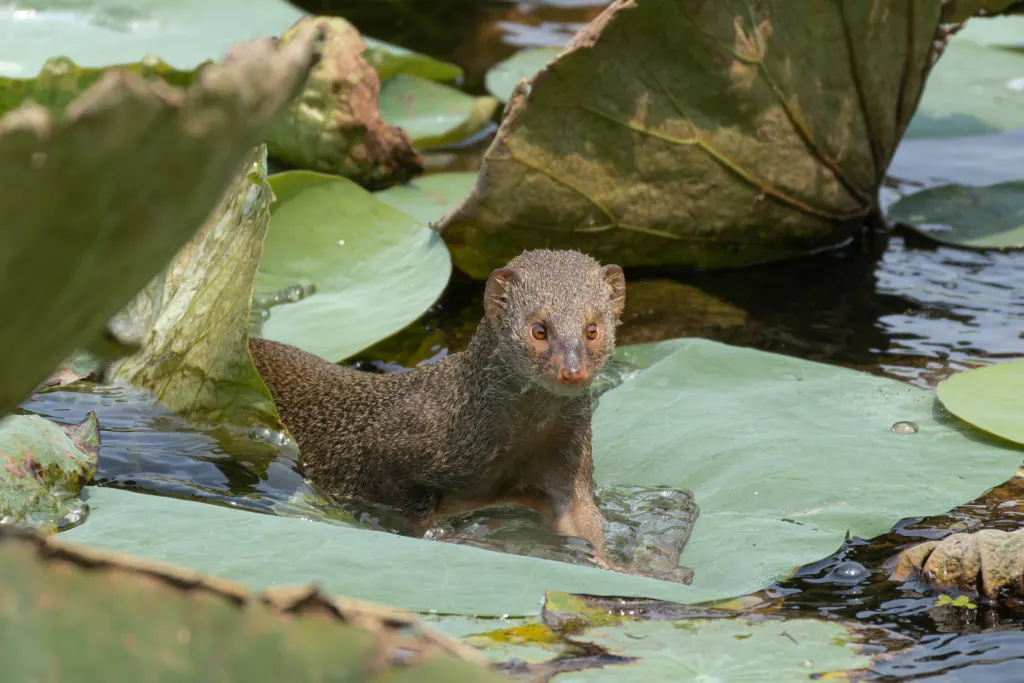
A mongoose facing a cobra is not just quick. Deep in its muscles it carries a molecular lock that a key family of snake toxins struggles to open, and researchers in Israel pinned down exactly how it works more than 30 years ago.
Clips of mongoose-versus-cobra standoffs have been climbing Reddit this week. Here is the science behind why the small mammal so often walks away.
Defense one: tire the snake out
The Indian grey mongoose, the species of Rudyard Kipling’s “Rikki-Tikki-Tavi,” weighs just 0.9 to 1.7 kilograms (2 to 4 pounds). Its main tactic is stamina. It baits the snake into striking again and again, dodging each lunge acrobatically until the snake tires.
It also has backup armor. When it squares off with a snake, its stiff, coarse hair stands on end, and its skin is thick and loose. Neither is a guarantee, which is why the third defense matters most.
Defense two: a receptor the venom cannot grip
Many elapid snakes, the group that includes cobras and kraits, rely on alpha-neurotoxins. These toxins latch onto the nicotinic acetylcholine receptor, the docking point that lets nerves tell muscles to move. Block it, and the muscles, including the ones used for breathing, stop responding.
In 1992 a team at the Weizmann Institute of Science in Rehovot, Israel, led by D. Barchan and S. Fuchs, published a study in the Proceedings of the National Academy of Sciences titled “How the mongoose can fight the snake.” They showed that the mongoose receptor “does not bind alpha-BTX in vivo or in vitro,” meaning alpha-bungarotoxin, a classic krait neurotoxin, failed to attach to it in living animals or in the lab.
The reason was a handful of swapped building blocks. The team cloned the relevant stretch of the mongoose receptor and compared it with the mouse version. The two were more than 90% identical, with just seven amino acid differences in the region. Five of those seven sat in the presumed binding site itself, clustered near a key pair of cysteines at positions 192 and 193.
That is the clever part: five of seven changes landed on the exact spot the toxin targets, the equivalent of changing the shape of a lock without touching the rest of the door. The receptor still does its normal job, because the residues needed to bind acetylcholine were left unchanged.
Borrowing a snake’s own trick
The researchers also found that the mongoose receptor, like the snake’s own, carries a potential glycosylation site in that binding pocket, a spot where a sugar chain can be attached. Snakes use resistant receptors to avoid poisoning themselves, and the mongoose arrived at a similar answer.
Mongooses are not alone. They are one of at least four mammal groups with mutations in this receptor that protect against snake venom, and each group evolved its version independently. The mongoose is the only one known to achieve it through glycosylation.
Resistant, not invincible
None of this makes a mongoose bulletproof. The study tested a single toxin type, and venoms are complex mixtures. The real secret is the combination: speed and endurance to avoid most bites, plus a receptor that blunts the worst of the ones that land.
For more on venomous mammals, read how slow lorises make their toxin by licking a gland on the arm. And if you have ever wondered where human fear of snakes comes from, a study found babies are not born afraid of snakes.
Further reading
- Barchan et al. (1992), PNAS: How the mongoose can fight the snake
- Europe PMC full text (PMC49782)
- Wikipedia: Indian grey mongoose
Image: Tisha Mukherjee, CC BY-SA 4.0 via Wikimedia Commons
This article was produced with AI assistance and reviewed by our Editorial Desk. How we work.