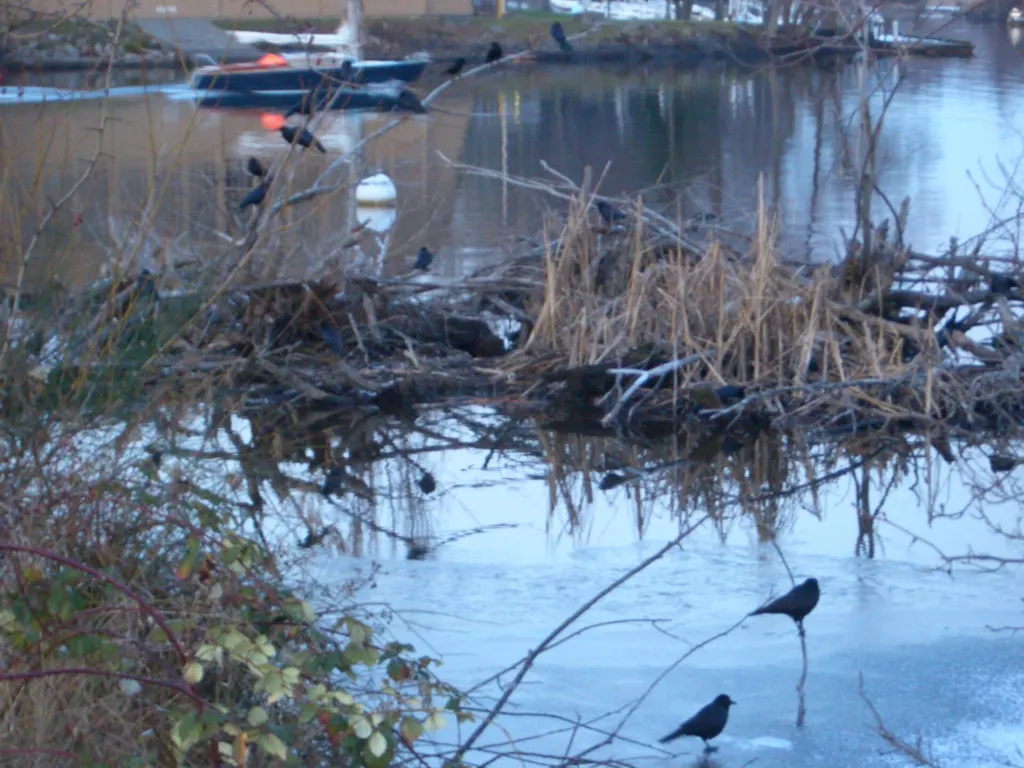
If a few dozen crows have started landing in your yard at dusk this autumn, they are not plotting anything. They are commuting. From late fall into winter, American crows leave their family territories each evening and fly to communal roosts that can hold anywhere from a few hundred birds to around two million, according to the Cornell Lab of Ornithology, and the flocks you see at sunset are the traffic on the way there.
The habit is old. Cornell notes that some roosts have formed in the same general area for well over a century, and that in recent decades many have shifted into towns and cities, where the noise and the droppings put the birds in conflict with people.
Why crows pile up in winter
American crows are social year-round, but the winter roost is a different scale of gathering. Cornell describes a kind of double life: a family of up to 15 birds, including grown offspring from as many as five different years, defends a home territory and forages there together, yet individual crows also peel off to join big flocks at dumps and farm fields, and to sleep in the mass roost. Family members fly to the flock together and then scatter inside the crowd.
Field references for the species give the same picture from the other end: outside the nesting season the birds routinely gather at night in roosts of thousands or even millions. Most American crows stay put through the year, while most Canadian birds drift south, which is one reason yards in the northern United States can suddenly fill with more crows in November than they held in July.
Put those two facts together and the autumn spike in your yard has a simple explanation. The breeding season is over, the young of the year are flying with their families, Canadian migrants have arrived, and every evening all of them are heading for the same bedroom. A Badiyaa rule of thumb: a yard flock at 4 p.m. is a staging stop, and the real roost is usually a stand of tall trees a few miles away, so watch which direction the birds leave and you will have found it.
They know your face
The other reason crows feel uncanny in a yard is that they remember people. In a 2012 study published in the Proceedings of the National Academy of Sciences, University of Washington professor John Marzluff and colleagues captured 12 wild adult male crows while wearing one mask, then fed them for four weeks while wearing a different one. Brain scans later showed the birds’ brains responding to the two faces through regions that, in Marzluff’s words, “are not unlike those that work together in mammals, including humans.” The crows had never been mistreated; being caught was enough to tag the first face as a threat.
The university’s summary of the work puts it bluntly: cross a crow and it can remember you for years. The practical lesson for a homeowner is the mirror image. Crows that are fed reliably and left alone, Marzluff said, come to treat their keepers as valued social partners.
Living with a yard full of crows
Crows do not usually visit feeders, Cornell says, but they will come for peanuts left in the open, for compost, for garbage and for pet food. If you want fewer of them, the controls are the food sources, not the birds. Lidded bins, pet bowls brought indoors at night and covered compost remove most of the attraction. If you want more, a handful of unsalted peanuts at the same time each day will do it, and the birds will learn your schedule faster than you learn theirs.
- Noise and mess: the roost itself, not the yard flock, is where droppings pile up; a few birds passing through at dusk leave little behind.
- Dead crows: American crows die easily from West Nile virus, and the species is tracked as an early-warning indicator of the virus; the birds cannot pass it to people directly, but report a dead crow to your local health or wildlife agency rather than handling it.
- Folklore: the old association of crows with death and bad luck comes from their occasional feeding on carrion; Native American traditions, by contrast, treat the bird as a sign of good luck because of its intelligence.
The birds themselves are not rare. BirdLife International put the population at about 31 million in 2012, and the species is listed as least concern. The oldest wild American crow on record was at least 17 years and 5 months old when it was photographed in Washington State, old enough to have made the same evening flight to the same roost more than 6,000 times.
Further reading
Image: Vmenkov, CC BY-SA 3.0 via Wikimedia Commons
This article was produced with AI assistance and reviewed by our Editorial Desk. How we work.