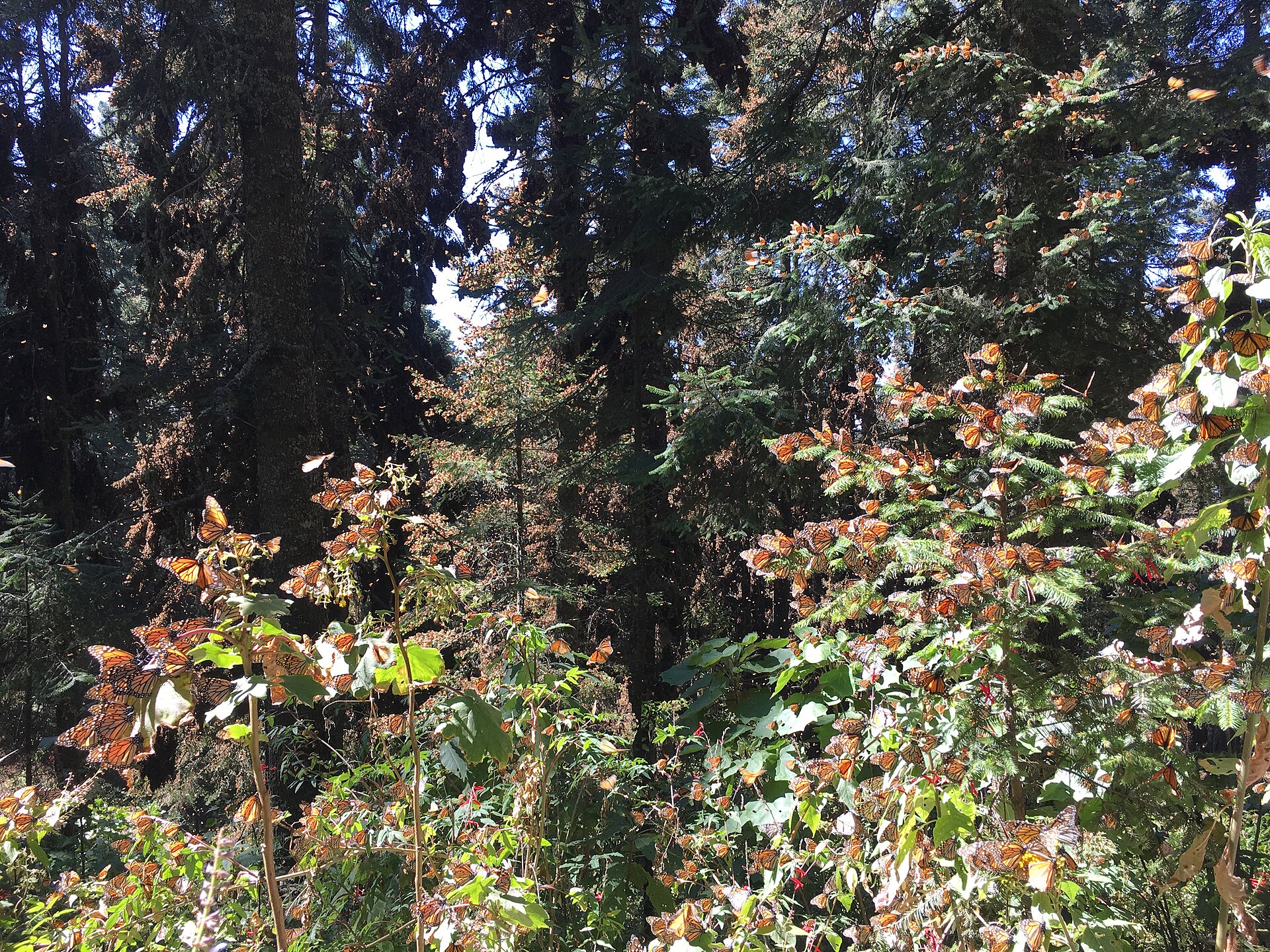
Monarch butterflies are settling into a handful of Mexican mountaintops right now, packing so tightly onto fir trees that the branches bend under them. The butterflies making that trip have never seen Mexico before, yet they reach the same small patches of forest their great-grandparents left in spring.
The US Forest Service calls the monarch the only butterfly known to make a two-way migration the way birds do. Its Forest Service guide to monarch migration and overwintering puts the longest one-way flights at about 3,000 miles.
Where the monarchs spend the winter
The eastern population, which breeds across the United States and southern Canada east of the Rocky Mountains, winters in the same 11 or 12 mountain areas in the Mexican states of Michoacán and México. The butterflies stay from October to late March.
They pick oyamel fir forests between 2,400 and 3,600 meters up, or roughly 7,900 to 11,800 feet. There the air holds between 0 and 15 degrees Celsius, about 32 to 59 degrees Fahrenheit. That is cold enough to slow the butterflies down so they burn little energy, but not so cold that they have to dig into their fat reserves. The damp forest air also keeps them from drying out.
Monarchs west of the Rockies take a shorter trip, wintering along the California coast near Santa Cruz and San Diego in eucalyptus, Monterey pines and Monterey cypresses.
A billion butterflies on a few trees
Most of the eastern monarchs end up inside Mexico's Monarch Butterfly Biosphere Reserve, about 100 kilometers, or 62 miles, northwest of Mexico City. The UNESCO World Heritage listing for the reserve says up to a billion monarchs arrive each year and gather in 14 overwintering colonies, eight of which sit inside the protected area. Those eight hold an estimated 70 percent of the eastern population.
UNESCO describes the scene plainly: the clusters weigh down tree branches, fill the sky when they take off, and the beating of their wings sounds like light rain. A single monarch weighs less than a gram, the Forest Service notes, but tens of thousands can cling to one tree, and sometimes the branches snap.
The four-generation round trip, worked out
The journey south is made by one long-lived generation. The return north takes several. Badiyaa laid out the numbers from the Forest Service guide:
- Daily distance: 50 to 100 miles, with a record of 265 miles in one day.
- Longest trips: about 3,000 miles, which at 50 to 100 miles a day works out to 30 to 60 days of flying, in line with the agency's estimate of up to two months.
- Trip north: the overwintering butterflies breed in spring, and it takes three to four generations to reach the northern United States and Canada.
How the butterflies find their way is still not settled. The Forest Service says solar position and Earth's magnetic field both seem to play a part, rather than any single cue, and UNESCO calls the homing a mystery.
How the population is counted
Scientists measure the colonies by the forest area they cover, not by head count. The reserve's Wikipedia entry reports that monarchs in central Mexico covered 1.79 hectares in the 2024-25 winter, almost double the 0.90 hectares of the winter before, and that colonies hold between 6 million and 60 million butterflies per hectare. At that density range, Badiyaa's calculation puts last winter's count at somewhere between about 11 million and 107 million butterflies.
Mexico first protected the sites in 1980, widened the reserve in 1986 and again in 2000, and UNESCO listed it in 2008. For more animal journeys, read about Gus the emperor penguin's 3,500-kilometer swim and how owls turn their heads 270 degrees.
The colonies will stay put until late March, when the warming days send the first generation north toward Texas.
Sources
- Monarch Butterfly Migration and Overwintering, USDA Forest Service, 2026
- Monarch Butterfly Biosphere Reserve, UNESCO World Heritage Centre, 2008
- Monarch Butterfly Biosphere Reserve, Wikipedia, 2026
Image: U.S. Fish and Wildlife Service - Midwest Region, Public domain via Wikimedia Commons
This article was produced with AI assistance and reviewed by our Editorial Desk. How we work.