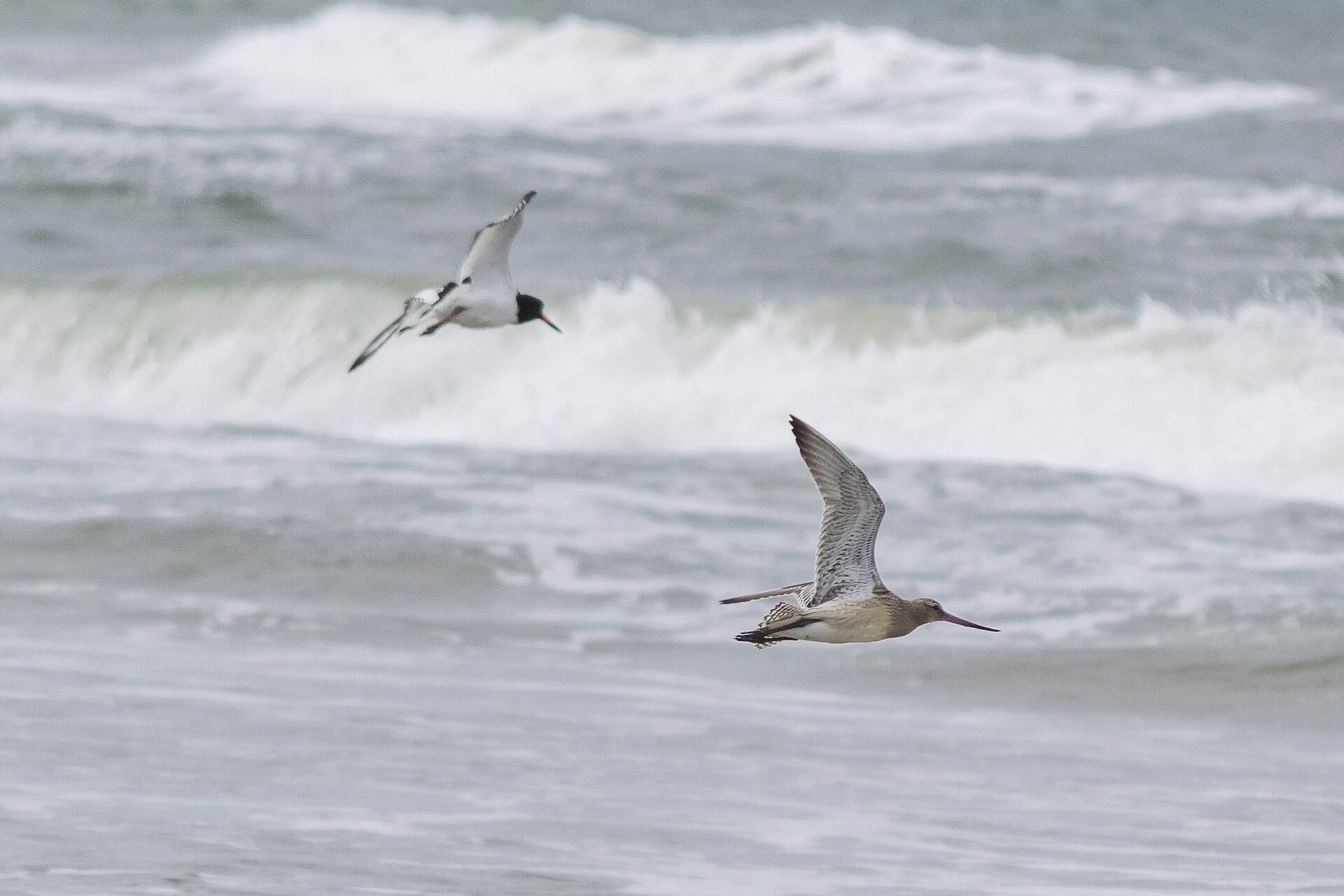
A young bar-tailed godwit flagged B6 left Alaska on October 13, 2022, and did not touch down again until it reached Tasmania, at least 13,560 kilometers (8,430 miles) and 11 days and 1 hour later. No tagged bird has been recorded flying farther without a stop.
The record, logged on the bar-tailed godwit's Wikipedia page, was also the first time a tagged godwit had been tracked on that route. B6 was a juvenile on its very first migration.
Godwits have been in the spotlight this week because of Phil, the British-tagged bird Badiyaa covered when Phil the godwit flew 6,800 miles from Norfolk's Wash to Siberia and back. Phil's trip was a round journey with stops. His Pacific cousins do something stranger: they cross an ocean in one go.
How fast B6 flew
Eleven days and one hour adds up to 265 hours in the air. Divide 13,560 kilometers by 265 and B6 averaged about 51 kilometers an hour, or roughly 32 miles an hour, nonstop, around the clock, over open sea. In one hop it covered about 1,600 miles more than Phil's whole there-and-back trip.
A run of broken records
B6 sits at the end of a line of record holders, all from the Alaska-breeding subspecies known as Limosa lapponica baueri:
- 2007: a female flagged E7 flew eight days nonstop from western Alaska to the Piako River near Thames, New Zealand, 11,680 kilometers. Her full round trip that year took 174 days and covered 29,280 kilometers, with just 20 days of flying.
- 2020 and 2021: a male flagged 4BBRW set the record twice, the second time with a flight of about 13,000 kilometers from Alaska to New South Wales.
- 2022: B6 pushed the mark to 13,560 kilometers.
The E7 flight came out of satellite tracking led by the US Geological Survey's Alaska Science Center. In the team's 2009 paper in Proceedings of the Royal Society B, Robert Gill and colleagues reported that seven females carrying implanted transmitters flew nonstop for 8,117 to 11,680 kilometers across the central Pacific, with flights lasting 6.0 to 9.4 days. They argued the ocean works for godwits as "an ecological corridor rather than a barrier," a wind-assisted path with few predators or pathogens. The tracking points from those birds are public in the USGS bar-tailed godwit data release.
How a wader manages it
The trick is fuel. Before leaving, these godwits pack on the biggest fat loads measured in any migrating bird, and they shrink their digestive organs to save weight for the trip. Favorable winds matter too: birds in New Zealand often leave early when the forecast helps them.
The flights carry real risk on the ground as well. The species is listed as Near Threatened, and fewer birds survive as mudflats in the Yellow Sea, their key refueling stop on the way north, are walled off and reclaimed. In 2024 Australia listed both baueri and its Siberian-breeding relative menzbieri as Endangered.
For another bird that barely rests in the air, read how frigatebirds sleep 42 minutes a day on ten-day ocean flights. In New Zealand, where many Alaska-bred godwits spend the northern winter, their numbers fell from more than 100,000 in the late 1980s to 67,500 in 2018.
Sources
- “Bar-tailed godwit”, Wikipedia, 2026
- “Extreme endurance flights by landbirds crossing the Pacific Ocean (Proceedings of the Royal Society B)”, USGS Alaska Science Center and partners, 2009
- “Tracking Data for Bar-tailed Godwits (Limosa lapponica)”, U.S. Geological Survey, 2023
Image: Paul van de Velde, CC BY 2.0 via Wikimedia Commons
This article was produced with AI assistance and reviewed by our Editorial Desk. How we work.