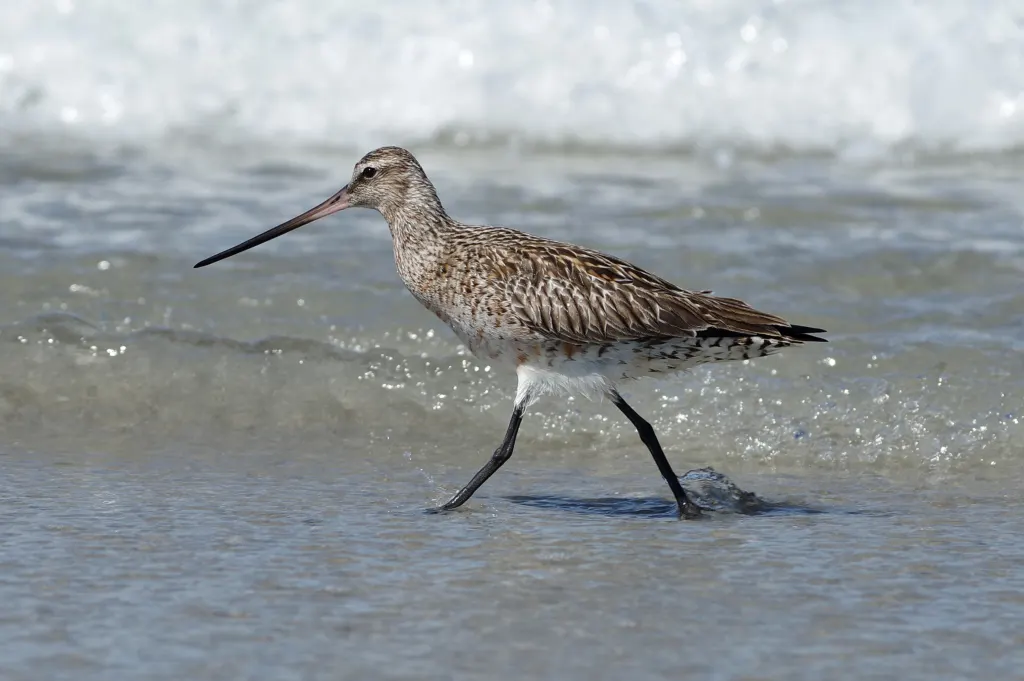
A wading bird named Phil has flown about 6,800 miles from eastern England to the Russian Arctic and back, carrying a tracker that weighs just six grams. The bar-tailed godwit landed on the Wash in Norfolk this month, and the RSPB’s announcement on November 17 says it is the first time the conservation charity has followed one of these birds’ full migration from England.
The round trip took Phil to the Taymyr Peninsula in central Siberia, one of the most remote breeding grounds on Earth, and home again by a different route.
The route, stop by stop
Volunteers from the Wash Wader Research Group fitted the tag in January. The bird is named after Phil Ireland, who led the group for many years. Here is the journey the tracker recorded:
- January: tagged on the Wash, the large bay between Norfolk and Lincolnshire.
- March: crossed to the Wadden Sea, the tidal flats along the Dutch, German and Danish coasts.
- Late May: flew on to the Taymyr Peninsula in central Siberia to breed.
- Return: crossed the Arctic Ocean to northern Norway and stopped on three small islands off the Norwegian coast.
- Autumn: went back to the Wadden Sea, then home to the Wash.
The maps the RSPB published show a loop rather than an out-and-back line: a southern route east in spring and a northern route west in late summer.
Why the Wash matters
“It’s amazing to think that a bird we tagged here on the Wash in January has travelled thousands of miles to Siberia and made it all the way back again,” said Jeff Kew, a coastal adviser at the RSPB.
Nigel Clark of the Wash Wader Research Group called the bay “the UK’s single most important coastal wetland for migratory waders.” He added that tracking birds like Phil “shows us how connected the Wash is with the rest of the flyway.”
That flyway, the East Atlantic route linking the Arctic, Europe and Africa, depends on a chain of muddy coasts where birds rest and refuel. The RSPB notes that the wetlands of England’s east coast between the Humber and the Thames have been put forward as a potential UNESCO World Heritage Site.
How small is a six-gram tag?
A six-gram tag is roughly the weight of a sheet of printer paper folded a few times, but what matters is how it compares with the bird. Wikipedia’s bar-tailed godwit profile gives male weights of 190 to 400 grams. Working that through, six divided by 400 is 1.5%, and six divided by 190 is about 3.2%, so Phil’s tag weighs somewhere between 1.5% and 3.2% of his body weight, depending on his size and how much fuel he was carrying at the time.
A family of record breakers
Phil’s 6,800 miles, about 10,900 kilometers, is a long trip with rest stops. His relatives in the Pacific fly much farther without stopping. Godwits of the Alaskan subspecies cross the ocean to Australia and New Zealand, and the species’ migration records include a juvenile tagged B6 that left Alaska on October 13, 2022, and flew at least 13,560 kilometers to Tasmania in 11 days and one hour, the longest nonstop flight known for any bird.
The species is listed as Near Threatened, with a global population estimated at about 1.1 million in 2025. Birds that breed on the Taymyr Peninsula belong to a subspecies that winters along the coasts of western Europe and West Africa, which is why Phil’s winter home is Norfolk.
Badiyaa has covered other long-haul fliers, including frigatebirds that sleep 42 minutes a day on ocean flights and saw-whet owls migrating across North America. Phil now joins the thousands of waders that pack RSPB Snettisham on the highest tides of the winter.
Sources
- Phil the Bar-tailed Godwit migration news release, RSPB, 2026
- Bar-tailed godwit, Wikipedia, 2026
Image: Hobbyfotowiki, CC0 via Wikimedia Commons
This article was produced with AI assistance and reviewed by our Editorial Desk. How we work.