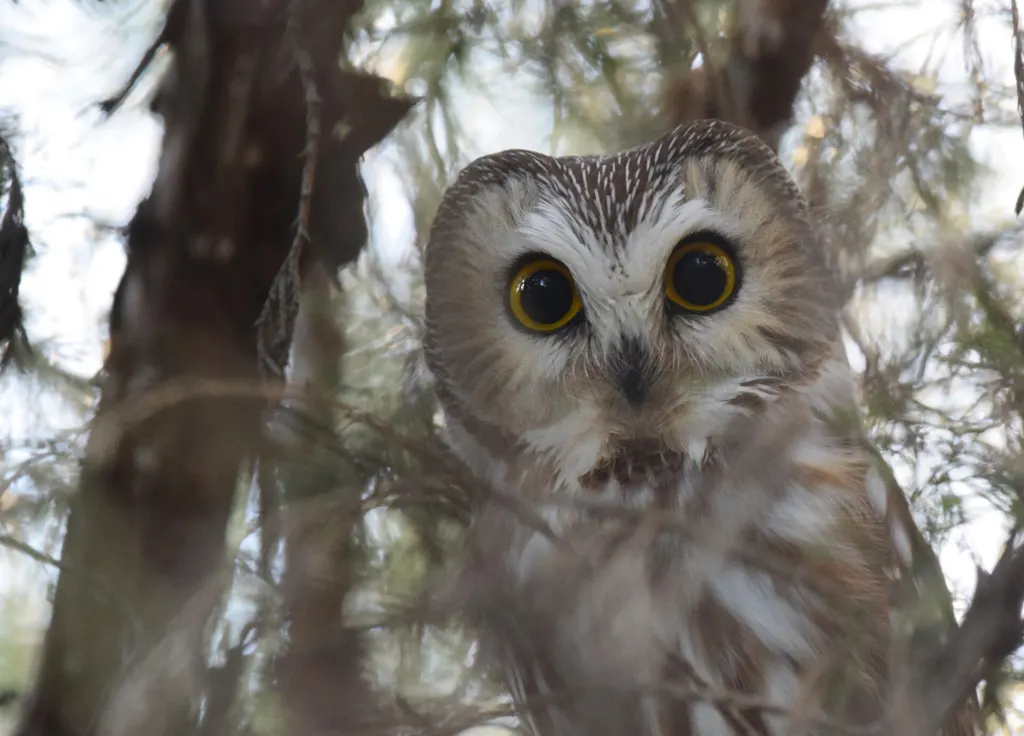
A 44-second clip of a northern saw-whet owl giving its rapid, whistled “too-too-too” has passed 38,000 views since the bird-identification channel Bird Watching HQ posted it on Sunday, October 25. The song in the clip belongs to late winter and spring. The owl itself, though, is on the move across North America right now, and that same call is how researchers find it in the dark.
A spring song in an autumn feed
The Cornell Lab of Ornithology describes the song as an insistent run of whistled notes held on roughly one pitch, at about two notes a second. Males use it to advertise a territory. Cornell says a calling male can be heard up to half a mile away, while the species literature records the call carrying about 300 meters (980 feet) through forest, so half a mile is a best case on a still night.
Some quick arithmetic shows how busy that song is. At two notes per second, a bird singing without a break would fit close to 90 notes into a clip of this length, all on the same note. That flat, metronome quality is what separates it from the low, soft hoots of bigger owls.
Timing matters too. Cornell says the song rings out on evenings in mountain conifer forests between January and May, and breeding birds keep at it into early summer. In autumn the species goes quiet. Researchers at the University of Illinois say the owls call very little on migration and roost low in thick cover, which makes them hard to detect from October onward.
October is when the owls travel
For a long time nobody knew much about where saw-whets went in winter. That changed in the 1990s with Project Owlnet, a network that Cornell says now links more than 100 banding sites. The method turns the clip’s sound into a tool: banders broadcast the male’s territorial toot beside fine mist nets, and the owls fly in, even though it is the wrong season for the song.
The Ward Laboratory at the University of Illinois runs one of those stations at Kennekuk County Park, with nets open from mid-October to early December since 2020. Its numbers give a feel for the traffic. The team has banded 177 new owls and caught 16 that were first ringed elsewhere, including birds from Michigan and Minnesota. Females dominate: 86 of the owls banded were female against just 9 males, which supports the idea that most saw-whets passing through Illinois are female. The lab’s nets show the migration through central Illinois peaking in late October and early November, so this week sits close to the busiest stretch.
Why a breeding call pulls in migrating owls is still an open question, and the Illinois group is testing tagged birds’ responses to different recordings to find out. The travelers can be bold, too: in October 1999 one landed on a fishing boat 70 miles off Montauk, New York, according to Cornell.
A robin-sized hunter
Adults measure about 17 to 22 centimeters (6.7 to 8.7 inches) and average around 80 grams (2.8 ounces), close to the weight of an American robin. They hunt mostly mice, deer mice above all, and Cornell notes that a saw-whet often eats an adult mouse in two sittings. John James Audubon recorded that people in Massachusetts already called the bird a saw-whet in the early 1800s, likening its voice to a saw being sharpened on a whetstone; Cornell adds that nobody agrees which of its calls earned the name.
Earlier this month we covered a short-eared owl clip with a similar problem of timing: a widely shared owl sound that, in the wild, belongs to a different season.
What the clip gets right, and what it leaves out
As an audio reference, the video does its job. The sound is the species’ real advertising song, and the channel’s description correctly says males use it in the breeding season to attract mates and hold territories. Anyone hoping to recognize a saw-whet on a winter walk will learn the rhythm in under a minute.
The packaging is looser. The description credits the recordings to nature recordist Lang Elliott and says the images were licensed from a stock-footage library, so the picture and the sound were very likely captured separately, and no place or date is given for either. The “4K” in the title describes the picture, not the recording. “Hooting” is generous as well: the song is a high whistle, not a deep hoot. None of that makes the clip wrong, but viewers are watching an assembled illustration, not one owl filmed as it sang.
How to meet a saw-whet this fall
- Look for a public banding night. The Illinois team’s students run “Owl Night” events at Kennekuk County Park, Homer Lake Forest Preserve and Allerton Park, where visitors may see an owl up close if one is caught.
- Listen for small songbirds making a racket by day. Cornell says chickadees and other birds that find a roosting saw-whet will scold it until it leaves.
- Check dense, low cover. Illinois owls usually roost in cedars and honeysuckle 6 to 10 feet off the ground, often near eye level.
The Illinois nets stay open into early December. After that, the next chance to hear the song from the clip for real comes on quiet January nights in conifer woods.
Further reading
- Wikipedia: Northern saw-whet owl
- University of Illinois Ward Laboratory: Northern saw-whet owl research
Image: Andy Reago & Chrissy McClarren, CC BY 2.0 via Wikimedia Commons
This article was produced with AI assistance and reviewed by our Editorial Desk. How we work.