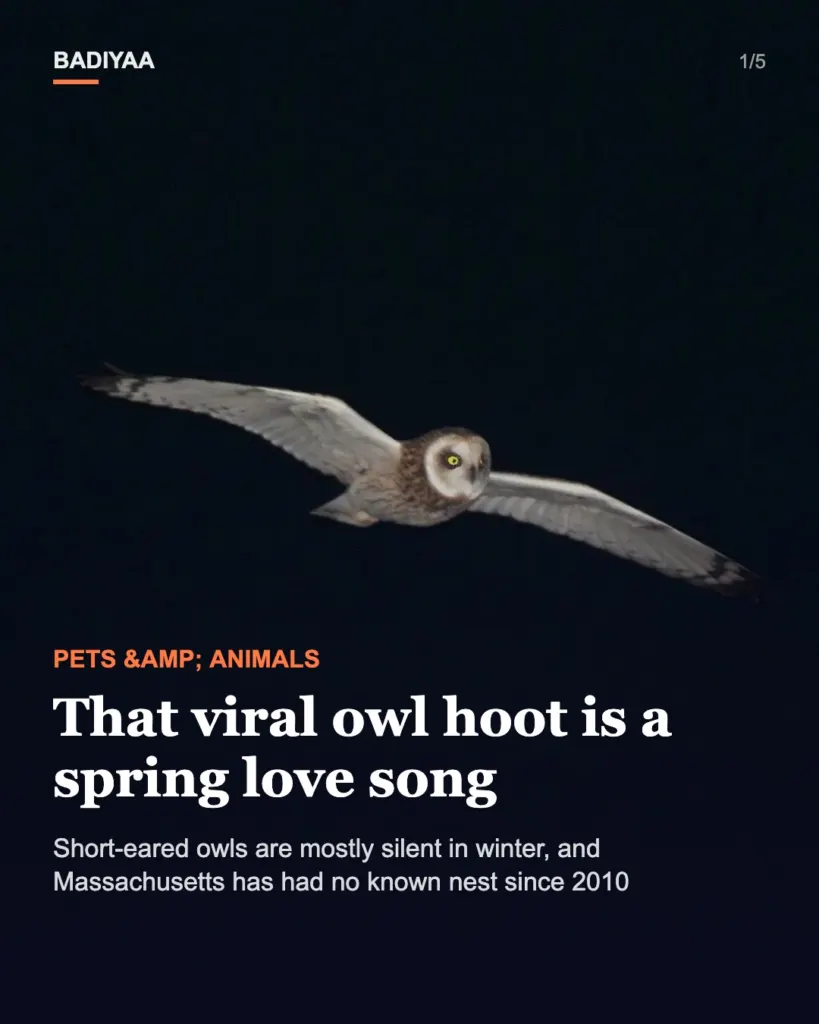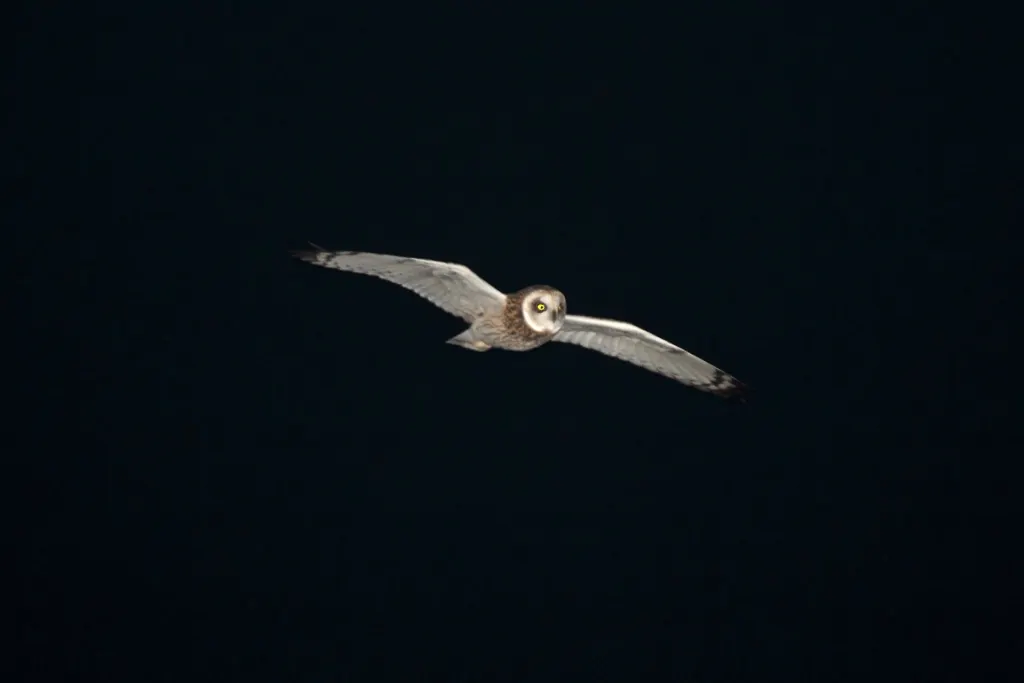
A 33-second clip of a short-eared owl giving a run of soft, muffled hoots has drawn more than 62,000 views on YouTube since a bird-identification channel posted it on Sunday, October 18. The channel’s own description says the footage is licensed from a stock library, and it gives no location or date for the recording.
The sound itself is genuine owl behavior, and it is a spring sound. Researchers at the Cornell Lab of Ornithology describe the species’ primary call as a series of a dozen or more hoots, given by males in courtship flight and sometimes from the ground or a raised perch. In Massachusetts, state biologists say courtship begins in March: the male climbs 100 feet (31 meters) or more, circles tightly, repeats a soft call 13 to 16 times, then drops toward the grass while clapping his wings together under his belly.
Why fields go quiet in October
For most of the year this owl says very little. Cornell calls the species “not especially vocal,” and on its wintering grounds it is generally silent. The rest of the repertoire is rough rather than musical. Adults of both sexes bark, scream or whine when a nest or chicks are threatened, females sometimes make a clucking note, and adults and young snap their bills at intruders. Connecticut’s wildlife agency likens the voice to the nasal bark of a dog, written as “wak, wak.”
The other sound worth learning is not vocal at all. Both sexes clap their wings in flight, a quick slap that Cornell compares to a hand striking a thigh.
One of the most widespread owls on Earth, and scarce in New England
Asio flammeus nests in open country across the Americas, Europe and Asia, as well as on Hawaii, the Galápagos and Caribbean islands, and turns up on every continent except Antarctica and Australia. Eleven subspecies are recognized, among them the pueo, the only owl native to Hawaii. BirdLife International’s assessment for the IUCN Red List estimates 1.2 million to 2.1 million birds worldwide and rates the species Least Concern.
That global figure hides sharp regional losses. Cornell classes it as a common bird in steep decline, and several US states now protect it:
- Massachusetts lists it as endangered; the last known nest in the state was found on Tuckernuck Island in 2010.
- Connecticut treats its small wintering population as threatened and has no confirmed breeding pairs, although the owls nested north of Hartford before the 1860s.
- New Mexico lists the species as endangered.
The causes named by these agencies overlap. The owls need big, open grasslands, marshes and coastal heath, and those places keep disappearing under development. Nests sit on the ground, where skunks raid them. Massachusetts also points to second-generation anticoagulant rodenticides, poisons that build up in raptors feeding on contaminated rodents, while adding that their effect on whole populations is still unknown.
Where to look this winter
Northern breeders drift south as the cold arrives, and Massachusetts reports small numbers settling into suitable habitat across the state from late fall through winter. Cornell’s advice for anyone outside the northern US and Canada is to search in winter over open fields, grasslands and even airports, close to dawn or dusk. A hunting bird flies low and loose, with a moth-like wingbeat, often just 1 to 10 feet (0.3 to 3 meters) above the grass, and hovers briefly before dropping onto prey. In Massachusetts, meadow voles make up more than 90 percent of what these owls eat.
Give them room. Both Connecticut and Massachusetts ask people to watch from a distance, because disturbance at roosts and nests lowers survival, and a bird resting on the ground is easy to flush before you even spot it. If one flies out of view, stay put: the owls hunt in wide loops and often pass the same spot again.
What the clip gets right, and what it leaves out
As a sound reference, the video is fair: repeated, low hoots are what birders on breeding grounds hear in spring, and the caption correctly ties them to courtship and territory. The weakness is missing context. A viewer gets no place, no date and no season, and because the pictures are stock footage, there is no way to tell who recorded the bird or where. Anyone who heads out to a winter marsh this month expecting that sound will most likely watch a silent hunter instead.
For dated, located recordings, Cornell’s Macaulay Library archive is the better reference; its northern calls include a male recorded in North Dakota on April 6, 2007, the kind of early-spring morning when the hooting starts again.
Further reading
- Wikipedia: Short-eared owl
- MassWildlife: Short-eared owl
- Connecticut DEEP: Short-eared Owl fact sheet
Image: Dominic Sherony, CC BY-SA 2.0 via Wikimedia Commons
This article was produced with AI assistance and reviewed by our Editorial Desk. How we work.
Spot an error? Help verify this story
The story in 5 slides