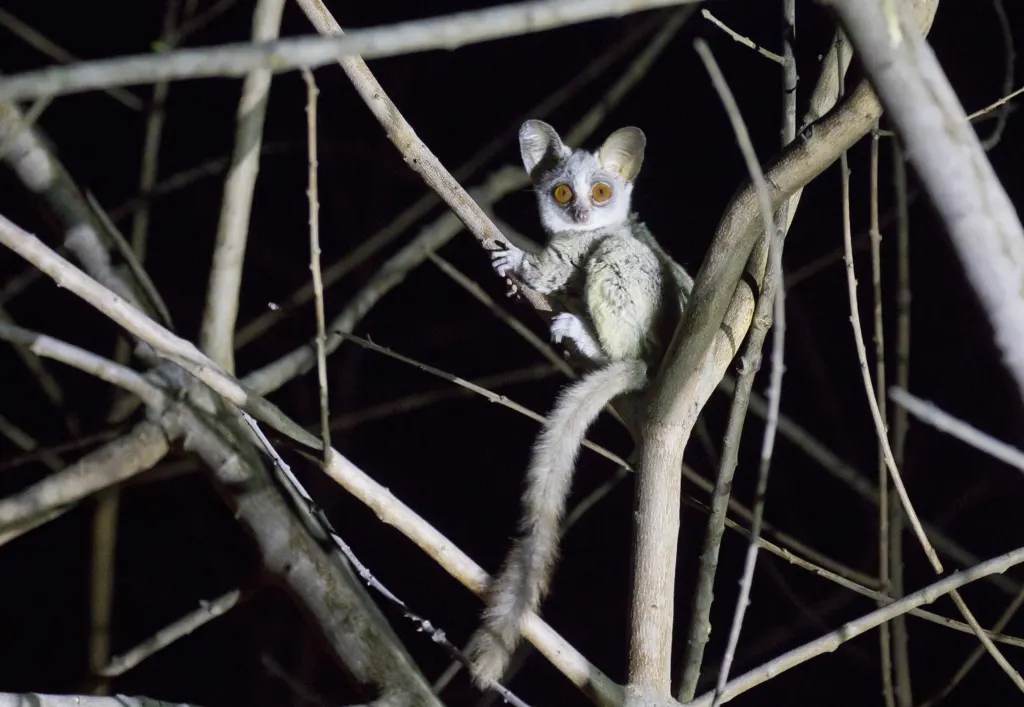
A bush baby can clear 2.25 meters, about 7 feet 5 inches, in a single leap, the highest reliably reported jump for the animal. For a primate small enough to sit in two cupped hands, that is a spring its leg muscles alone should not be able to deliver.
Bush babies, properly called galagos, are small nocturnal primates found across mainland sub-Saharan Africa. Short clips of them nibbling human food, including scrambled eggs, turn up regularly on social media, but Badiyaa could not trace the original creator of the latest one. Eggs are not as odd a choice as they look: a University of Michigan species account of the lesser bush baby lists grasshoppers as its favorite food, but adds small birds, eggs, fruit, seeds and flowers to the menu. In droughts, that same account says, the animals live on nothing but gum oozing from acacia trees.
A catapult in the ankle
Galago leg muscles make up roughly a quarter of the animal’s body mass. Even so, a study published by the Royal Society worked out that the jumping muscles would have to perform six to nine times better than a frog’s to explain the leaps. The answer lies in the lower leg, where tendons stretch and store elastic energy before release, working like a loaded spring.
In the air, a galago tucks its arms and legs against its body, then flings them out at the last instant to grab a branch. A run of hops can carry one about 10 yards in a few seconds, and single horizontal leaps of 3 to 5 meters have been described for the lesser bush baby. Its tail is longer than its head and body put together and helps push off. On the ground it may hop like a tiny kangaroo, or simply walk on all fours.
Built for the night
- Eyes: very large, for seeing in near darkness.
- Ears: thin and bat-like, able to track insects in the dark. Galagos fold them back while bounding through thorny bush, and again while resting.
- Teeth: lower front teeth form a comb-like “toothcomb” used in grooming, plus a special grooming claw on the second toe of each hind foot.
- Diet: insects caught on the ground or snatched out of the air, other small animals, fruit and tree gum.
They find their way partly by smell. Galagos mark their routes with urine, and by following that scent trail they can land on exactly the same branch night after night. Each species has its own set of loud calls, distinct enough that scientists can identify every known species by sound alone. At the end of the night, a group gathers with a rallying call and sleeps together in a nest of leaves, a tangle of branches or a tree hollow.
Tiny babies, carried by mouth
After a pregnancy of 110 to 133 days, a female gives birth to one, two or three young. Each newborn weighs less than half an ounce, or 14 grams, about the same as three US nickels. Within a week, the mother starts carrying her infant in her mouth and parks it on a branch while she feeds. The young nurse for six weeks and feed themselves by two months.
The family belongs to the same wider branch of primates as the lorises of Asia, the group that includes the slow loris, one of only seven venomous mammals. By number of species and sheer abundance, bush babies are Africa’s most successful members of that group, according to the African Wildlife Foundation. For a very different primate survival story, see how golden snub-nosed monkeys huddle through China’s snowy winters.
Why they are called bush babies
The name likely comes from their wailing, baby-like cry or from their looks. In Afrikaans they are nagapies, or “night monkeys”. Some are kept as pets, though like many primates they can carry diseases that cross between species, and they tend to draw customs attention when imported. In captivity they live 12 to 16.5 years, which suggests a natural lifespan of more than a decade.
Further reading
Image: Andrey Giljov, CC BY-SA 4.0 via Wikimedia Commons
This article was produced with AI assistance and reviewed by our Editorial Desk. How we work.