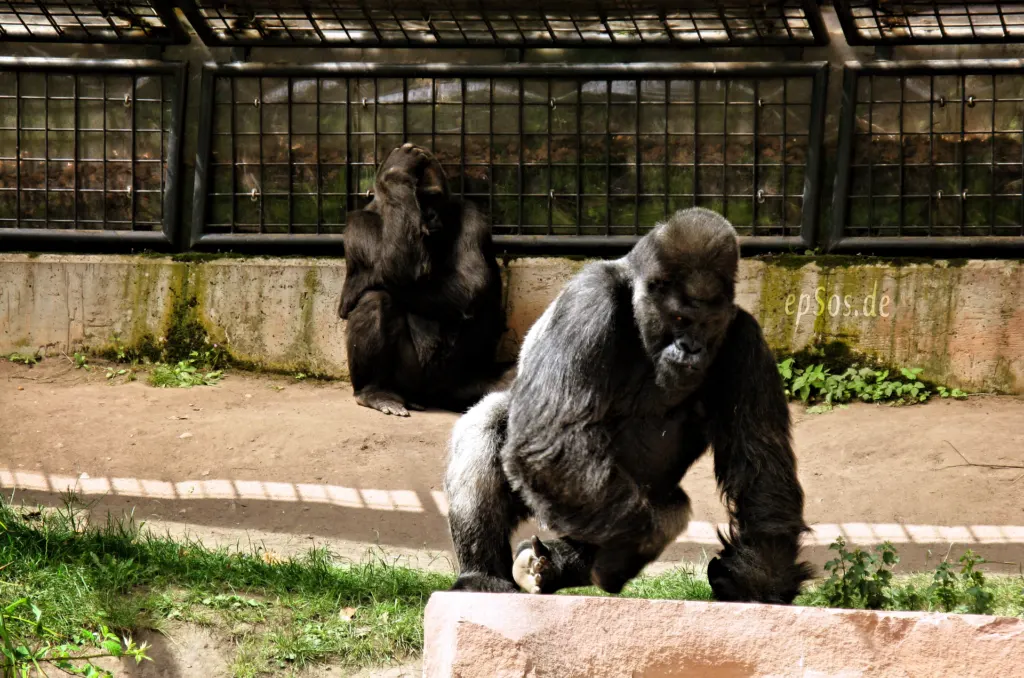
Koko the gorilla used a large vocabulary of hand signs adapted from American Sign Language, understood words for objects, actions and qualities, and charmed the world for four decades. What researchers never found was solid evidence that she strung those signs into sentences with grammar, the feature that makes a language a language.
That gap sits at the heart of one of the most famous animal studies of the 20th century, and it still shapes how scientists talk about ape communication.
Firework girl
Koko was born at the San Francisco Zoo on July 4, 1971. Her full name, Hanabiko, is Japanese for “firework girl,” a nod to her Independence Day birthday. She was a western lowland gorilla, a critically endangered species. After being hospitalized as an infant for malnutrition, she was hand-raised, and Francine Patterson began teaching her signs as part of doctoral research at Stanford University.
Lessons started in a noisy children’s zoo exhibit, then moved to a trailer and later to a preserve in Woodside, California. Koko lived there with male gorillas Michael and, after his death in 2000, Ndume.
What Koko could do
Patterson published peer-reviewed studies in the late 1970s showing Koko communicated with signs drawn from ASL. Because gorilla hands are thick and move differently from human hands, many signs had to be modified, so Patterson called the result “Gorilla Sign Language.” Patterson also reported that Koko coined new combinations, signing “finger” plus “bracelet” for a ring.
A famous 1978 magazine cover showed Koko photographing herself in a mirror, and her 1985 picture book about adopting a kitten, All Ball, became a bestseller.
What the evidence did not show
In 1979 Herbert Terrace published results from his own chimpanzee study, Nim Chimpsky, which suggested apes were largely imitating their trainers. Terrace and Laura-Ann Petitto argued that Koko might be responding to unconscious cues from handlers and asked for tighter testing. Others said she was signing because signing earned rewards, not because she grasped meaning.
A further problem was interpretation. When Koko signed “sad,” only the handler could decide what that meant. Patterson countered that blind and double-blind tests had been run and that the gorillas signed to each other and to strangers without prompting.
Sign language expert Sherman Wilcox criticized edited clips of a Koko “climate speech” as “disrespectful of ASL,” worried they reinforced the myth that ASL has no syntax.
Could and could not, side by side
- Could: learn a large set of signs and use them to ask for things she wanted.
- Could: understand nouns, verbs and adjectives, including abstract words such as “good” and “false.”
- Could: score between 70 and 90 on various IQ scales, according to the reported tests.
- Could not, on the evidence: show the syntax or grammatical sentences that language scientists require.
The scientific consensus landed on that last line: Koko learned signs and used them to communicate, but did not speak sign language in the full sense. Badiyaa’s wildlife coverage has followed other great apes too, including Lulingu, a rescued Grauer’s gorilla now raising a baby in Congo’s Virunga park, and how cats change their meowing when a human can help.
Koko died in her sleep at the Woodside preserve on June 19, 2018, aged 46. Ndume was later transferred to the Cincinnati Zoo.
Further reading
Image: epSos.de, CC BY 2.0 via Wikimedia Commons
This article was produced with AI assistance and reviewed by our Editorial Desk. How we work.