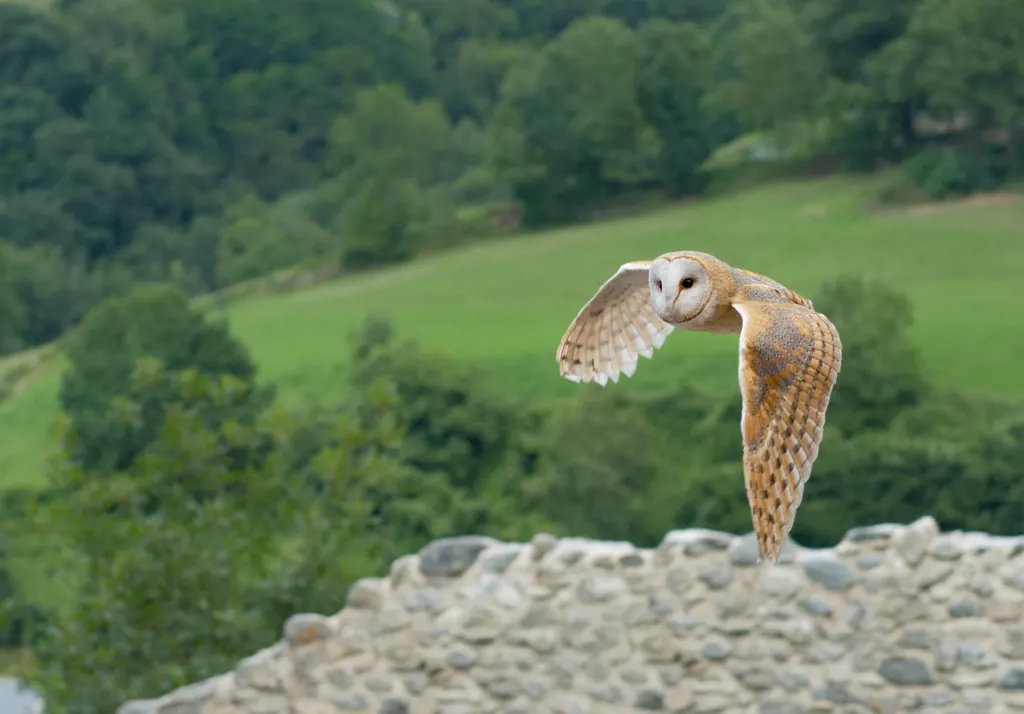
Fit a young barn owl with prisms that shift everything it sees off to one side, and something remarkable happens: over time the bird’s hearing shifts to match. Stanford neurobiologist Eric Knudsen showed that the owl’s brain redraws its internal map of sound so that noises line up with the false picture from its eyes, even though its ears were right all along.
It is one of the clearest demonstrations of how a growing brain decides which sense to trust, and the answer is sight, every time.
An owl with a map of sound in its head
Barn owls hunt in near darkness, so they need to pinpoint a rustle precisely. In 1978 Knudsen and Masakazu Konishi reported a map of auditory space in the owl’s midbrain, in a structure now called the inferior colliculus. Neurons there are laid out by where a sound comes from, left to right and up and down, a two-dimensional map that was the first of its kind found in the brain that was not a map of the body’s surface.
The owl builds that map from two cues. A sound reaches the nearer ear a fraction of a second sooner, which tells the bird the horizontal direction. The owl’s ears are also lopsided, with the right opening aimed higher than the left, so a sound’s loudness differs between the ears depending on its height. The ring of facial feathers, called the ruff, sharpens that vertical sense at high frequencies.
The prism experiment
Knudsen’s team placed displacing prisms over both eyes of young owls, moving their whole visual world by a fixed amount. Their ears and timing cues were untouched. Even so, the auditory map in the brain gradually slid over until it agreed with the shifted view. The birds had reassigned perfectly good sound cues to the wrong places in space.
In the words quoted from his work: “Even though interaction with the environment from the beginning of life has proven to owls that their visual perception of stimulus source location is inaccurate, they nevertheless use vision to calibrate sound localization, which in this case leads to a gross error in sound localization.”
There were limits. A 1985 study by Eric and Phyllis Knudsen found that vision could change how large an auditory error was, but not flip its direction.
Earplugs, age and a second chance
The team also tried the reverse problem, plugging one ear or removing the ruff feathers and the flaps in front of the ears. At first the owls misjudged where sounds were. Over time the map recalibrated to the new cues, again using vision as the reference, and it adjusted fastest and furthest in young birds.
For years the thinking was that this flexibility shut off after a critical period in youth. Work with Steven Esterly and John Olsen published in 1994 showed adult owls keep some ability to adapt, just less. A 1998 paper went further: owls that had adapted to altered cues when young could readjust far more readily as adults, as if the old wiring were stored and could be switched back on.
A short timeline of the owl studies
1978: the auditory space map is reported. 1979: owls are shown to use differences in sound spectrum between the ears. 1985: vision is shown to steer how young owls adjust their hearing. 1994: adult plasticity is documented. 1998: early experience is shown to widen what the adult brain can relearn.
For more on how owls are built for the dark, read Badiyaa’s look at the eastern screech owl and its horse-like whinny, the short-eared owl’s spring courtship hoots, or why predators and grazers evolved differently shaped pupils.
Knudsen chaired Stanford’s neurobiology department from 2001 to 2006 and received the Gruber Prize in Neuroscience in 2005.
Further reading
Image: Luc Viatour, CC BY-SA 3.0 via Wikimedia Commons
This article was produced with AI assistance and reviewed by our Editorial Desk. How we work.