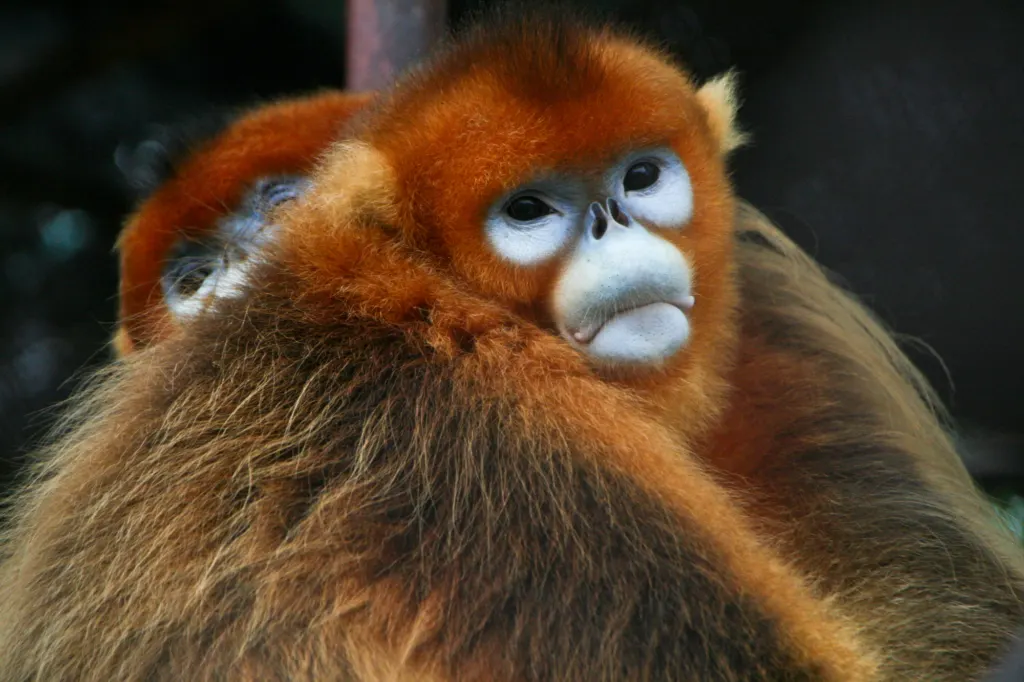
The golden snub-nosed monkey handles colder weather than any other primate except humans, and on freezing nights in central China it gets through by piling together. Mothers curl around their young, adult females pair off with each other, and the big males usually sleep apart or keep watch.
That cuddling is what makes the species so photogenic, but for the monkeys it is also a survival strategy. Only about 8,000 to 15,000 of these animals are thought to remain, and the IUCN Red List classes Rhinopithecus roxellana as endangered.
Where they live
The species lives only in China, in temperate mountain forests of Sichuan, Gansu, Shaanxi and Hubei provinces, at roughly 1,500 to 3,400 meters (4,900 to 11,200 feet). Snow falls often. The average yearly temperature in its range is about 6.4°C (43.5°F), and January lows dip to around −8.3°C (17.1°F). Chinese speakers call it the Sichuan golden hair monkey.
These monkeys are almost fully arboreal, passing about 97% of their time in the canopy. Biologists split them into three subspecies, kept apart by crowded lowland valleys: one around the rim of the Sichuan Basin, one in the Qinling Mountains of Shaanxi and one in the Shennongjia area of Hubei.
Why they huddle
A study of a free-ranging band in the Qinling Mountains found that winter night behavior is a trade-off between keeping warm and keeping safe. Thick fur helps, yet sleeping clusters grow bigger after dark than during the day, and the monkeys drop to the lower branches to escape the cold, windy treetops.
Clustering may also help a group notice danger sooner. Leopards, wolves, dholes, Asiatic golden cats, golden eagles and northern goshawks all hunt them. When a goshawk alarm sounds, youngsters are pushed into the middle of the group while the strongest males move toward the threat.
A layered society
The species runs one of the most complex social systems among primates. Its basic unit is a single breeding male with several females and their young. Many of these units travel together as a band that can reach about 600 animals, shadowed by groups of bachelor males waiting for a chance to take over a harem. Females help one another carry and care for infants, a habit called alloparenting.
Adult males look very different from females. They wear long golden guard hairs over the back and shoulders, measure about 58 to 68 cm and weigh around 16.4 kg (36 lb), roughly twice a female’s size. Newborns start out gray and only turn golden as they grow up.
Primates have turned up on Badiyaa before: macaques in a lab looked away from lifelike digital monkey faces, and the slow loris turns out to make venom by licking a gland on its arm.
A diet built on lichen
For much of the year the monkeys live on lichens, topped up with young leaves, seeds, buds and bark. At Shennongjia Nature Reserve lichen is the main food from November to April. The richest lichen grows on dead trees, and the harvesting of those trees is a big reason the species is losing ground.
A short timeline outside China
- 1984 to 1989: the San Diego Zoo kept golden snub-nosed monkeys.
- 1985: the San Francisco Zoo kept the species.
- 2004: Guernsey Post issued a stamp highlighting its endangered status.
- 2025: France’s ZooParc de Beauval took in the species, the first zoo anywhere outside Asia to do so.
Beyond mainland China, only Hong Kong, Japan and South Korea keep them today. The species sits on CITES Appendix I, which bars international trade, and wild troops live in protected areas including Foping, Wanglang and Baihe nature reserves.
Further reading
Image: Jack Hynes, CC BY-SA 2.0 via Wikimedia Commons
This article was produced with AI assistance and reviewed by our Editorial Desk. How we work.