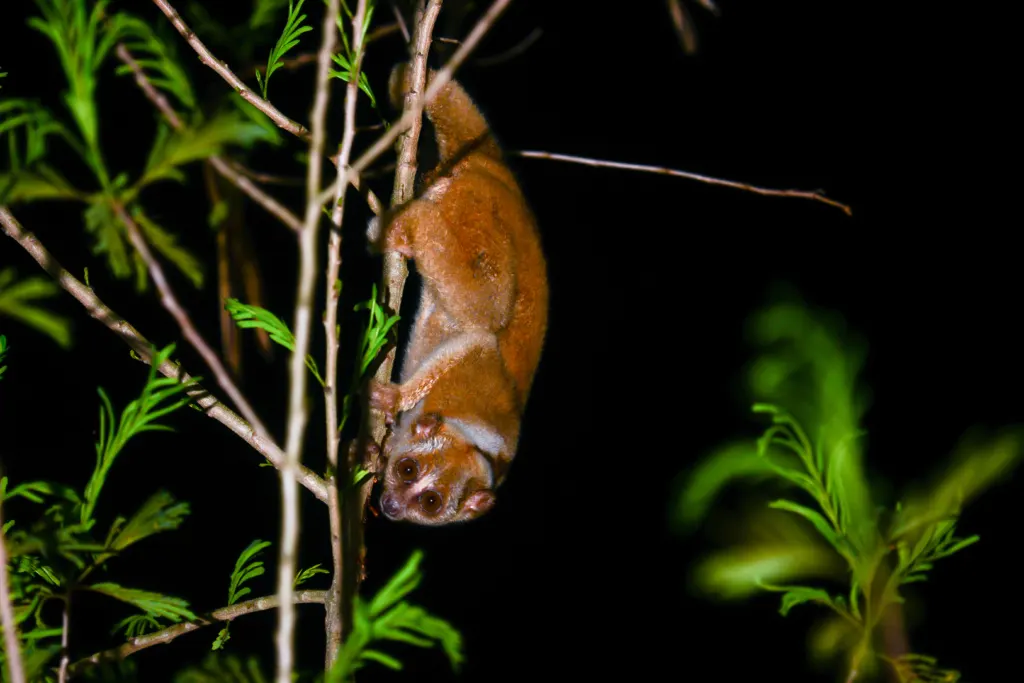
The slow loris looks like a plush toy with saucer eyes, yet it carries a chemical weapon in its elbows. These small Southeast Asian primates lick a gland on the inside of each upper arm, mix the oily secretion with saliva, and deliver the blend through a bite. That makes slow lorises one of only seven kinds of mammals known to be venomous, and the only primates on the list.
The animal is trending again after a Reddit “today I learned” post about its venom and its second tongue drew a busy comment thread this week, including people who said they had nursed wild lorises back to health.
How the venom works
The key ingredient comes from the brachial gland, a patch of bare, gland-rich skin on the arm near the armpit. In 2003, chemists at Columbia University in New York isolated the main protein in that secretion from the Sunda slow loris. It weighed about 18 kilodaltons and its two chains showed nearly 70% sequence similarity to Fel d 1, the main allergen that makes people sneeze around house cats.
Alone, the gland oil does little. Combined with saliva it becomes far more potent. When researchers offered binturongs, clouded leopards and sun bears cotton swabs dabbed with the mixture, the predators backed off or showed obvious distaste, while the secretion by itself drew only mild interest.
A 2013 review led by primatologist Anna Nekaris of Oxford Brookes University in England counted 212 compounds in the venom of the pygmy slow loris and 68 in the Sunda species. The review weighed four ideas about what the venom is for and found the weakest support for killing prey. The strongest case was defense against parasites and rival lorises, with predators possibly put off too.
Mothers use it as well. Before leaving an infant parked on a branch while they forage, a female can lick her arm glands and then groom the baby with her teeth, leaving a protective coat of toxin on its fur.
The second tongue
The “two tongues” part of the viral post is real, though the extra one is small. Like lemurs, slow lorises have lower front teeth that lie flat and point forward, forming a comb used for grooming and for scraping tree gum. A structure called the sublingua, or under-tongue, sits beneath the main tongue. It ends in hard, serrated points that rake between those comb teeth like a toothbrush, clearing out hair and debris.
Why the cobra comparison matters
Nekaris and her co-authors proposed something stranger. Slow lorises have an extra vertebra that gives them a snake-like way of moving, a dark stripe down the back, hissing aggressive calls and now a venomous bite. The team suggested that during the Miocene, when both lorises and cobras spread through Southeast Asia, lorises may have evolved to resemble spectacled cobras so that predators would leave them alone.
Cute, slow and in trouble
Here is the timeline that turned a shy forest animal into an internet star and a trafficking target:
- 2003: the cat-allergen link in loris gland protein is published.
- March 2011: a clip of a pet slow loris being tickled had passed six million views. Nekaris warned that most viewers did not realize owning one is illegal in most countries.
- 2013: the venom review appears, the same year a new species, the Kayan slow loris, was named.
Every slow loris species assessed before 2012 is listed as Vulnerable or Endangered, and demand from the exotic pet trade and traditional medicine is the biggest driver of their decline. The whole genus sits on CITES Appendix I, the strictest tier of international wildlife trade rules, as the slow loris entry notes.
For more unusual animals, Badiyaa has looked at the tuatara, a New Zealand reptile with a third eye and two blind fish found only in groundwater near Haditha in Iraq.
A slow loris runs its body at about 40% of the metabolic rate expected for a mammal its size, roughly the same as a sloth, which is part of why it moves so deliberately.
Further reading
Image: Rushen, CC BY-SA 2.0 via Wikimedia Commons
This article was produced with AI assistance and reviewed by our Editorial Desk. How we work.