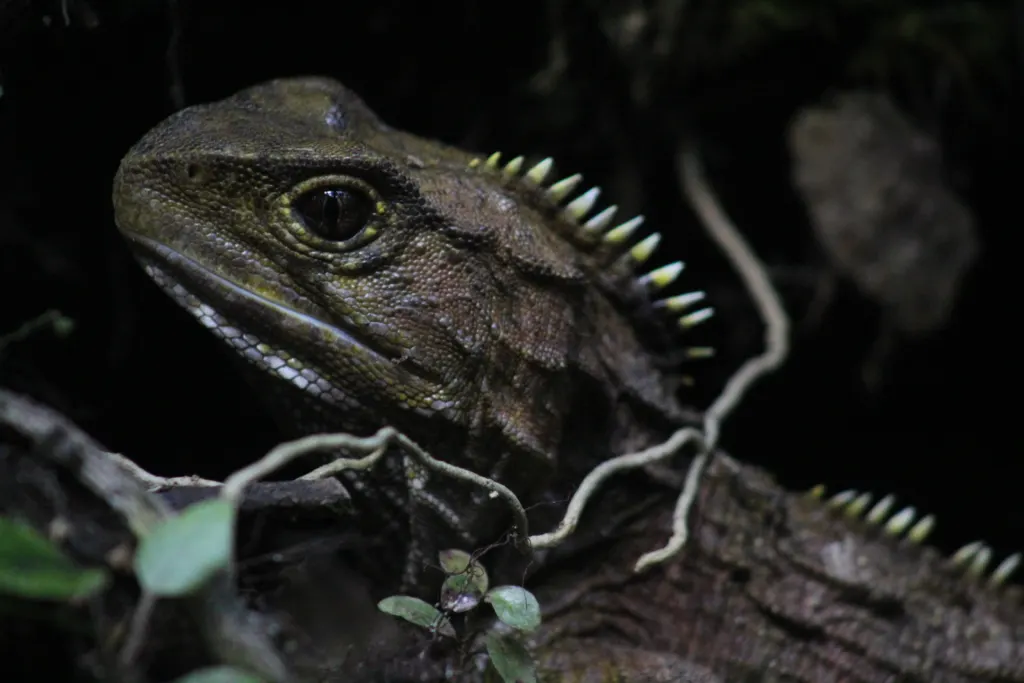
A reptile in New Zealand hatches with a third eye on top of its skull, complete with a lens and a retina, and the same animal can still be fathering young at 111. The tuatara sounds like something a child would invent. It is real, it weighs about as much as a bag of sugar, and it lives on a scatter of offshore islands.
New Zealand’s Department of Conservation puts the typical lifespan at around 60 years and the upper end at about 100. One captive male blew past that figure. Henry, who lived at the Southland Museum in Invercargill, became a father in January 2009 at 111, after surgery to remove a cancerous tumor. His partner, Mildred, was 80. All 11 of their eggs hatched.
Do the subtraction and Henry was born around 1898, three years after New Zealand first gave his species legal protection.
The eye you can only see on a baby
The third eye is called the parietal eye, and among living four-limbed animals it is at its most developed in this species. It sits in a small gap in the skull roof. It has a lens, a cornea-like plug, a retina of rod-shaped cells and a reduced nerve link to the brain.
You need good timing to spot it. A hatchling shows a see-through patch at the crown of its head, but within four to six months scales and pigment grow over the spot.
Do not picture it scanning for danger. It senses light, yet researchers doubt it can register movement or build a picture. The leading idea is that it works more like a built-in clock and calendar, helping set daily rhythms, possibly tracking the seasons and perhaps assisting with temperature control.
Not a lizard, whatever it looks like
Museum experts filed the tuatara under lizards until 1867, when Albert Günther of the British Museum spotted features shared with birds, turtles and crocodiles. It is in fact the last living member of Rhynchocephalia, an order that ruled the small-reptile world during the Jurassic and first appears in rocks about 244 million years old.
Biologists tend to avoid the phrase “living fossil” now, because no continuous fossil record shows the species staying unchanged. The oddities are real all the same:
- A double row of upper teeth, with the lower jaw slotting between them
- No eardrum and no ear hole, though it still hears low sounds
- Teeth that are never replaced, so very old animals end up on soft food
- Activity at 41°F, a temperature that shuts most reptiles down
The slowest family planning in the reptile world
Tuatara need 10 to 20 years to reach breeding age, keep growing until about 35, and females lay only once every few years. That pace is the catch in the longevity story.
Here is the rough math: a female who starts at 20 and lays every four years until 60 gets through only about 10 clutches in four decades of adult life.
Egg temperature adds another twist. At 70°F, a hatchling is equally likely to be male or female. Nudge the nest up to 72°F and about 80% come out male; drop it to 68°F and about 80% are female. Conservation teams are watching that sensitivity as the climate warms.
Rats did the worst damage. Kiore, the Polynesian rat, took eggs and hatchlings, and the Department of Conservation says few if any tuatara remained on the two main islands by the time European settlers arrived. Wild populations held on across 32 islands. In 2005 the species went back to the North Island mainland inside the fenced Zealandia sanctuary in Wellington, and a nest found there in late 2008 produced a hatchling the following autumn. The total population today is estimated at 60,000 to 100,000 animals.
Further reading
Image: Nil NZ, CC BY-SA 4.0 via Wikimedia Commons
This article was produced with AI assistance and reviewed by our Editorial Desk. How we work.