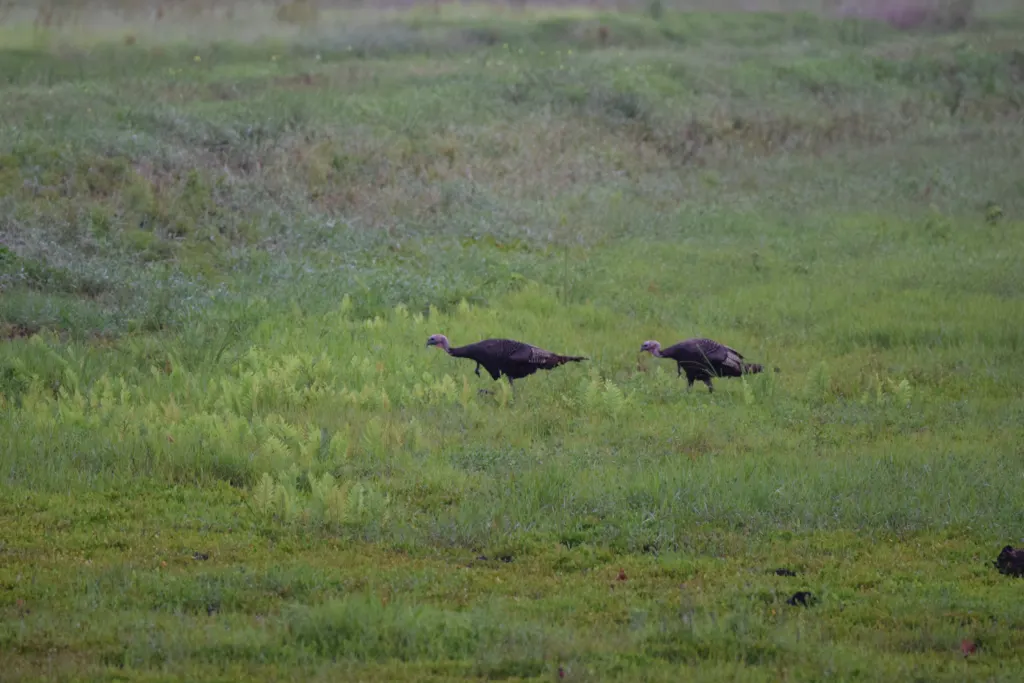
The wild turkey can hit 50 miles per hour in the air and 18 miles per hour on foot, according to the US Fish and Wildlife Service. That makes it a very different animal from the heavy, flightless farm bird that ends up on most Thanksgiving tables next Thursday.
Both birds are the same species, Meleagris gallopavo. The domestic turkey descends from a southern Mexican subspecies that people in Mexico tamed centuries ago, while six wild subspecies still roam North America. The wild ones lead far busier lives.
Built to escape
The Fish and Wildlife Service’s turkey fact sheet gives the bird’s top speeds: about 18 mph running and up to 50 mph flying. Wild turkeys usually prefer to run from danger, and their flights tend to be short bursts close to the ground. At dusk they flap up into trees and spend the night on high branches, because their eyesight, sharp by day, is poor in the dark.
They do not migrate. In snowy regions such as the Northeast, the Rockies and the Midwest, flocks ride out blizzards in the shelter of conifers.
A big bird with a lot of feathers
An adult male, called a tom or gobbler, usually weighs 11 to 24 pounds; hens are roughly half that. A grown turkey carries 5,000 to 6,000 feathers. Toms also grow a “beard,” a tuft of stiff, hair-like filaments on the chest that keeps lengthening throughout the bird’s life, and about one hen in ten grows one too.
The bare head is a mood ring. Wikipedia’s wild turkey article notes that a tom’s head and neck shift between red, white and blue, turning almost solid white when he is most excited, while the fleshy flap over the bill, the snood, swells during displays.
More than a gobble
Toms gobble in spring to announce themselves, a call that can carry about a mile. But turkeys also cluck, purr, yelp, cackle and “putt.” Some hens strut and fan their tails just like the males. Young turkeys, called poults, eat mostly insects at first and switch toward plants after about four weeks.
Wildlife biologists can even read a turkey’s droppings: a male’s are J-shaped and a female’s are spiral-shaped, and a wider dropping points to an older bird.
A comeback in numbers
Overhunting and habitat loss nearly wiped the species out. Estimates of the low point vary. The Fish and Wildlife Service cites about 200,000 birds in the early 1900s, while game managers quoted in the species’ population history put the US total as low as 30,000 by the late 1930s, with the bird gone from 18 states. Trap-and-transfer programs then moved wild birds into empty habitat. The population was put at 1.3 million in 1973; today the service cites about 6.5 million, a figure from the National Wild Turkey Federation.
The Franklin myth
Benjamin Franklin never formally proposed the turkey as the national bird. The idea comes from a private letter to his daughter Sarah Bache dated January 26, 1784, in which he mocked the eagle on a society’s crest and wrote that “the Turkey is in Comparison a much more respectable Bird, and withal a true original Native of America.”
For the history of how the bird reached the holiday table, read our story on turkey’s round trip from Mexico to Europe and back to Jamestown, and for the strangest way to cook one, how John Madden made the turducken famous.
Wild versus farm turkey at a glance
Wild: up to 50 mph in flight, roosts in trees, dark bronze feathers, six subspecies. Farm: bred for weight, generally unable to fly far, usually white-feathered, one domesticated line. Thanksgiving falls on November 26 this year.
Sources
- Wild Facts About Wild Turkeys, US Fish and Wildlife Service, 2026
- Wild turkey, Wikipedia, 2026
Image: USFWS/Southeast, Public domain via Wikimedia Commons
This article was produced with AI assistance and reviewed by our Editorial Desk. How we work.