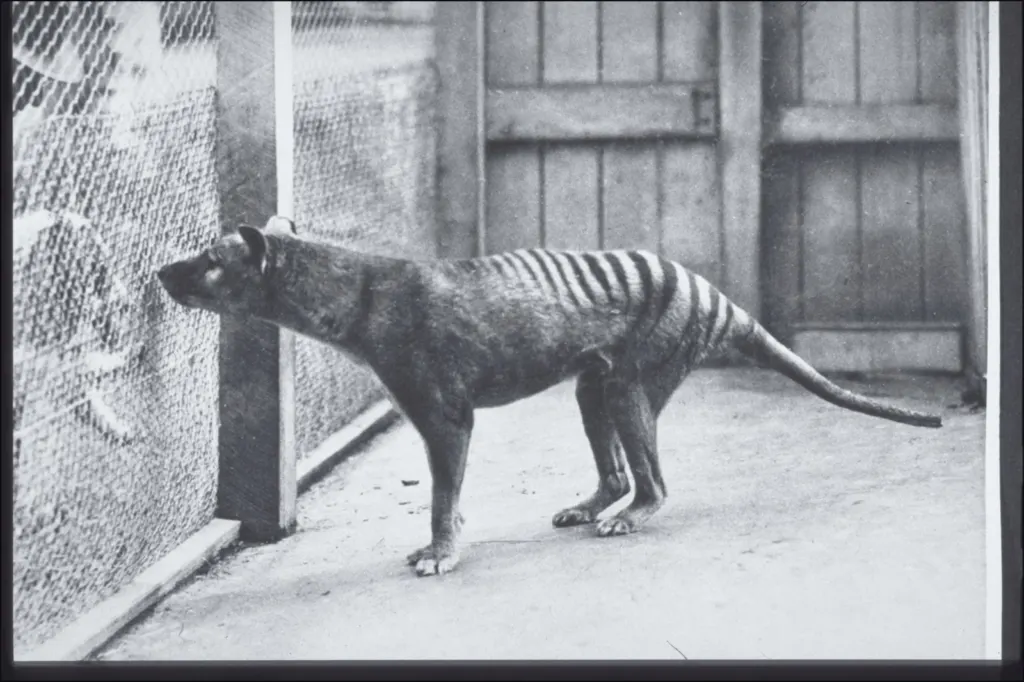
The striped animal pacing the edge of its pen in a black-and-white clip now circulating on Reddit has not existed for 90 years. The footage shows a thylacine, the dog-like marsupial also called the Tasmanian tiger, filmed at Hobart Zoo in Tasmania in 1933, three years before the last known member of its species died there.
The clip was shared to r/nextfuckinglevel on November 9 under the title “Black-and-white footage of the extinct Thylacine pacing inside its enclosure.” The version making the rounds has a computer-voiced narration and a music bed added, and the top replies were complaints about the AI voice rather than the animal. Strip those additions away and what is left is some of the most studied film in zoology.
What the 1933 film shows
Naturalist David Fleay shot about 45 seconds of the zoo’s thylacine in 1933. In it the animal sits, walks the perimeter of its enclosure, yawns, sniffs the air, scratches and lies down. Fleay paid for the footage: the thylacine bit him on the buttock while he was filming.
The yawn is the moment scientists return to. Thylacines could open their jaws to about 80 degrees, a gape visible in part in Fleay’s sequence. Despite that gape and 46 teeth, studies suggest the jaw was too weak to kill sheep, the very crime that farmers accused the species of committing.
The film keeps yielding data. A 2026 analysis of archival footage concluded the thylacine’s walk matched that of opportunistic pouncing predators, though its authors warned the surviving film captures only a slice of how the animal moved.
Not the only footage, and not “Benjamin”
Fleay’s reel is one of a small set. Moving pictures of live thylacines were shot at Hobart Zoo in 1911, 1928 and 1933, and two more films are known from London Zoo. The last known footage of the animal was filmed in 1935 by Sidney Cook for a promotional film titled Tasmania the Wonderland. In 2021, the National Film and Sound Archive of Australia released a digitally colorized version of Fleay’s clip for National Threatened Species Day, matching colors to historic descriptions.
One name in the comment section needs correcting. A reader hailed the animal as “Benjamin,” a name that has followed it for decades. It is a myth: in 1968 a man named Frank Darby, who claimed to have been a curator at the zoo, invented the name, and it spread through the press despite Darby never working there. The animal’s sex is still debated.
How a species disappeared
- About 3,600 to 3,200 years ago: Thylacines vanish from mainland Australia and New Guinea, possibly after the dingo arrives. The dingo never reaches Tasmania.
- 1830: The Van Diemen’s Land Company introduces bounties on thylacines over fears for sheep.
- 1888 to 1909: The Tasmanian government pays £1 for each dead adult and ten shillings for each pup, more than 2,200 bounties in all, with many more animals likely killed unclaimed.
- 1933: Fleay films the Hobart Zoo thylacine.
- 10 July 1936: Tasmania finally grants the species official protection.
- 7 September 1936: The last known thylacine dies at Hobart Zoo, 59 days later.
That 59-day gap between legal protection and the endling’s death sums up how late the response came. Since 1996, Australia has marked National Threatened Species Day every 7 September, the anniversary of that death.
Why it still hits viewers
A mature thylacine stood about 60 centimeters (24 inches) at the shoulder, with a stiff, kangaroo-like tail. Both sexes had a pouch, which gave the animal its name: thylacine comes from the Greek word for pouch. On film it reads as a dog, but it is a marsupial that evolved to fill a wolf’s role.
The genome of the thylacine has since been sequenced, and groups are working on efforts to bring it back. Reddit’s verdict on the clip was blunter. “Easily one of the saddest videos,” one reader wrote.
For a happier Australian marsupial story, the northern hairy-nosed wombat recovered from 35 animals to more than 400. For the deep-time view of extinction, our explainer on who killed the ice-age mammoths covers the long debate over climate and humans.
Further reading
Image: Harry Burrell, Public domain via Wikimedia Commons
This article was produced with AI assistance and reviewed by our Editorial Desk. How we work.