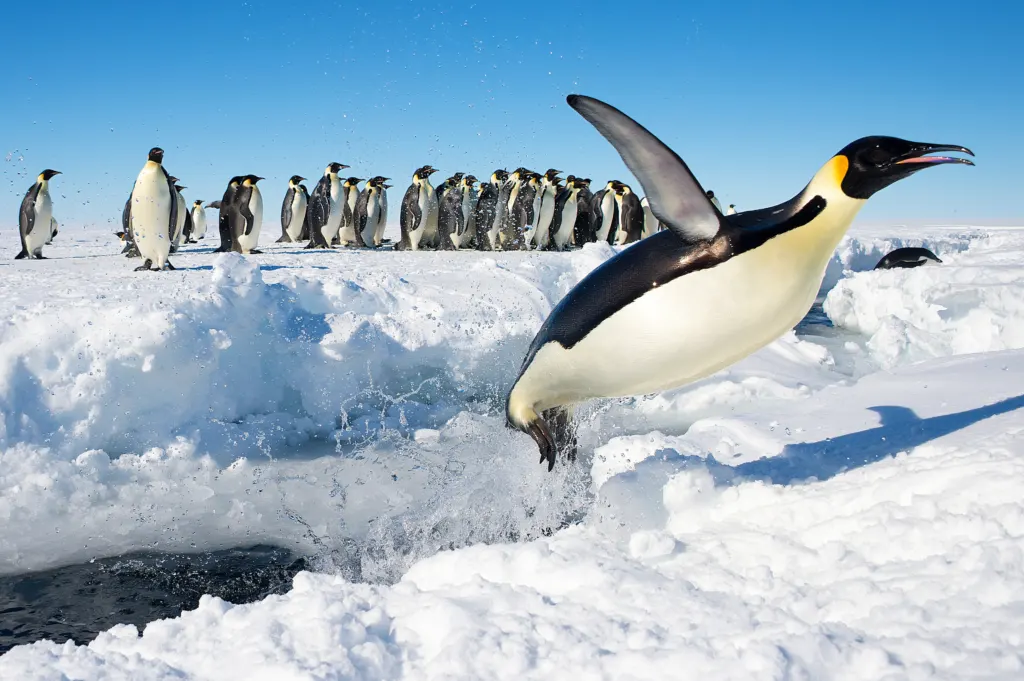
Two years ago this month, surfers at Ocean Beach in Denmark, Western Australia, watched a large black-and-white bird come out of the waves on November 1, 2024. It was an emperor penguin, the first of its species ever recorded in Australia, and it had come roughly 3,500 kilometers (about 2,200 miles) from Antarctica.
The bird, a male later named Gus, was thin. He weighed 21.3 kilograms (47 pounds), while healthy adult males of his species can top 45 kilograms (100 pounds). Some onlookers first took him for an oversized seabird.
Twenty days in a backyard rehab pen
Gus went to Carol Biddulph, a registered wildlife rehabilitator in the area, who chose his name as a nod to the Roman emperor Augustus. She and her husband, a veterinarian, fed him fluids, then a fish slurry, then whole fish. Because emperor penguins live in dense colonies, a mirror went into his enclosure so he would have something resembling company.
The care worked. By the time he left, Gus had put on more than 3 kilograms and weighed 24.7 kilograms (54 pounds). On November 20, 2024, staff from the Western Australian Department of Biodiversity, Conservation and Attractions took him out by boat and released him at sea, a few hours south of the coast near Albany. The timing mattered: the southern summer was coming, and an emperor penguin overheats easily once air temperatures climb past about 20 °C (68 °F).
How far off course Gus really was
Emperor penguins live almost entirely between 66 and 77 degrees south. Stray birds have turned up before on Heard Island, South Georgia and in New Zealand, but Denmark sits near 35 degrees south, which makes Gus the most northerly emperor penguin on record.
To put the distance in context, a feeding adult usually travels between about 82 and 1,454 kilometers per trip while raising a chick. Gus’s swim was well over twice the longest foraging trips recorded for the species. Researchers still do not know why he went so far. The leading idea is that he followed food north and was carried off course by currents, but nobody has proved it, and he carried no tracker after release.
Casey Youngflesh, an associate professor at Clemson University who studies ecology, said in an interview at the time that birds turning up this far from home are called vagrants. “An increasing frequency of such events might suggest that something is changing for this species,” he said.
He was not the first emperor to wash up far from home. In June 2011, a juvenile nicknamed Happy Feet came ashore at Peka Peka beach near Wellington, New Zealand, after eating about 3 kilograms of sand, apparently mistaking it for snow. He needed several operations and was released near Campbell Island with a transmitter that went silent eight days later.
Why a lost penguin drew so much attention
Emperor penguins are listed as Near Threatened and depend on stable sea ice to breed. A 2023 study found that more than 90% of their colonies could face quasi-extinction by the end of the century if sea ice keeps shrinking. A single wanderer on a Western Australian beach says nothing on its own about that trend, but it put a famously remote species in front of people who would never otherwise see one.
For more from the far south, read how iceberg A-81 stalled off South Georgia, or meet Midway Atoll albatross pair George and Geraldine. More wildlife stories sit in our Pets & Animals section.
What to do if a penguin turns up on a beach
Wildlife authorities in Australia ask the public to keep people and dogs well back, avoid feeding or handling the bird, and call the state wildlife line so a licensed carer can assess it. Gus spent 20 days in care before going back to the Southern Ocean, and he has not been identified since.
Further reading
Image: Christopher Michel, CC BY 2.0 via Wikimedia Commons
This article was produced with AI assistance and reviewed by our Editorial Desk. How we work.