Only one pair of short-tailed albatrosses breeds anywhere outside Japanese waters, and they have names. George and Geraldine nest on Sand Island at Midway Atoll, roughly 1,300 miles northwest of Honolulu, and across seven breeding seasons they have sent five chicks out to sea.
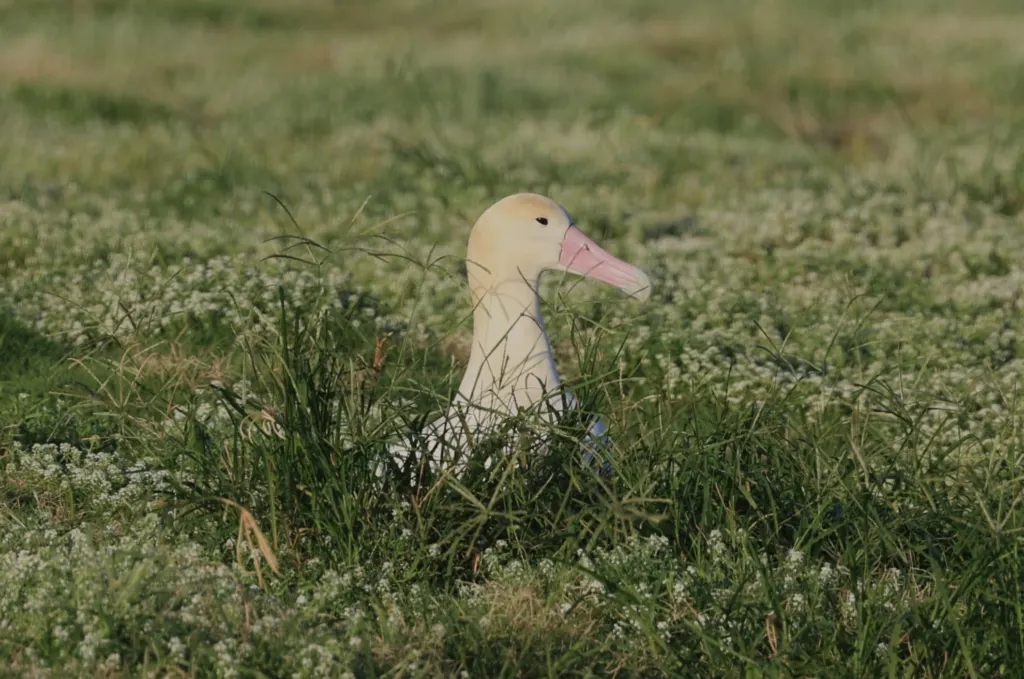
Their last homecoming was photographed in December 2025 by Jon Plissner, a supervisory wildlife biologist with the US Fish and Wildlife Service. The two adults were back at their usual Sand Island nest, and a younger bird stood nearby: their own chick from 2019, now returning as an adult-sized visitor. The volunteer group Friends of Midway Atoll National Wildlife Refuge called the scene “a heart-warming Makalena family reunion,” using the Hawaiian name for the species.
A pair that keeps coming back
Albatrosses mate for life and return to the same patch of ground season after season, and George and Geraldine have followed that script closely. The Agreement on the Conservation of Albatrosses and Petrels, an international treaty body that tracks the pair, counts 2024/25 as their seventh breeding season. That attempt failed: the egg did not hatch, according to a March 2025 update from the treaty’s information officer. Before that miss they had fledged five chicks from six tries.
Their fifth success came in 2024. Refuge staff fitted that chick with metal and colored leg bands on April 17, filmed it for the last time on May 23, and judged it had flown off around the end of that month.
Some of the earlier chicks have since been spotted back on the atoll as juveniles. That matters, because short-tailed albatrosses usually do not breed until they are about 10 years old, so a returning youngster is the first hint of a second Midway pair years from now.
From 25 birds to a few thousand
The couple’s fame makes more sense against the species’ history. Feather hunters killed the short-tailed albatross on an industrial scale in the late 1800s, with some estimates running past 10 million birds, and by 1949 a visiting researcher declared it extinct. A few dozen young birds had survived at sea, and the first egg on Japan’s Tori-shima island was laid in 1954.
Here is the arithmetic of that recovery: Tori-shima’s breeding population has grown from 25 birds to about 3,540, which works out to roughly 140 times as many in seven decades. The whole species still numbers only about 4,200 breeding birds, and the short-tailed albatross remains listed as Vulnerable.
That is why one nest on a coral atoll gets its own updates. Midway hosts hundreds of thousands of Laysan albatross pairs and many black-footed albatrosses, yet George and Geraldine are its only breeding Makalena. They are large birds, with wingspans of 7 to nearly 8 feet and a pink bill that turns blue at the tip with age, so volunteers can pick them out of a crowded colony.
Long flights, long shifts
A breeding season asks a lot of both parents. The female lays a single egg, and the pair take turns sitting on it for about 65 days while the off-duty bird feeds far out over the North Pacific. Ocean wanderers manage remarkable feats in the air; Badiyaa has looked at how frigatebirds sleep with half a brain during ten-day flights and at the Andean condor’s nearly 11-foot wings, and the science of how big birds slow down to land applies to albatrosses touching down on a windy atoll too.
Midway’s winter volunteer crew arrived in October 2026, and the refuge’s albatross nesting season runs through the winter months. If the pair keep their usual timing, the first sighting of their ninth season should come from Sand Island before the end of the year.
Further reading
Image: Jon Plissner, USFWS, Public domain via Wikimedia Commons
This article was produced with AI assistance and reviewed by our Editorial Desk. How we work.