To touch down at exactly zero speed without a single wingbeat, a pigeon-sized bird would have to start its approach at more than twice its normal cruising speed, cover about 60 meters (roughly 200 feet) of ground and gain about 20 meters (65 feet) of height. That is the headline number from a mathematical model built by aerospace engineers at the University of Manchester in England, and it helps answer a puzzle anyone who has watched a pigeon arrive on a ledge may have noticed: birds flap hard at the very moment they seem to want to slow down.
The study, titled “Flight dynamics and optimal control of unpowered avian landings,” appeared in Proceedings of the Royal Society A, and the university announced it on 2 November 2026. A post about it climbed the r/science forum on Reddit this week under the line “Why birds speed up to slow down.”
How the team modeled a landing
The group, led by Dr Ben Parslew, a lecturer in aerospace engineering, treated a landing bird the way an engineer treats a glider. They asked a narrow question: if a bird does not flap at all, what flight path lets it reach the lowest possible speed at the instant its feet make contact, while it still keeps enough aerodynamic control to finish the maneuver?
The answer turned out to be expensive in space. In theory a gliding bird can bleed off every last bit of speed, but only by trading speed for height on a long, rising path. For the pigeon-sized case, that meant a fast entry, around 60 meters of horizontal travel and a 20-meter climb. Real birds rarely have that much room. A branch, a gutter or a feeder gives them a few body lengths, not half a soccer field.
That gap points to the role of flapping. According to the university, wingbeats during landing may be less about simply losing speed and more about losing it inside the cramped space a real perch allows. Powered flight costs more energy than gliding, so the bird is paying extra for a shorter stopping distance.
“Birds might make landing look effortless but coming to a safe stop presents a fundamental physical challenge,” Parslew said in the university’s announcement. “Landing isn’t as simple as just slowing down. The slower a bird flies, the less aerodynamic control it has, so it has to find a way of reducing its speed while still being able to manoeuvre safely.”
Why hawks dip before they perch
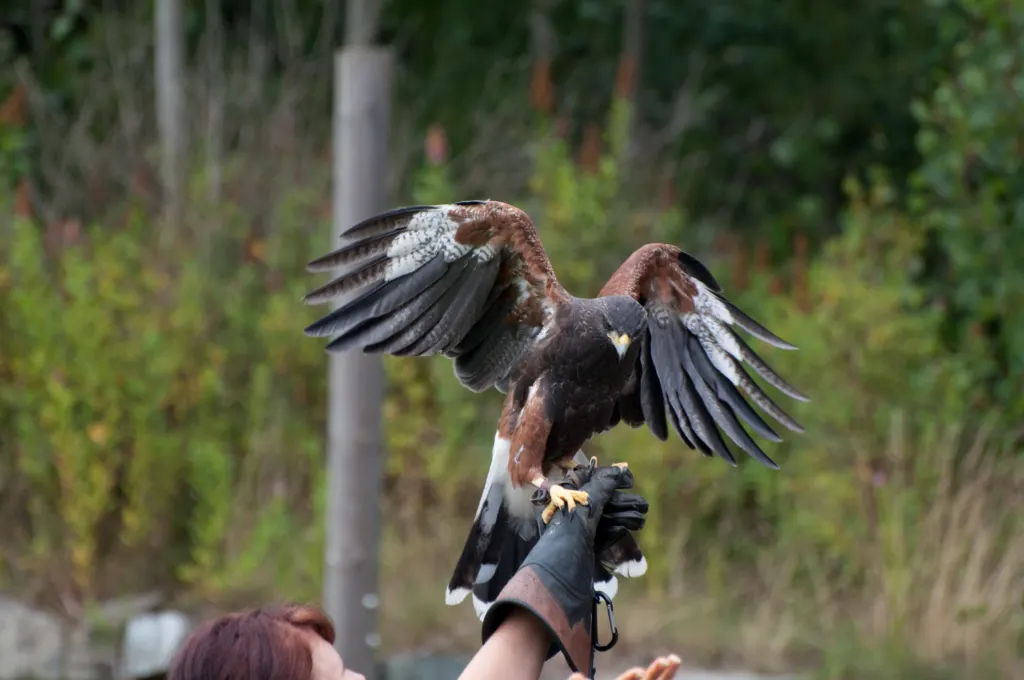
The model also speaks to a habit falconers know well. Earlier work on Harris’s hawks showed the birds learning to drop below a perch and then glide upward onto it. The older explanation was that the dip shortened the stretch flown after the wings stall, the point at which control fades.
The Manchester team says the swoop does more than that. In their calculations the path reflects a trade-off between arriving slowly and spending as little time as possible stalled, and touchdown speed seems to carry more weight in shaping the swoop than earlier studies recorded. Put simply, diving first lets a hawk turn speed into height on the way up, so it reaches the perch slow but still steerable.
The ground is a harder target
Landing on flat ground removes that trick. A bird cannot dip below the surface and swing back up, and it cannot climb through its destination. The model found that a gliding bird coming down to the ground always arrives with some speed left over, which its wings, its legs or both must absorb.
That has a cost written into anatomy. Absorbing impact calls for stronger muscle and bone, especially in the legs, and extra weight makes flying harder. The researchers suggest that this tug-of-war, light enough to fly well but sturdy enough to land safely, may have helped shape how birds evolved. They add that the same physics could apply to other flying animals that land without powered flight.
What the numbers mean in everyday terms
A quick comparison shows how far the zero-speed glide sits from real life. A pigeon is roughly a third of a meter long. Sixty meters of approach is therefore about 180 pigeon lengths, and a 20-meter climb is about the height of a six-story building, all to shave the last few meters per second off its speed. A bird that flaps instead can stop within a few body lengths of its perch, which is what city birds do on every window ledge.
Limits of the study
This is a theory paper, not a field survey. The core result describes unpowered landings, so it shows what a bird could not do without flapping rather than measuring the flapping itself. The pigeon-sized figures come from one modeled body size, and the university does not report tests on live birds as part of this work. The evolutionary link between landing loads and leg strength is offered as a suggestion, not a demonstration. Parslew said the team also wanted insight into “how physical demands of landing may have helped shape their evolution,” which leaves room for follow-up work on real flight paths.
The paper carries the identifier 10.1098/rspa.2026.0103 in volume 482 of the journal.
Further reading
Image: Neil McIntosh from Cambridge, United Kingdom, CC BY 2.0 via Wikimedia Commons
This article was produced with AI assistance and reviewed by our Editorial Desk. How we work.